
“Japanese chefs believe that their soul goes into their knives once they start using them… You wouldn’t put your soul in the dishwasher, now would you?”
— Masaharu Morimoto
I’m not going to lie.
I love my knives so much that when I think about my last will and testament, I don’t think about the beneficiaries of my life insurance policy, or where I want my final earthly remains to rest – I think about my chef knives, and which friend I would entrust each knife to… to care for, to love, to use, and to cook with in the event that something happened to me (don’t get any ideas guys).
My knives are unquestionably among my favorite things.
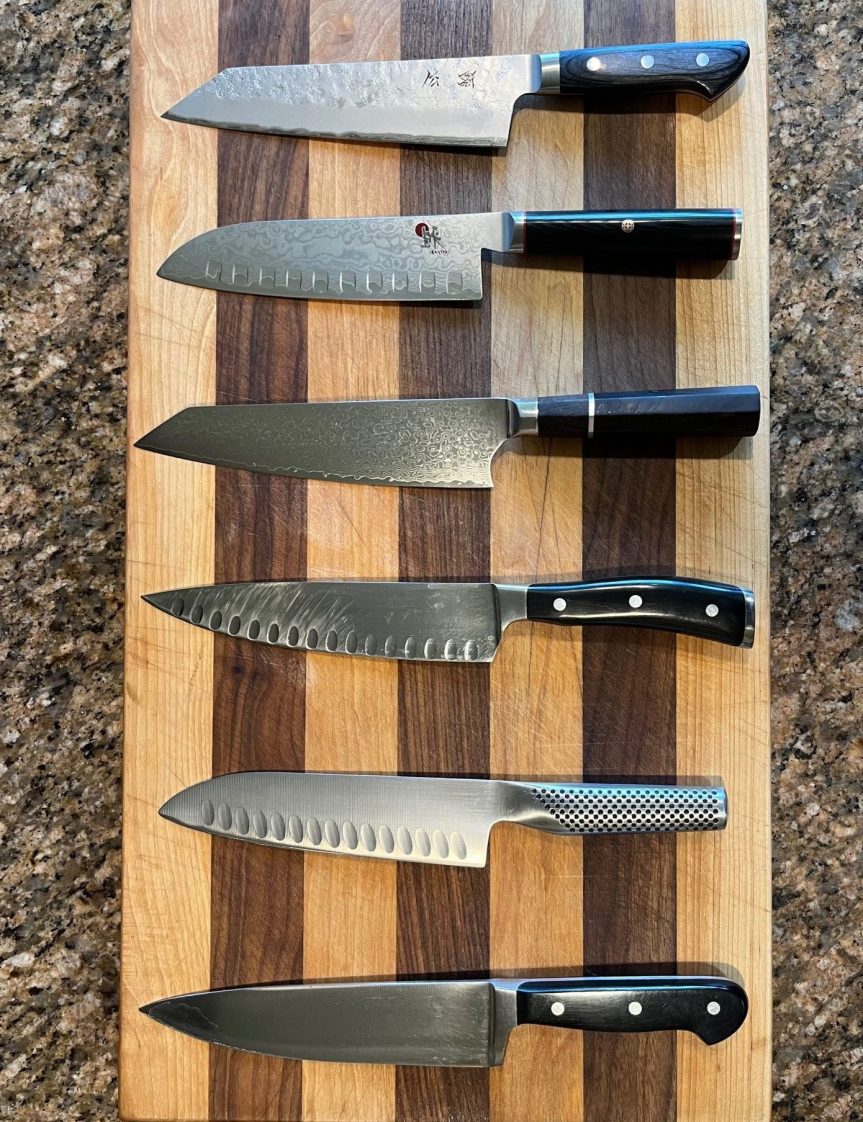
Over the years, I’ve been fortunate to collect quite a few different knives, but here are some whose stories I think are worth telling:
. . .
The Knife: Classic Ikon 8″ Chef Knife, by Wüsthof
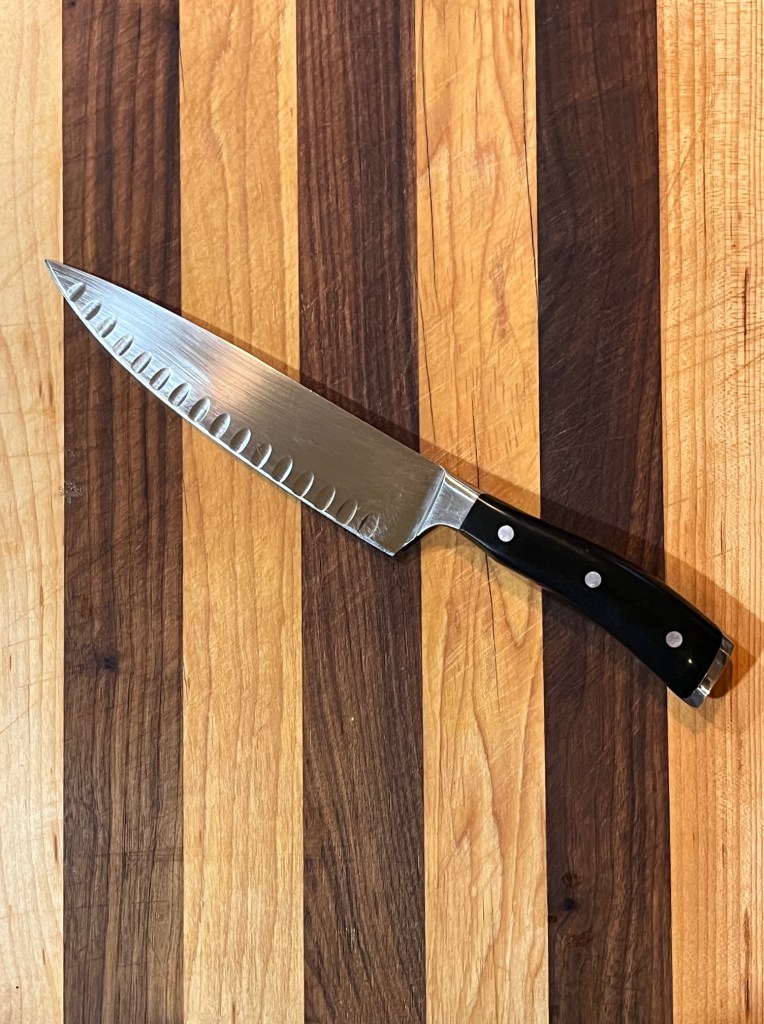
The Geek Specs: Fully forged German stainless steel, X50 CrMoV 15 (Chromium, Molybdenum, Vanadium); Rockwell Hardness 58; 14° compound bevel; POM contoured triple-rivet handle
The Story: This was my first ever chef knife. I bought it at Williams-Sonoma. I showed up with a bag of potatoes, tried out a whole bunch of knives, and settled on this one. I literally had no idea how to use it.
If you’d like proof that you can literally teach yourself to do anything with enough dedication, practice, and courage (and in this case several boxes of Band-Aids and even one incident that required a couple stitches), check out this video.
My Wüsthof has served me extremely well over the years. If you look closely, you can see that the blade has been worn down to the grantons (the hollow ovals). I don’t really reach for it all that much these days unless I’m feeling nostalgic, but it will always hold a special place in my heart.
Pros/Cons: This knife’s greatest strength is also its greatest weakness – it’s heavy. In some senses, a heavy knife is great due to the fact that the knife will do most of the work for you, because you don’t have to apply a lot of force to get it to go through things. This also means that it takes a fair bit of energy to wield. So while my hands sometimes get tired from gripping a lighter knife if I’m going through, say, 10lbs of carrots, I can also get tired simply lifting a heavier up and down for every cut I make. If you’re primarily a rock-chopper, a traditional, heavy German steel has it’s advantages to be sure.
In addition to being a great rock-chopper, because this knife has a pointed tip, a sharp belly, and a softer steel (which means it can go through bones without getting chipped), it excels at butchering poultry, breaking down chickens, and carving large roasted turkeys.
I don’t think that Wüsthof makes this exact knife anymore, but you can get the 8″ Classic Ikon Chef Knife without the granton edge here; you can also get the Classic 8″ Chef Knife with the granton edge in the non-Ikon version here.
The Knife: Evolution Series 8″ Chef Knife, by Miyabi
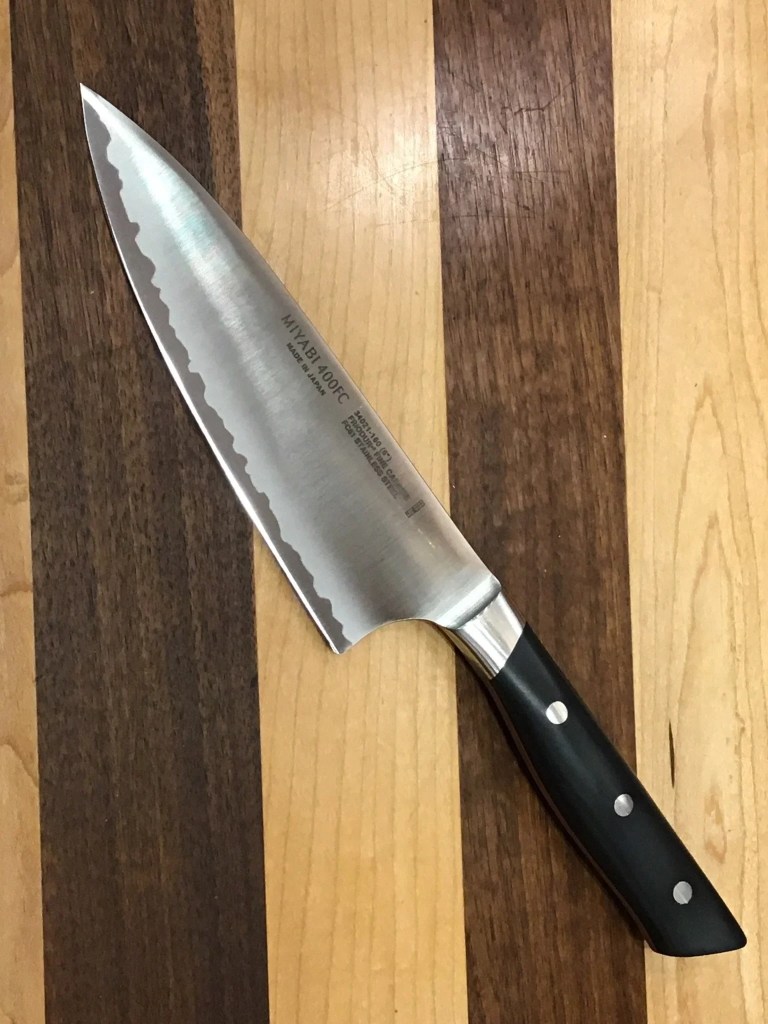
The Geek Specs: Fully forged Japanese Steel, Seiki Japan (Friodurx2 Ice Hardened Fine Carbide Steel, 400FC); Rockwell Hardness 61; 12° double-compound bevel; POM contoured triple-rivet handle
The Story: I bought this knife maybe 12 years ago after having given my faithful Wüsthof a run for its money. I noticed that while the Wüsthof was still usable, I had worn the blade down to the granton edge, and that caused the blade to stick to some things – especially during vegetable prep.
Influenced by the cuisine and technique of both European and Japanese kitchens, I was still dialing in exactly how I liked to cut, so I was using a combination of rock-chopping and tap-chopping but wasn’t truly consistent in my approach. Since I didn’t know exactly was looking for, I decided the best thing to do was to try a few knives out in person.
I repeated my process of years earlier, showing up this time at Sur La Table with a bag of potatoes. The young kid behind the counter really knew his stuff and watched my hodge-podge knife technique with a German chef knife I was trying out.
“Looks like you can’t figure out if you want to cut using traditional Western knife technique, or if you’re more Japanese in how you cut,” he said, assessing my situation perfectly. “Why don’t you try this knife from Miyabi – it’s a Western shape with Japanese specs.”
Impressed, I bought it on the spot, and used it for quite a while. Using this knife really helped me figure out that my preferred prep and cutting techniques are much more Japanese in orientation, even though many of my cooking methods resemble something more Western.
After I’d acquired quite a few knives and gotten more consistent with my technique, I lent it to a friend – who still has it. I don’t think much of my soul ever got into that knife, but I have a funny feeling that his has, so I’ll let him keep it.
Pros/Cons: Don’t get me wrong – this is a great knife, especially considering it’s relatively low price point. Thing is, for me, it’s exactly the opposite of what I personally need. As the guy a Sur La Table said, this is a Western knife with Japanese specs, so if that appeals to you, this might be your knife; what I needed is a Japanese knife with Western specs, such as…
The Knife: G-10 7″ Santoku, by Global
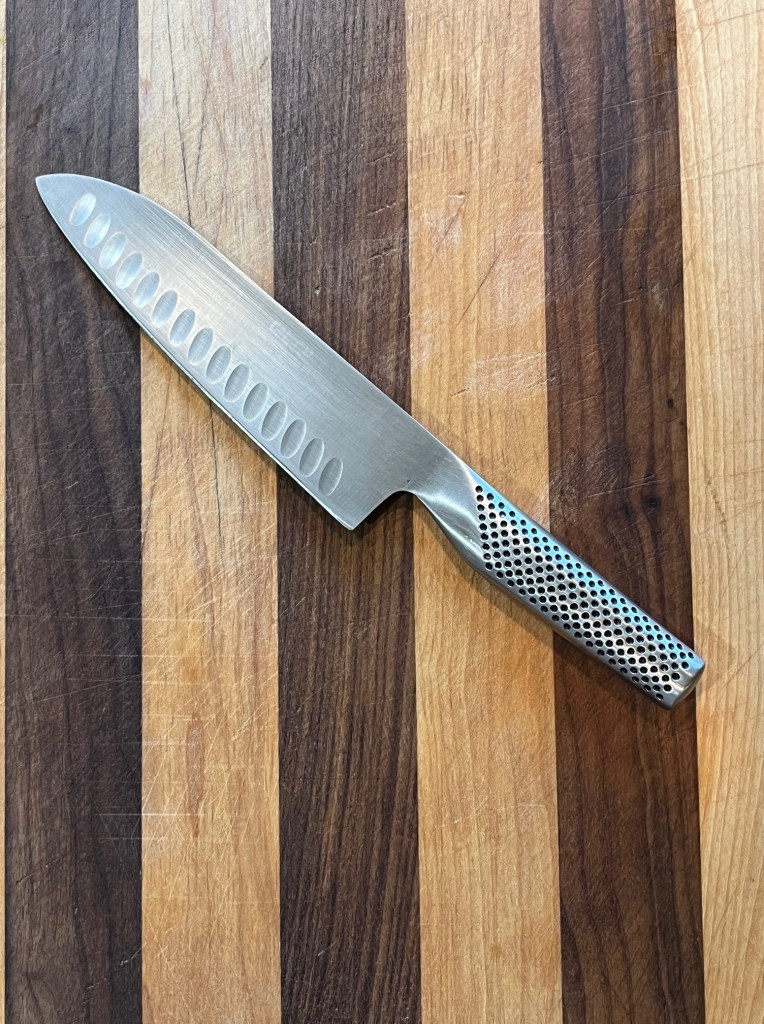
The Geek Specs: Fully Forged High Carbon Stainless Steel, Ice Hardened, CrMoV 18 (Chromium, Molybdenum, Vanadium); Rockwell 57; 15° Double Bevel Convex Edge; Handle is stainless steel and sand filled, which makes it uniquely balanced depending on the angle it’s being held at.
The Story: I’d just finished reading Anthony Bourdain’s Kitchen Confidential in which he waxes eloquent about the benefits and beauty of Global chef knives. He says:
“Most of the professionals I know have, for years, been retiring their Wüsthofs and replacing them with the lightweight, easy-to-sharpen and relatively inexpensive vanadium steel Global knives, a very good Japanese product which has – in addition to its many other fine qualities – the added attraction of looking really cool.”
And he’s right – they do look cool. And they are lightweight. So, of course I had to have one.
By now, I’d figured out that my personal knife technique was much more akin to the Japanese tradition than the Western way of doing things, so instead of opting for an 8″ Western chef’s knife, I decided to go for a Santoku shape instead.
And I decided to do this right before my lifelong friend and cooking buddy Jon (referenced elsewhere in this blog) flew out from Indiana to visit me in California for a week of hiking, wine and whisky tasting, and, of course, cooking.
It was at this point that I learned an important thing; namely, there are certain times when it’s not advisable to try something new or untested: You don’t change horses mid stream. You don’t buy new hiking boots right before a long hike. You don’t eat Buffalo Wings before an important presentation at work the next day.
And you don’t buy a new chef knife the day before you’re about to dive into a week’s worth of cooking.
To treat my friend on the first night of his visit, I went out to the local butcher and got some really expensive New York Strip steaks which I planned to let dry on a wire rack in the fridge over night. When I got them home, I decided the fat cap on one of them was just a little thick (you can already see in your mind’s eye what’s going to happen here, can’t you?), and so I grabbed my shiny new Global santoku in one hand, the steak in the other, and promptly slid the blade right through the fat cap, and through the pad and fingernail on my thumb, straight to the bone.
Damn, that knife was sharp out of the box.
Despite this mishap, we (the knife and I) had a great week. So did my friend and I. And I continued to use that knife for quite a long time, even though we’d gotten off to a rocky start. That knife definitely has a lot of my soul in it, and for a long time it was the first one I reached for on my knife strip. I probably still use it in some capacity at least once a week.
Pros/Cons: I love how lightweight it is; that said, it’s not great for dicing 20lbs of onions, or a 10lb bag of carrots or potatoes – because it’s light, you have to grip it pretty hard to control the blade, and it can make your hands tired over a long period of time. This one is also pretty much the reverse of the Miyabi mentioned above: Whereas the Miyabi is essentially a Japanese knife with a Western shape, this Global is a Western knife with a Japanese shape.
Lastly, the handle is a little funky to get used to, and can get a little slippery when wet, so it requires some care there. Still, very often this knife remains the first one I reach for if I’m not doing a major project and just need a quick, nimble, lightweight blade.
The Knife: 8″ Damascus Kiritsuke, by Mercer Culinary
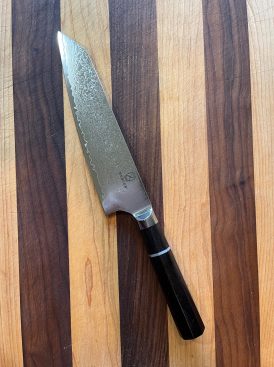
The Geek Specs: Forged Full Tang Damascus CroMoV + 1% Carbon, 1.5% Cobalt; Rockwell 62; 15° V-Edge Double Bevel; Octagonal Ebony Wood Handle
The Story: I had wanted a Kiritusuke style knife for a long time – in Japanese kitchens, this shape of knife, with the reverse tonto (that’s the downward angle of the tip of the knife ), is considered the Master Chef’s Knife because it can do any task in the kitchen and accommodate any cutting technique.
It is also notoriously difficult to control. Despite having confidently honed (nuk-nuk) my knife skills to a point (sorry) in my culinary career, I still managed to cut myself a fair amount of times before becoming fully comfortable with the mechanics of this particular knife. Most of these cuts were minor and were handled with a few Band Aids, although one required some superglue (not a recommended treatment option, by the way), but once I got the hang of it I never looked back.
Almost overnight, this knife became the one I grabbed first for almost every task in the kitchen – from heavy vegetable prep, to mincing delicate herbs, to breaking down whole chickens, to boning out legs of lamb – this knife was it. Shockingly, it’s also generally less than $100 – manufactured by Mercer Culinary who makes the go-to standard issue cutlery for America’s top culinary schools.
I love it so much that I bought two more of them as gifts for friends. I was pretty sure this knife would be the one I’d use 90% of the time for the rest of my culinary career, until I was gifted Excalibur (the last knife featured in this article).
Pros/Cons: The only con with this knife is that it’s a little difficult to master – just like any Kiritsuke.
Still, any nicks or cuts sustained in the learning process will be well worth it. I cannot begin to describe how this knife shape will improve the speed and efficiency of your prep – and as I mentioned above, it can do anything. Additionally, it’s perfectly balanced to my liking, sharp AF, doesn’t require a lot of maintenance, and can take a fair bit of abuse. It’s a workhorse and a racehorse built into one.
Honestly, if I was going to recommend ONE chef knife to someone looking to make their first serious investment into a knife – or honestly to anyone, even if they already have a few knives – this one would be it: Excellently constructed, sharp as hell, versatile, comparatively inexpensive.
The Knife: Kaizen II 7″ Santoku, by Miyabi
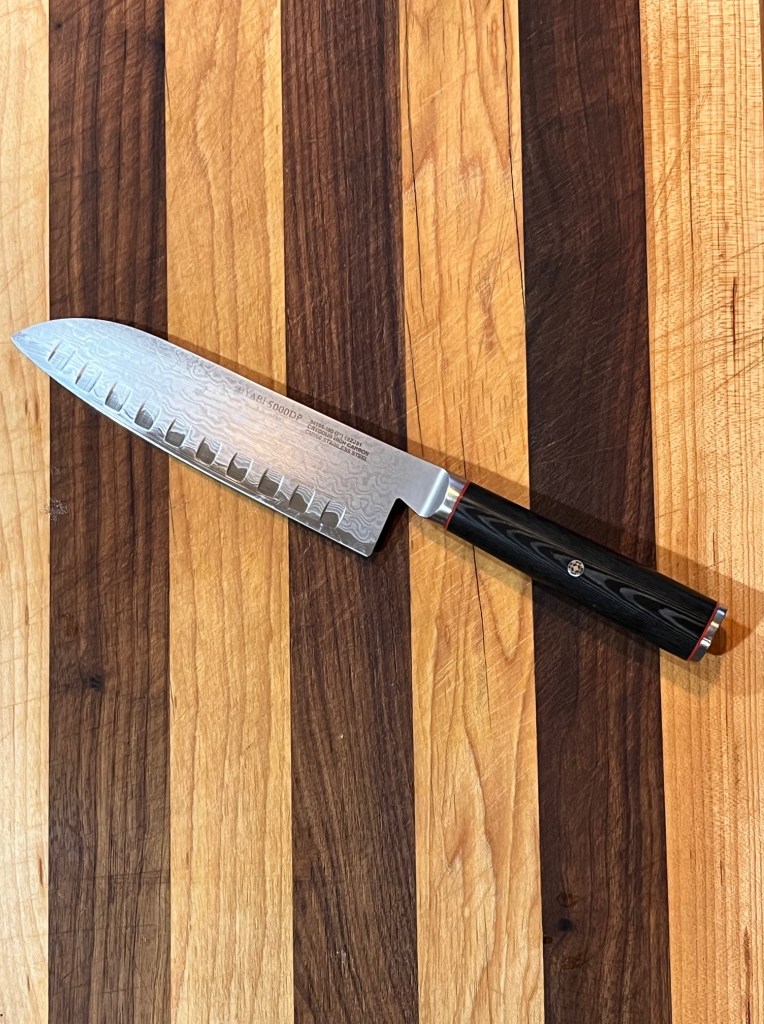
The Geek Specs: 49 Layer Forged, Honbazuke Method, Fine Carbide (Friodur x2) Damascus Stainless Steel; Rockwell 61; 12° V-Edge Double Bevel; Black Pakkawood Handle
The Story: I bought this knife in November of 2021 as a gift to myself. At that time, I was working 60+ hour weeks at my corporate job, and making better money than I ever had, so I figured I’d earned it. Even though I’d figured out that my prep technique was more in alignment with the Japanese tradition, for some reason I bought the 8″ Chef Knife version of this instead of the Santoku. I’m not sure why I did this; perhaps because a friend of mine had the Western version and I envied it.
Anyway, as soon as I got the Chef Knife version out of the box, I knew it wasn’t for me. I promptly put it back in its box, sent it back, and purchased the Santoku instead. When the Santoku arrived, I knew I’d made the right choice.
Pros/Cons: The pros of this knife are that it excels at tap-chopping and cross-chopping, and has just enough of a curve to its belly to be a decent rock-chopper. It’s highly versatile, and also perfectly balanced. A lot of my soul has gone into this knife in the last few years; it has been a faithful friend and was tied for #1 in my collection along with my Mercer Kiritsuke – until, once again, the introduction of… (dun dun)… Excalibur.
The Knife: 7.5″ Kiritsuke, by Seisuke Hamano (AKA Excalibur)
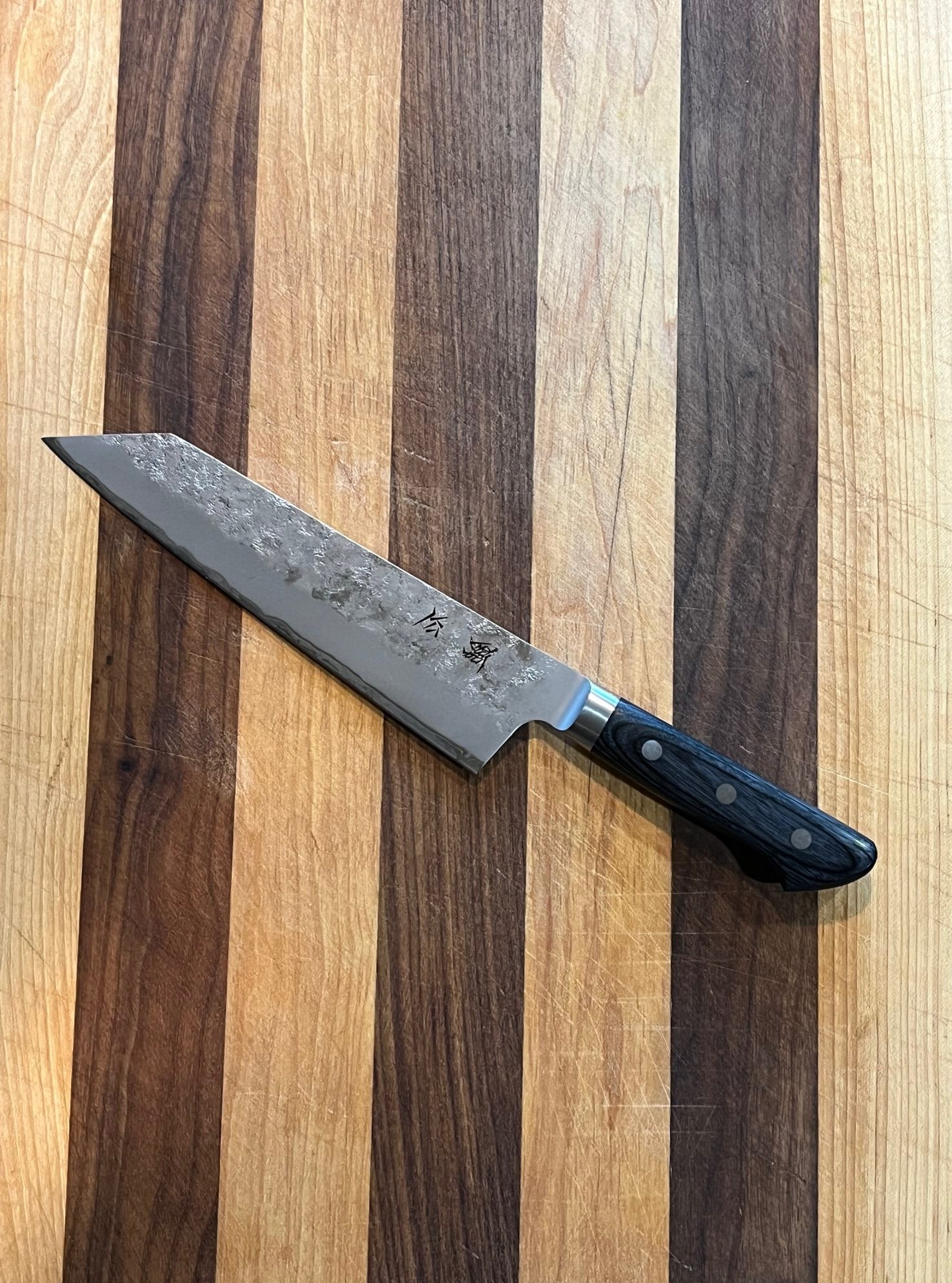
The Geek Specs: Fully forged Japanese Aogami Blue No. 2 (Tungsten/Wolfram 1.15%, Chromium 2.05%, 1.35% White Carbon No. 1) High Carbon Stainless Steel, 12° V-Edge Double Bevel, Seki Japan – Gifu Prefecture; Rockwell Hardness 60; Blue Pakkawood Handle
The Story: Every once in a while, I get to steward something so precious that it gets its own name (for example, I have a nickel coated 5 QT Copper Sauté pan I call “The Beast”).
Recently my step sons Nick and Danny, and Danny’s fiancé Kalani visited Japan, and they brought this knife back for me. I call it Excalibur.
Excalibur – along with the custom cutting block my wife gave me that is featured in most of the pictures in this blog, and my Citizen Eco Drive wristwatch – is the finest gift I’ve ever received.
Words cannot describe the sense of gratitude I feel every time I pick it up – it is perfectly balanced, razor sharp, and utterly beautiful. Even though I’ve had it for less than a year as of this writing, I can tell that a lot of my soul has already gone into this knife.
And when I say razor sharp, I mean this thing will end you. Once, I carelessly left the tip hanging over the edge of my cutting block when I set it down, and then, as I reached for something on the counter, brushed the back of my hand past the edge where the tip was hanging over. The knife didn’t move, but the blade went through the back of my hand leaving a clean and surprisingly deep slice.
A little over a week ago, I brushed the edge with my palm. I’m looking at the scratch on my hand as I type this. This knife is so sharp that I bought a special brush to wash it with in order to ensure I keep my hands clear of the blade, because I’m afraid that in a moment of carelessness, I’ll wipe the blade with a dish sponge with the edge facing my hand and send the blade through both the dish sponge, and my hand. This knife was, after all, made by blacksmiths who a few generations ago were making katanas for Samurai (I kid you not).
Additionally, the very edge of the blade is carbon – meaning it can be sharpened to a surgical sharpness, which this knife actually is, but it is prone to rusting. Because of this, it needs to be wiped clean after each use. I say goodnight to it every night by lightly coating the blade with a special mineral grade knife oil. If you look closely, you can see that the edge is developing a patina – which is not rust, but actually a naturally occurring type of oxidation that occurs with age and use. This patina adds to the unique, individual beauty of each knife.
Suffice it to say, this blade demands to be treated with some goddamn respect. But if you do treat it with the respect it deserves, it will reward you with the finest performance of your lifetime.
I’ll never forget the first time I tried it out. Nick (who is also my sous chef, chief taste-tester, dishwasher, and general partner in crime, all rolled into one) was standing in the kitchen with me. I grabbed a leftover jalapeño and went to work. The slices were literally paper-thin, and the action of the blade was effortless.
Excalibur can literally tap-chop f&*king tomatoes. It cuts onions and shallots so cleanly that you don’t cry – they do. It gently minces delicate herbs without coming close to crushing them. It flies through a bag of potatoes. Forget about breaking down a chicken; whole chickens quake in terror and break themselves down into 8 pieces in its presence. It slivers garlic so translucently thin that those slivers liquify in the pan with just a little oil… like Paulie’s prison sauce from Goodfellas – except Paulie used a razor blade, which admittedly was a very good system, but nothing compared to Excalibur.
In case you haven’t got the picture, using this knife is an experience, man.
Pros/Cons: The only real con to this knife is that its a little bit high-maintenance, and if you don’t respect it, it will murder you. It is utterly razor sharp and the fact that it’s a Kiritsuke shape – which again is notoriously difficult to control – makes it all the more dangerous.
I have years of experience under my belt – and my knife skills are solid enough that pro-chefs I’ve cooked with have complimented me on those skills – but even still, I’m still acutely aware of the fact that failure to treat this knife with anything less than the utmost discipline and serious respect could result in consequences. And rest assured, if you ever get just a little too comfortable, it’ll remind you with a gentle nick that it’s not to be trifled with.
I love it.
It’s sort of like having a pet dragon (I also sometimes call it “The Dragon”) – beautiful, but dangerous. But just like a pet dragon, it’s a loyal friend who will go to battle with you through the heaviest prep and on the latest nights after work. For example, I recently came home from work to find my wife making minestrone soup – and a lot of it. 5lbs of carrots, 5lbs of potatoes, 2 heads of celery, 1lb of asparagus, 3 leeks, 3 zucchini squash… Excalibur made light work of it all in around 15 minutes – maybe a little less.
Where To Get One: Nick bought this for me from Yoshimune Knives; as of this writing they do ship internationally and have it available. You can also order one directly from Seisuke Hamano, the maker of the knife. They have a store in Portland, OR.
. . .
“We become what we behold. We shape our tools, and then our tools shape us.”
— Marshall McLuhan
I have experienced this phenomenon firsthand in using my chef knives. From helping me discern and develop my own personal technique, to enhancing the speed and efficiency of my prep, to helping me understand the fiber structures of vegetables, and the bone and muscle structures of meats and proteins, each of the knives I’ve written about here have shaped me in some way.
Most importantly, these knives taught me the value of patience, hard work, courage, discipline, confidence, and respect in the kitchen. Cooking is a love language for me; these knives are the conduit through which my passion for the craft and my love for others passes into the food I make and serve.
I know a pro chef who, when he interviews line cooks for his restaurant, asks to inspect the prospective cook’s knife roll before anything else . If the knives are well cared for, razor sharp, and meticulously ordered, he knows he can count on this cook for the same the same dedication in his kitchen.
I do think that our knives are a reflection of us, and we are a reflection of them. As Masaharu Morimoto implied in the quote at the top of this story, there is a very special – almost spiritual connection – that chefs have with their knives.
I honestly don’t know if humans have souls – and the final resting place of my temporal remains is yet to be determined – but I am fairly confident that when I do eventually pass beyond the veil and into the next realm, whatever is left of me here on earth will remain in my knives forever.
And that is a very comforting thought.
Discover more from The Intrepid Gourmet
Subscribe to get the latest posts sent to your email.

 The Intrepid Gourmet