
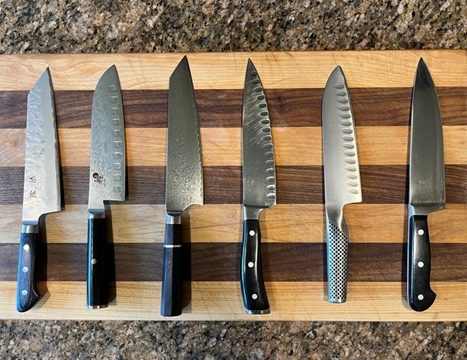
With so many different kinds of knives on the market, it can be hard to know which one to choose.
If you’ve been thinking about making the investment in a good knife, this post will give you some insight into some things you may wish to consider.
Many would argue that all you need in the knife department is ONE good chef knife; your chef knife probably will be the ONE thing you use every time you cook, so choose wisely – it’s going to be an extension of your hand and your best friend in the kitchen for years to come.
I recently purchased this one from Mercer because I wanted a Kiritsuke knife – although it’s on the inexpensive side, it performs marvelously, holds an edge like nothing else, and has quickly become the knife I reach for 90% of the time.
Knives and brands to look at: Wusthof – the Classic and Classic IKON Series, steer clear of the ‘Gourmet’ series), Global, Miyabi, MAC.
Don’t freak out: A good chef knife is going to cost you somewhere between $100 – $200. If you’re serious about cooking, it’s a worthwhile investment because it will last you 10 years or more, will improve the speed and efficiency of your prep, and will actually make your food taste better because you will be able to more easily make things the same size, ensuring even cooking.
Also, no one needs a full knife-block full of knives. Use the money you’d spend on a whole bunch of cheap knives, most of which you won’t use, to buy yourself ONE really good chef knife that you’ll use every day. Now that we’ve got that out of the way…
How to choose a chef knife? You need to consider the following things, in this order: Fit, Feel, Features. Comfort is of paramount importance which is why it’s critical to actually get a few knives into your hands before buying. Hands come in all shapes and sizes; so do knives – it’s important to match those things up. Does it feel well balanced when you hold it? Does the curvature of the handle match your hand? (Hint: If you hold it and something feels weird or is poking you in the wrong place, it probably isn’t your knife.) Is it the right weight? Not too heavy, not too light? Is the handle the right size for your hand? These are all the questions you want to be asking yourself when you’re trying out a chef knife.
Your best bet for determining the feel of a knife is to show up at your local cutlery store with a bag of cheap potatoes and ask to try a few out. Alternatively, ordering online can be fine – but make sure that the return process is easy just in case it doesn’t work out.
In terms of features, there are several things to consider:
First, you want to get a knife that is forged, not stamped. A forged knife is made from a single bar of steel which is then heated and shaped into a knife by a craftsman; a stamped blade is cut from a large sheet of metal cookie-cutter style, making it less durable.
Second, you’ll want to get something that has a full-tang – meaning that the metal from which the blade is forged extends all the way through the handle.
Third, I generally recommend stainless steel over carbon steel; stainless steel won’t rust or corrode and will hold an edge better than a carbon steel knife. Carbon steel knives are easier to sharpen due the the fact that the steel is softer, but require regular sharpening in order to keep them in working order. Additionally, carbon steel knives are prone to rust and corrosion.
Fourth, you’ll want to consider the blade. In terms of blade length, unless you have exceptionally small or exceptionally large hands something in the 7-8 inch range is good. In terms of hardness, a harder blade (60 + on the Rockwell hardness scale) will hold an edge longer but will be more prone to chipping – if you do chip it, you’ll need to have it professionally resharpened. A softer blade (55-60 on the Rockwell hardness scale) will require more frequent honing and sharpening but will be more forgiving and minor chips can probably be worked out at home. Most German knives (Wusthof, Henkels, etc) are slightly softer; Japanese knives (Shun, Miyabi, etc) tend to use harder steel. Typically, most chef knives range from somewhere between 55 – 65 on the Rockwell hardness scale.
Note: Some knives have what is known as a granton edge. These are the knives that have small ovals on the side of the blade. The idea is to help keep food from sticking. I’ve never noticed an appreciable difference, but the first knife I ever owned was an 8-inch Wusthof Classic Ikon (58 on the Rockwell Scale) with a granton edge. Eventually, it will wear down to the ovals – the knife will still be usable.
Have a look at the three shapes below:
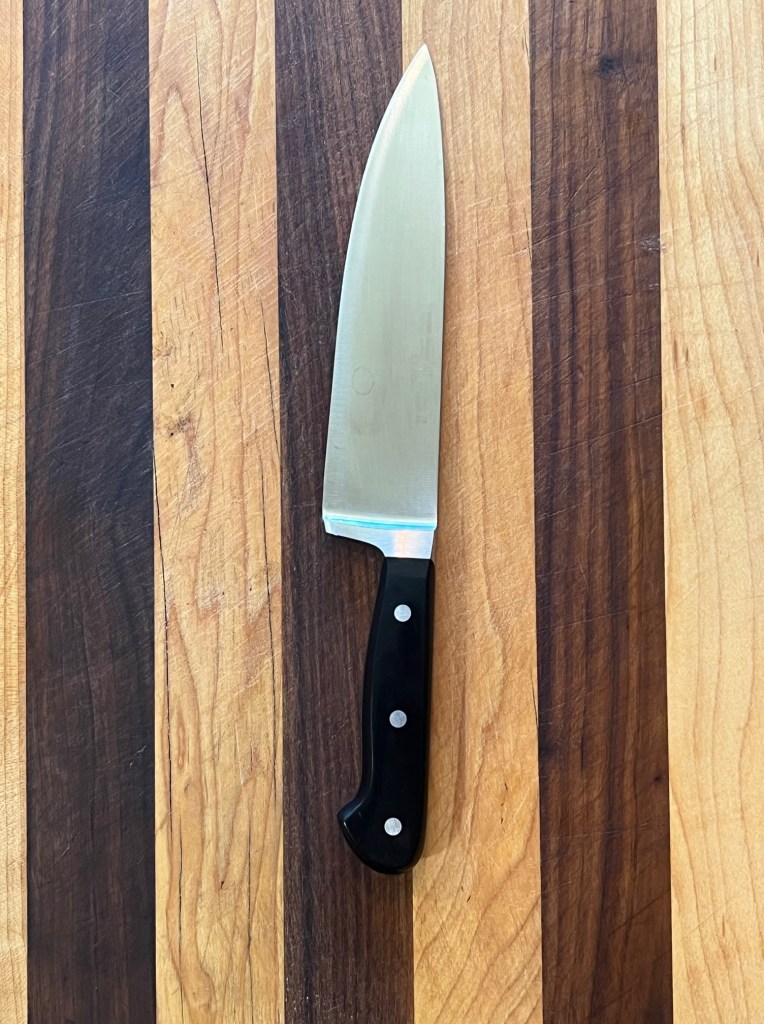
Ideal for rock-chopping
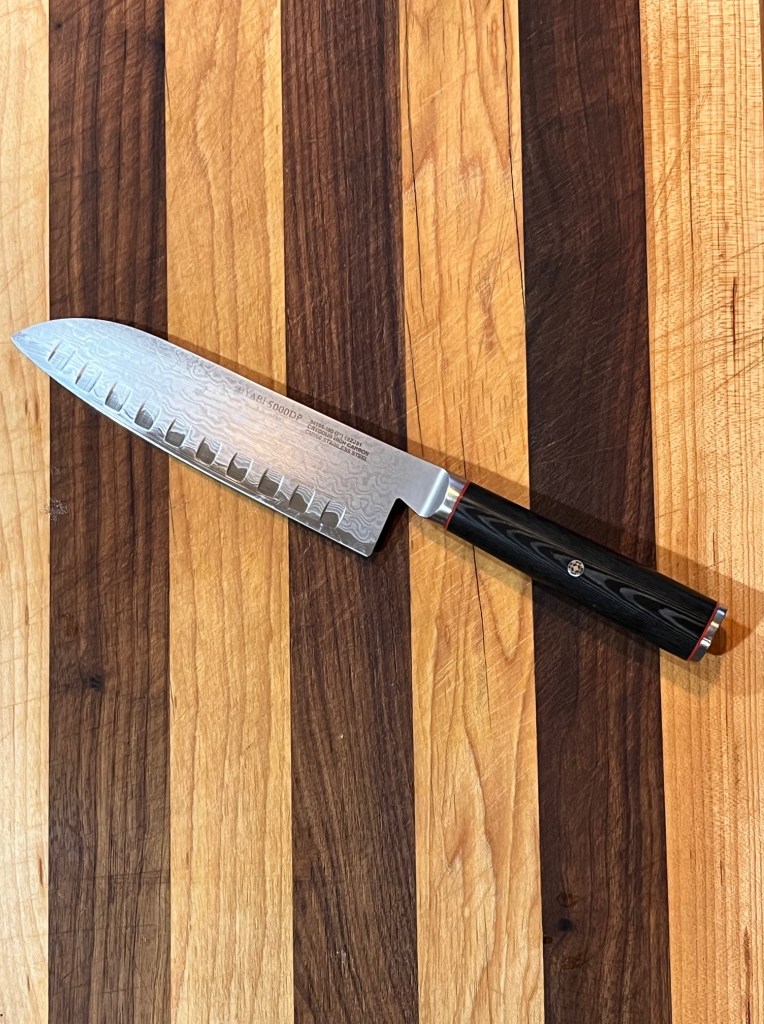
Ideal for tap-chopping
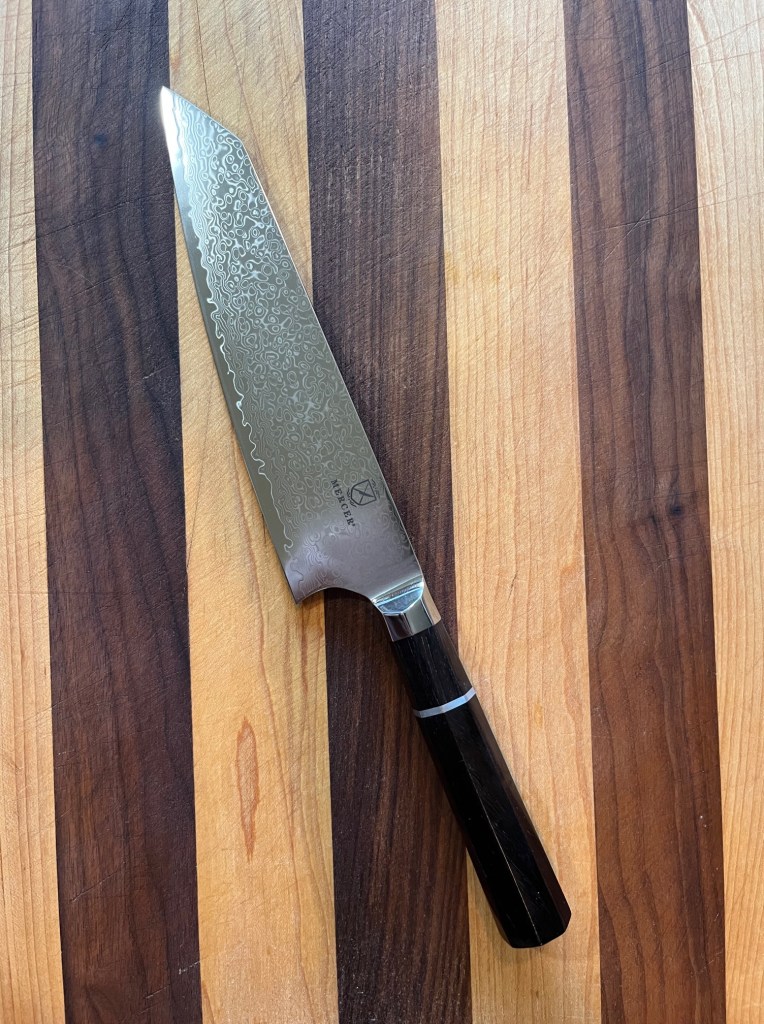
Can accommodate many techniques; difficult to control
The way you cut will directly influence the shape of blade you choose. The three most common cutting techniques used by professional chefs are (1) The rock-chop, (2) The tap-chop, which can be done two ways – push cutting (down and forward) and pull cutting (down and backward), and (3) the cross-chop.
Check out the video below to see each technique in action:
So, TLDR:
- Think about how you cut most of the time, and pick a knife suited to that style of cutting
- Make sure it feels good in your hand, and that it’s something you’ll want to hold for a long time
- Harder steel can be honed to a sharper edge and will hold that edge for a longer time, but can be difficult to sharpen and may chip more easily; softer steel will require more maintenance but is generally more forgiving in the long run
8″ Kiritsuke
Kaizen Series
7″ Santoku
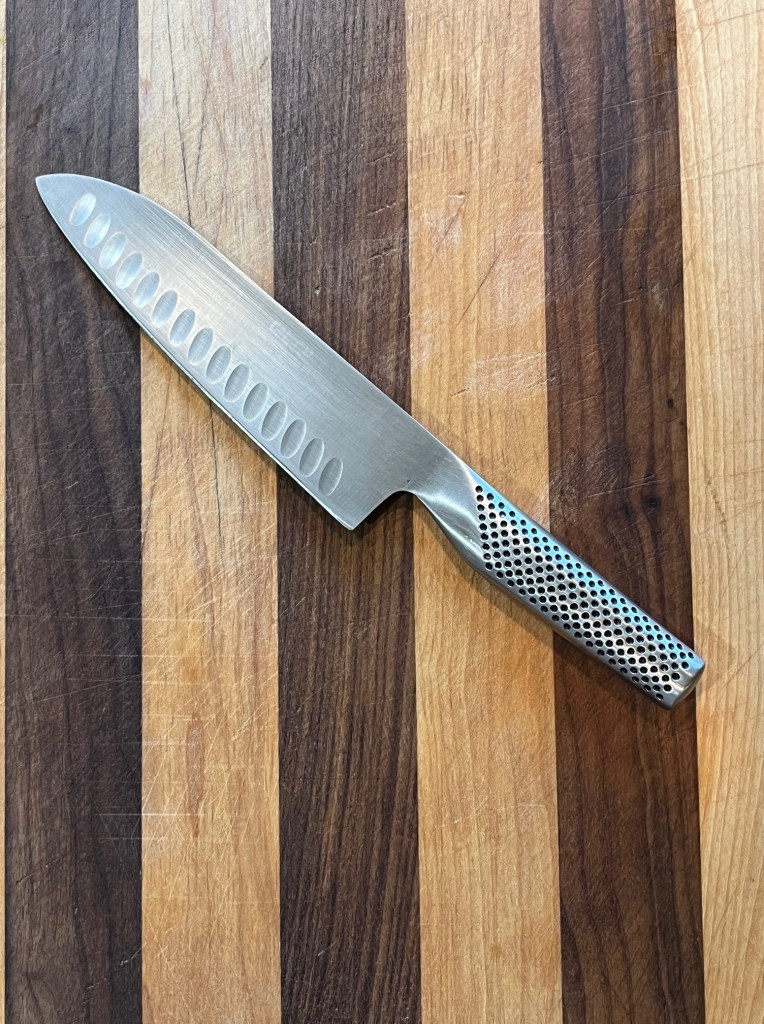
7″ Santoku
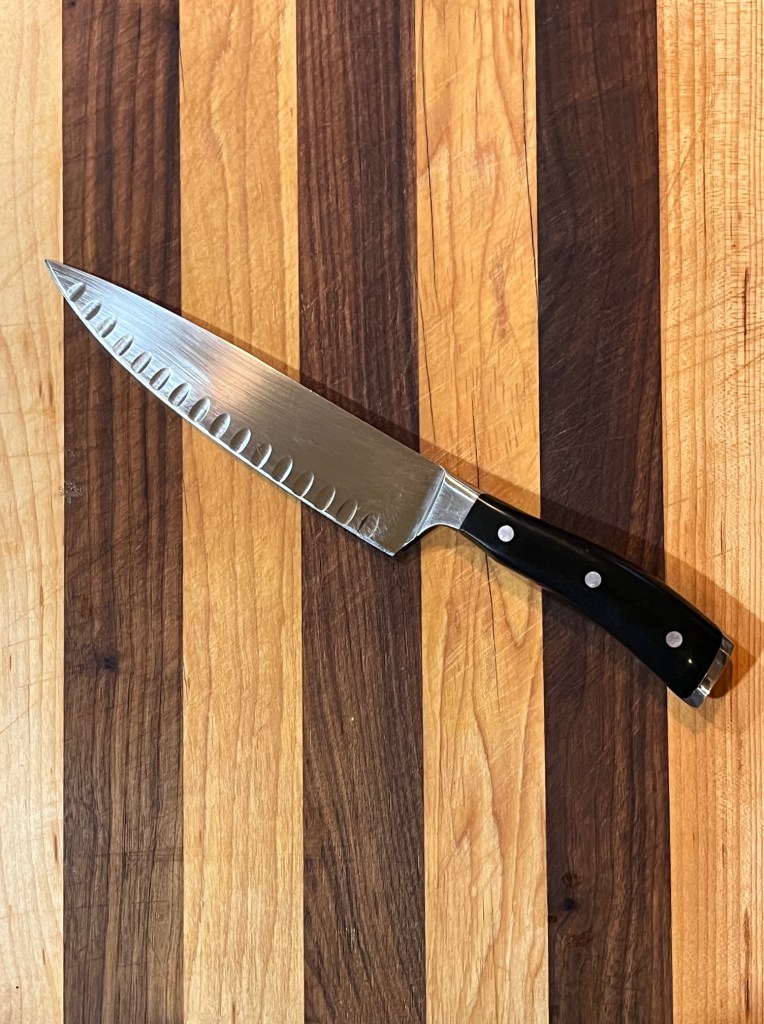
Classic Ikon
8″ Chef
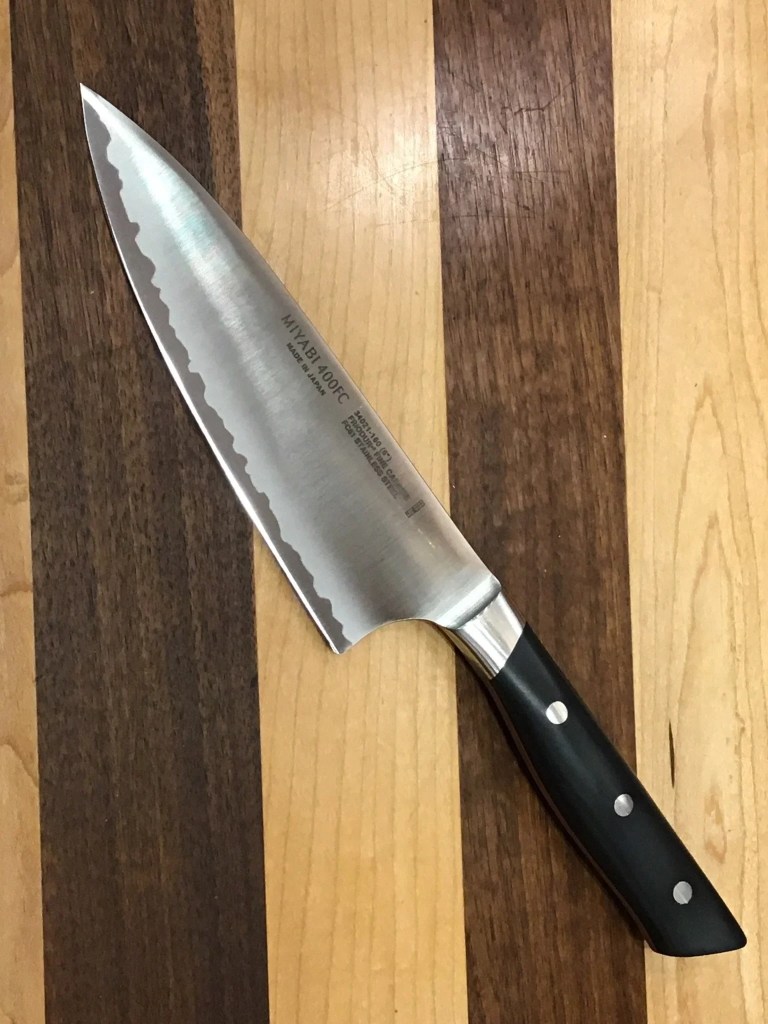
Evolution Series
8″ Chef Knife
Classic
8″ Chef Knife
The knives above are some of the ones currently in my collection.
Discover more from The Intrepid Gourmet
Subscribe to get the latest posts sent to your email.

 The Intrepid Gourmet
13 thoughts on “How to Choose a Chef Knife”