

There are a millions ways to cook a turkey, but there’s only ONE thing you need to know to get great results every time.
Read on to find out the secret…
This post was last updated on 11/10/2024
This post is about the ONE thing you need to know in order to guarantee a perfect Thanksgiving Turkey – but isn’t a recipe perse. The point of this post is to ensure that this Thanksgiving, your turkey is succulent, juicy, tender and delicious…
Not sad and horrible and dry, like this guy:
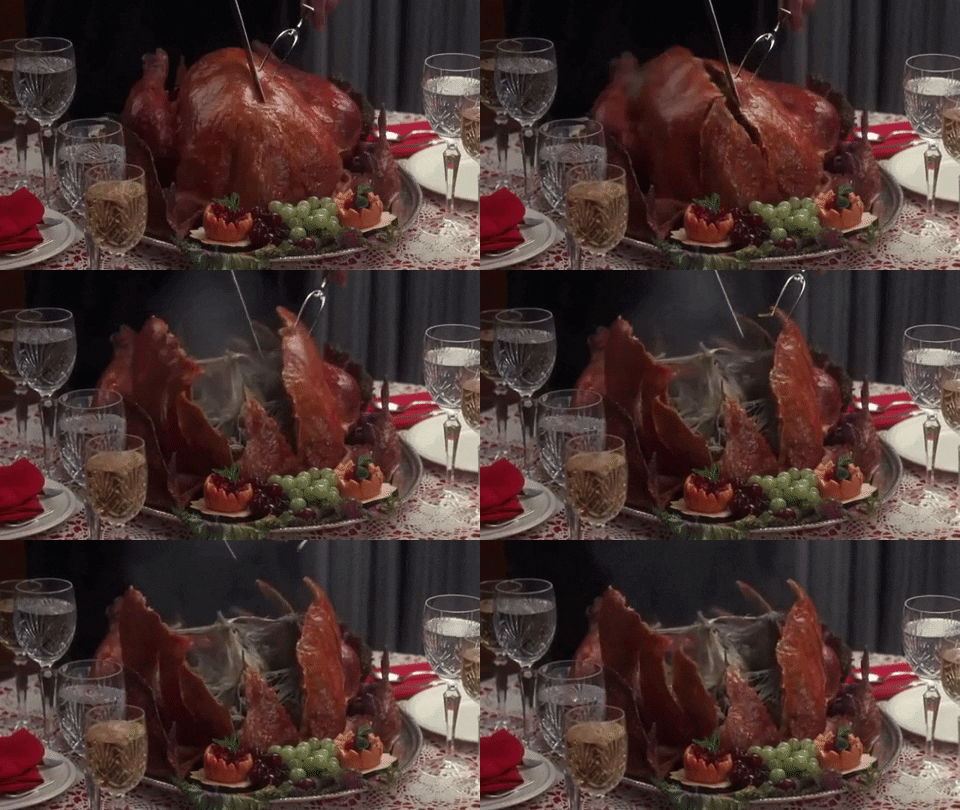
Which – if we’re being honest – is how turkey turns out a lot of the time. So often, in fact, that the scenario has made it’s way into many holiday movies – such as Christmas Vacation (pictured above), or Tim Allen spraying down a turkey with a fire extinguisher in The Santa Claus
Here’s the TL;DR just in case you’re reading this on Thanksgiving morning: insert a probe thermometer into the thickest, coldest part of your turkey – usually the joint between the thigh and breast, but well away from any bones – pop it in the oven, wait for it to hit 145°F (TRUST ME), set a time for 15 minutes (almost 30% longer than the FDA would say you have to), pull your turkey out, and let rest 45 minutes loosely tented in foil – it will be perfectly cooked.
If you’ve read enough of the posts on this blog you should have figured out by now that we always cook using temperature not time. Speaking of temperature, the poor turkey is probably the most overcooked item on anyone’s holiday menu. The reason for this is that turkeys (and most poultry) can house some really nasty bugs, not the least of which are salmonella and e. coli, both of which will leave you wretching up your guts for a few days – best case scenario.
Because we’re aware of this, we generally follow the USDA guidelines and roast our chicken until the internal temperature of the breast is 165°F and the thighs are 180°F.
This makes it possible for literally anyone to cook a chicken or a turkey and not poison anyone. And that’s the audience that the USDA is shooting for: anyone. And that’s fine, because as a government organization, that’s their job – to protect the general public from themselves.
However, that is not my job. My job is to help you get the juiciest, most delicious, succulent bird on the table that you possibly can.
So here’s the thing: It’s not like salmonella (or anything bacteria, virus, amoeba, what-have-you) are alive at one temperature and then suddenly dead at the next. The process of pasteurization, that is, the process of ensuring that food born pathogens are eliminated from food, is a matter of both time and temperature. So the FDA (also a government organization whose job is to keep us safe from ourselves, but in this case it applies to restaurants and food vendors and producers, not individuals) has this to say about pasteurization and poultry:
FDA Pasteurization Time for Poultry
|
Temperature (°F) |
Chicken |
Turkey |
| 136 | 63.3 Minutes | 64.0 Minutes |
| 140 | 25.2 Minutes | 28.1 Minutes |
| 145 | 8.4 Minutes | 10.5 Minutes |
| 150 | 2.7 Minutes | 3.8 Minutes |
| 155 | 44.2 Seconds | 1.2 Minutes |
| 160 | 13.7 Seconds | 25.6 Seconds |
| 165 | Instant | <10 Seconds |
What you will notice here is that the USDA recommends going all the way to 165°F because at that temperature, it’s a pretty much guaranteed fail-safe. It’s also guaranteed nasty, dried out bird. Bottom line here? According to the FDA, a turkey that’s been held at 145°F for 10.5 minutes is every bit as safe to eat as a bird roasted to within an inch of incineration to 165°F.
Of course, 145°F for a turkey is a little on the rare side; it’ll still be a bit pink and gelatinous and people will know it isn’t cooked – at least to what they’re used to. So, my recommendation is to insert a probe thermometer into the thickest, coldest part of your turkey – usually the joint between the thigh and breast, but well away from any bones – pop it in the oven, wait for it to hit 145°F, set a time for 15 minutes (almost 30% longer than the FDA would say you have to), and then pull your turkey out – it will be perfectly cooked.
Great news here is that your turkey will actually need to rest for a minimum of 30 minutes – an hour is better – before carving into it, so tent it loosely with foil while you get everything else ready, and carve it right before you put it on the table. During this time, the temperature is actually likely to rise a few degrees – but even if it doesn’t, it’ll still be hot when you slice into it, I promise!
Happy Thanksgiving!
Discover more from The Intrepid Gourmet
Subscribe to get the latest posts sent to your email.

 The Intrepid Gourmet
One thought on “Let’s Talk Turkey!”