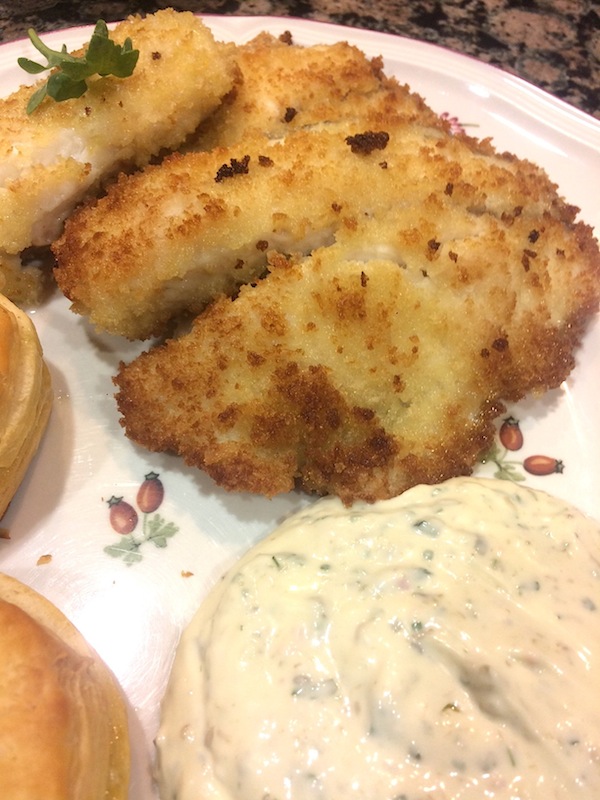
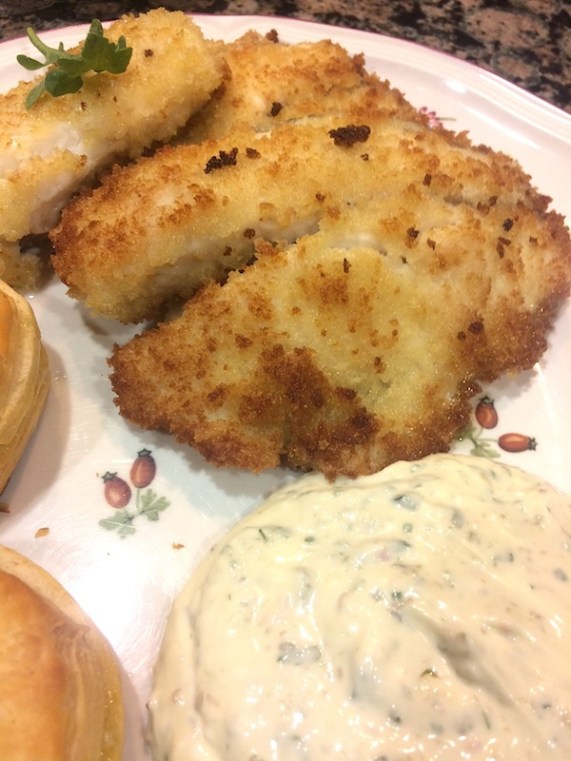
Panko Fried Fish Fillets with Homemade Tartar Sauce

Once fried golden brown, pop the fillets in the oven to cook them through.  This is a healthier alternative to deep fried battered fish and the results are fabulous.

Active Time:  15-20 minutes
Inactive Time:  15-20 minutes
Level: Easy
Serves: 4-6

Ingredients

For the Fish Fillets

  1.  6-8 firm white fillets (cod, tilapia or swai are all good choices), fresh or thawed from frozen
  2. 1/4 cup flour
  3. 1/4 cup cornstarch
  4. 1 TBSP Paprika
  5. Salt and Pepper
  6. 2 eggs
  7. 1 TBSP vodka (optional, adds crunch!)
  8. 2 TBSP cream or milk
  9. 1 cup Panko bread crumbs
  10. 1 TBSP butter (or clarified butter, which you can buy at Trader Joe’s, also called ‘ghee’)
  11. 2 TBSP regular butter
  12. 1-2 TBSP olive oil

For the Tartar Sauce*:

  1. 1 cup mayonnaise (or 1 egg, 3/4 cup vegetable or canola oil, and 2 TBSP olive oil, for Method 2, below)
  2. 2 TBSP sour cream
  3. 1/3 cup minced dill pickles
  4. 3 tablespoons minced shallots
  5. 2 tablespoons drained capers, minced
  6. 2 tablespoons finely chopped cilantro
  7. 1 tablespoon freshly squeezed juice from 1 lemon
  8. 1 1/2 teaspoons Dijon mustard
  9. 3/4 teaspoon freshly ground black pepper
  10. 1/2 teaspoon Kosher salt
  11. 1/4 teaspoon hot sauce

Instructions

For the Fish Fillets:

Preheat oven to 300°F

Set up your dredging station.  You’ll need two, wide shallow dishes and one medium sized bowl.

  • Put the flour and cornstarch in one of the wide, shallow dishes.  Season aggressively with salt and pepper; add paprika and whisk together.
  • In the second wide, shallow dish add Panko bread crumbs.  Crush lightly with the back of a wooden spoon.
  • Crack two eggs into the medium sized bowl; add vodka (if using) and cream/milk.  Whisk together until slightly foamy.
  • Set them up in this order:  Flour mixture, egg wash, bread crumb mixture

Heat olive oil and 1 TBSP clarified butter (or ghee) in a large skillet or sauté pan over medium heat and gently stir to coat the bottom of the pan.  Dredge a fillet first in the flour mixture (shaking of excess), then dip into the egg wash, and then dredge in the breadcrumb mixture, pressing firmly to adhere to each side.

Note:  If you want exceptionally crispy breading that is almost guaranteed not to fall off your fillets, do this:  Dredge in this order – Egg Wash, Flour, Egg wash, Panko Mixture.  Once breaded, place them on a baking sheet and refrigerate them for 30 minutes before continuing to the next step.

Add 2-3 fillets to skillet and fry 3-4 minutes on each side until golden brown.  Repeat with remaining fillets.

Note:  You  can fry more than one at a time, but you’ll probably need to work in batches – every time a fillet is added to the skillet, it will reduce the over-all temperature, which will hinder browning and increase the possibility of soaking the breading in oil rather than frying it.  I’ve found that 3-4 fillets at a time is a good number, depending on their size.  You may also need to add more fat to the pan between batches; this is also okay.  If you do, try to keep the olive oil-to-butter ratio at roughly 1:1.

When all the fillets are browned, place them on a wire rack set on a baking sheet, (or alternatively place them directly on a lightly greased baking sheet, although be warned: skipping the wire rack will make them mushy on the bottom, so seriously, use the wire rack!) and bake them in the preheated oven for about 10 minutes minutes until cooked through, with an internal temperature of at least 145F.

For the Tartar Sauce:

Method 1:  Combine all ingredients and refrigerate for at least 30 minutes.  Will keep for two days in the fridge.

Method 2:  Add all ingredients to the bottom of a jar or cup EXCEPT the oils.  Float the vegetable or canola oil on top of the ingredients.  Using an immersion blender, place the head of the blender all the way at the bottom of the container.  Pulse a few times to begin, then turn the blender on.  Allow a vortex to form to emulsify the sauce.  Once all the oil has been incorporated, stir in the 2 TBSP olive oil.  Refrigerate for 30 minutes; will keep for two days in the fridge.


*Tartar Sauce Recipe courtesy of Serious Eats.  I subbed out their parsley for cilantro and added the olive oil in method 2, but it’s basically their recipe.  Check out that post HERE.


Steak Fajitas

Steak soaked in a zesty citrus marinade and then grilled to perfection; serve with pico de gallo, homemade gaucamole, sour cream, roasted peppers and onions and Mexican cheese.  Easy, cheap and delicious.

Ingredients:

For the Steak

  1. 2.5lb London Broil or Tri-Tip Roast
  2. 1/2 cup orange juice
  3. 1/2 cup lime juice (approximately 6 limes)
  4. Zest of 1 lime
  5. 3-4 cloves garlic, minced
  6. 2 tsp chile powder
  7. 1/2 tsp cayenne pepper
  8. 1 TBSP kosher salt
  9. 1 TBSP coarsely ground black pepper.
  10. 1 cup mesquite wood chips (optional)

For the Pico de Gallo

  1. 1 Large yellow onion, finely diced
  2. 2-3 Roma tomatoes, finely diced
  3. Large pinch Kosher salt
  4. 2 jalapeño peppers, minced
  5. juice of one lime
  6. 2-3 TBSP cilantro, finely chopped

For the Guacamole

  1. 3-4 large, ripe Haas avocados (or 6-7 little organic ones)
  2. 1 jalapeño pepper, minced
  3. 1 3.5oz can hatch green chiles (optional)
  4. 4 TBSP pico de gallo (above)

For the Fajita Mix (peppers and onions)

  1. 2 TBSP olive oil
  2. 3-4 cloves garlic, minced
  3. 1 each: Red bell pepper, green bell pepper, yellow bell pepper
  4. 1 large yellow onion, halved and sliced into half-rings

For Serving

  1. Medium size yellow corn tortillas, 3-4 per person
  2. Freshly grated Cotijá cheese
  3. Shredded Mexican Cheese
  4. Sour Cream

Prep:

For the Steak

  1.  Whisk ingredients 2-9 together in a medium size mixing bowl.
  2. Transfer steak to large 1-2 gallon ziplock bag.  Add marinade to bag with steak and massage to incorporate well.  Refrigerate for 2-4 hours, or up to 8 hours.  Flip bag over half way through marinating process if possible.

For the Pico de Gallo

  1. Dice tomatoes first.  Add to colander and sprinkle with Kosher salt.  Toss gently to season and allow to sit in the sink 20 minutes.  Tomatoes will give up much of their moisture making your pico less watery.
  2. Prepare onions, jalapeños, lime and cilantro.  Stir to combine.
  3. Add tomatoes to mixture and stir to combine again.  Cover and refrigerate until ready to serve.

For the Guacamole

  1.  Halve avocados and remove pits.  Spoon avocado out of shells into a medium to large mixing bowl.
  2. Add ingredients 2-4 and mash well using a potato masher.  (Note:  Guacomole is best served right away.  If left in contact with air too long it will oxidize and turn brown.  If preparing a couple hours in advance, smooth guacomole in bowl, drizzle with lime juice, and cover with plastic wrap with the plastic wrap in full contact with the guacamole).

For the Fajita Mix (peppers and onions)

  1. Prepare all ingredients as directed
  2. Add to a 10-12 inch cast iron skillet and stir (or toss if you’re strong enough; cast iron is heavy) to combine.

Cook

  1. Light 1 or 2 burners if using gas; if using charcoal light 1 chimney starter full of lump charcoal and set grill up for 2-zone cooking.  Make sure the grill is good and hot.  Just prior to grilling steak, add 1 cup mesquite wood chips, if using.  Click HERE for more information on grilling and smoking.
  2. Remove steak from marinade and pat dry.  Discard leftover marinade.
  3. Place steak down on hot side of grill and sear, approximately 5 minutes per side, until nicely browned.  Transfer to cool side of grill.
  4. Add cast iron skillet to hot side of grill and close the lid.  Sauté fajita mixture in cast iron until nicely caramelized and soft, 15 – 20 minutes.  Stir occasionally.  Steak and vegetables should finish at roughly the same time, but if they don’t just remove the one that is done and tent with aluminum foil.
  5. Once steak and Fajita mixture are done, remove and allow to rest for a few minutes
  6. Warm tortillas on a griddle or in a frying pan.  Sprinkle with cotijá cheese and continue to toast until cheese is melted.
  7. Slice steak thinly across the grain on the bias using a sharp knife

Serve

Plate Steak, Pico de Gallo, Guacamole, Fajita mixture, shredded Mexican cheese and sour cream together.  Have eaters assemble fajitas at table as desired.


A Tribute to Anthony Bourdain

Until recently, I had never shed a real tear over the passing of a celebrity. While the deaths of other famous people have saddened me greatly, the tragic and devastating loss of Anthony Bourdain hit me hard and I wept.

Perhaps for some people it is a musician, actor or artist whose work had a deep impact on their life, but for me it was a chef. Anthony Bourdain inspired me and changed me for the better through his cooking, his writing and most importantly through his kind and generous personality.

Anthony Bourdain was one of my heroes; the chef I always look to for advice first (if Tony says don’t use a garlic press, then I won’t, at least not too often, etc) and the man who first inspired me to really take my cooking seriously. My passion for food, my love of being in the kitchen and this blog exist in large part because of Bourdain’s influence on my life.

Despite his reputation as a pretentious asshole (a reputation which he clearly enjoyed with an impish glee), it was clear that he was a man who deeply cared about other human beings. His traveling and eating and conversing with people from all walks of life around the world was not driven by a self indulgent search for pleasure; rather it was driven by a fascination with the human condition, a desire to give voice to the voiceless and a deep and genuine love for those with whom he came into contact.

My first Bourdain experience was watching an episode of his show No Reservations in which he visited Maine and wherein his cameraman, Zack, who had grown up in Maine, took Anthony to all of his favorite local haunts. They also visited Primo in Rockland – an old Victorian era house converted into a restaurant by well known chef Melissa Kelly which specializes in Italian and Mediterranean cuisine using only the freshest local ingredients.  So fresh, in fact, that the vast majority of the food served there is actually grown there – it’s part restaurant, part farm.  I knew I had to go there.

In 2010, my wife and I honeymooned in New England and we made the pilgrimage to Primo for dinner.  The décor was astounding, the setting idyllic and the food – well, it was the best meal I’d ever eaten and remains so to this day.  We casually mentioned to our server that our visit to Primo was our honeymoon dinner, and the next thing we knew, a bottle of dessert wine arrived at our table – compliments of the chef.  Chef Kelly, that is.  Later that evening, as we were finishing our meal and the restaurant was closing down for the night, Chef Kelly invited us down to her kitchen and showed us around.  She was approachable, gracious and generous with her time, even at the end of what was probably an 18 hour workday.  And it was in this moment I knew that I wanted to learn to cook.  Not just cook, but cook.  And so thanks to Anthony Bourdain and Chef Kelly the journey began – I was no longer satisfied with being a decent or even good cook – I wanted to be a great cook.

Since Bourdain was the only chef I’d really heard of, I started watching his shows: A Cook’s Tour and No Reservations.  His traveling, his writing and his encounters with people all over the world inspired me to be brave, to try new things, to eat things I might not have ever been brave enough to try.  Hell, I’d think to myself, If Bourdain can eat a Namibian warthog anus cooked al-denté over an open fire in the African bush, I can eat this live amaebi my sushi chef just handed to me as a gift.

Bourdain’s writing and TV shows also inspired me to try my hand in the kitchen.  I’d watch the preparation of some French classic on one of his shows and think to myself, I could probably make that.  As an anniversary gift after our first year of marriage, my wife bought me my first real chef’s knife – a Wusthof Classic Ikon – a knife I used many times weekly until very recently when I realized I’d finally worn the granton edge down to the ovals.  I cried a bit that day too.

I’ll never forget, early on in my culinary ventures, when I was dicing an onion (of course with my new Wusthof Classic Ikon) and nearly took my thumb off.  I’m looking at the scar as I type these words.  Blood was everywhere.  I’d managed to slice myself straight through to the bone and in that moment I thought to myself Is this really worth it?  So I turned to Bourdain for advice – Tony, how should I slice an onion?  And I came across this video:

As an aspiring cook, this was the advice I needed to hear.  Not just in terms of technique, but in terms of “Suck it up and learn how to do this properly.”  And I had no problem admitting that I was really an idiot – and I turned to Bourdain to learn how to be less of one.  I could probably fill a book with other stories and techniques that I learned from Bourdain, but since this is a blog post, I won’t do that here.

More important, though, than what I learned about cooking, food and technique from Bourdain was how to relate to people of other cultures and other walks of life.  Watching him go to places all over the world and vicariously experiencing his love of people, food and culture helped me learn to be more tolerant.  He taught me to ask basic questions, like “What makes you happy?” when first encountering someone very different from myself.

When news of Bourdain’s suicide broke, I was beside myself.  How could someone how had so much, who had experienced so much, who meant so much to so many people feel so isolated, desolate and hopeless that he would take his own life?  And then I remembered that if I’d learned anything from Tony, it was to be kind. You never know what someone else might be going through and outward appearances can be deceiving.

Beneath the bravado and the masculine machismo and more than occasional snark, Anthony Bourdain was a very kind man.  A man who loved other human beings.  A man who wanted to share what he was passionate about with others.  A man who wanted others to do well – indeed to thrive – and who wasn’t afraid to step up and say what needed to be said, to give voice to the voiceless, to challenge his readers and viewers to be kinder, better people and remind all of us that food isn’t ultimately about self-indulgence or seeking pleasure, but that food brings us together.

The next time you break bread with someone, remember that.  All humans have to eat, so remember that sharing a meal with another person is possibly the most primal, simple kindness we experience in our lives.  Eating with another person is an opportunity to encounter them in an authentic and relaxed way and because of this, many lasting friendships form over the simple act of sharing a meal.  And if Tony Bourdain taught us anything, it was that.

I leave you with this video – one of my favorite videos of Anthony Bourdain because I believe here, for whatever reason, he is relaxed enough to show his true self.  It is him making Linguine Con le Vongolé – the dish he loved to serve to those whom he loved most.  Maybe make this for dinner sometime soon.


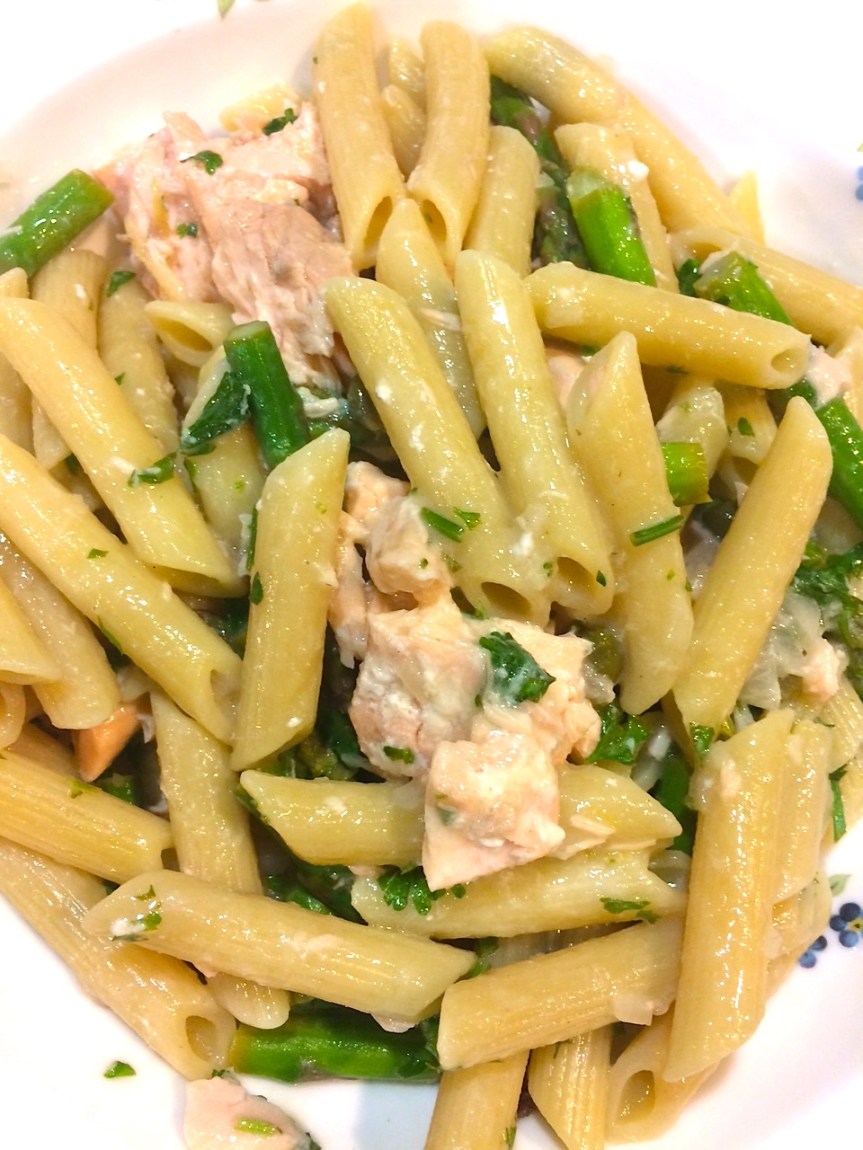
Salmon Poached in White Wine with Penne and Asparagus

This delicious seafood pasta dish comes together in about 45 minutes, is simple to make and relatively inexpensive.  Its clean, bright flavor profile yields a result greater than the sum of its parts and it is therefore both perfect for a weeknight dinner and elegant enough for a romantic dinner for two.

Time: 45 minutes
Level: Easy
Cost: Approximately $4/plate
Serves: 4

Ingredients

  1. 1 large salmon filet, approximately 1lb, cut into four pieces and skin removed
  2. 2 TBSP Kosher salt
  3. 2 cloves garlic, minced
  4. 1 small shallot, minced
  5. 1 TBSP unsalted butter
  6. 1 TBSP olive oil
  7. zest of 1 lemon
  8. 1 TBSP capers (optional)
  9. 1lb asparagus, cut into 1 inch pieces
  10. 1/3 bottle cheap but drinkable dry white wine
  11. 1 box (1lb) penne pasta, cooked according to package directions
  12. Handful (approximate 1/3 – 1/2 cup) fresh parsley, finely chopped
  13. juice of two lemons
  14. grated parmesan cheese (optional, for serving)

Instructions

  1. Begin by heating water for pasta and blanching asparagus.  Make sure it is at a rolling boil and then add a good 2 TBSP of Kosher salt.  Blanching the asparagus will turn the water green, but also impart a vegetal favor to your pasta which is subtle and quite nice.
  2. Heat butter and olive oil in a large sauté pan until melted over medium low heat.  While butter is still foamy, lower the heat to low and add the shallots, garlic and lemon zest.  Cook until fragrant and shallots are soft, 2-3 minutes.  If the garlic starts to brown, you’ll have to start over, so go slowly and use very low heat.
  3. When aromatics (shallot, garlic, lemon zest) are just barely sizzling, add white wine and capers, if using.  Bring to a boil and then reduce heat to a simmer.  Add the salmon filets to the liquid, cover the pan, and allow to sit at a bare simmer for 15-20 minutes, or until salmon reaches an internal temperature of 130°F.  If you are using a very good pan with excellent heat retention, you may be able to off the heat entirely and allow the salmon to poach in the residual heat.  Bottom line:  The lower and slower the better.
  4. While salmon is poaching prepare asparagus and pasta.
    1. Add asparagus to boiling water, return to a boil, and cook 3-4 minutes.  Remove with a slotted spoon and rise immediately under cold running water (or shock them in an ice bath) to stop the cooking process.  Set aside.
    2. Cook pasta according to package directions.  If salmon is still not done once pasta is finished, drain in a colander and set aside.  Be sure to reserve 1/2 cup of pasta water.
  5. Once salmon is up to temp, carefully remove to a cutting board and allow to rest.  Be careful, it will be very tender and flakey and you don’t want it to fall apart just yet.
  6. Add penne and asparagus to sauté pan and toss in the sauce until well combined.  Add a couple tablespoons of pasta water to thicken the sauce if neccessary.
  7. Slice salmon filets into small, bite-sized pieces and add to the pan with the sauce, asparagus and penne.
  8. Squeeze the juice of two lemons into the pan and add a handful of chopped parsley.  Use salad tongs to gently toss until combined and serve.  Pass parmesan at the table.

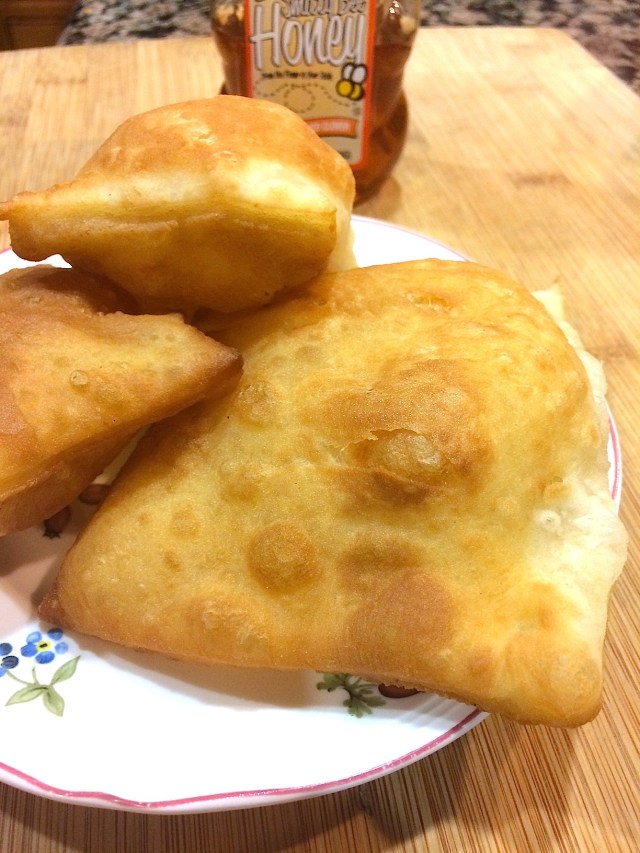
New Mexico Sopapillas

I love these guys – puffy, airy little pastries designed to do one thing: be a delivery mechanism for awesome flavors.  They are a staple of New Mexican cuisine, and as far as I can tell, almost exclusive to it as well.
Sopapilla literally means “little soup pillow” and that’s what they are best at – sopping up delicious sauce from the plate, or soaking in delicious chili.  My first encounter with a sopapilla was at a Sadie’s in Albuquerque, NM back when I was in high school.  This was also the first time I encountered Chili Verde, chili in general, and food that was legitimately spicy.  I had been wanting to try to make these for years, but for a whole variety of reasons never got around to it until the other night, and they were amazing.  Sprinkled with a bit of cinnamon sugar or a drizzle of honey, they also make an awesome breakfast.  Also, this was REALLY easy.

Time: 30 minutes
Level: Easy
Cost: Really, really cheap seeing as they’re made from stuff you probably have on hand
Makes:  Approximately 18-24 sopapillas

Ingredients

  1. 3 cups all purpose flour, plus perhaps 1-2 TBSP
  2. 2 tsp double-acting baking powder
  3. 1 tsp salt
  4. 1 cup whole milk
  5. 1/4 cup warm water
  6. 6 TBSP unsalted butter, melted
  7. 1.5 quart (48 oz) vegetable or canola oil, for frying

Instructions

  1. Combine dry ingredients (1-3) in a large mixing bowl and whisk to combine.
  2. Create a well in the bowl using the dry ingredients, it should look like a little volcano; a mound of ingredients with a little hole, perhaps 2 inches in diameter, in the top.
  3. Combine wet ingredients (4-6) in a 2 cup measuring cup and whisk briefly to combine.
  4. Add about half of the wet ingredients to your flour-mixture volcano.  Using your hands, begin scooping the dry ingredients from the edges of the volcano into the wet ones on top.  Add the rest of the wet ingredients and continue to mix until a rough dough has formed.  If your dough is super sticky, coat it with 1 TBSP flour.  Once the dough is fairly consistent, coat with 1 more TBSP flour and cover with plastic wrap or a clean towel.  Punch down and fold a few times to make sure everything is really worked together.  Allow dough to rest for 20 minutes.
  5. Once dough is rested, remove it from the bowl and divide into two parts.  Place one part back in the bowl and cover while you work with the other part.  On a lightly floured work surface, use a rolling pin to roll the dough out to about 1/8 inch thick, trying to get it as consistent as possible.  Cut off rounded edges to make a rectangular piece of dough and discard the trimmings.  Cut dough into rectangles approximately 1.5″ x 2″.  Repeat with the remaining dough.
  6. Heat oil in a large pot to 375°F – 400°F
    • Cook’s Note:  When frying stuff, I’ve found that my 5qt sauté pan is actually the perfect size.  480z of oil comes do about 2″ deep, which is all you really need to fry just about anything.  The fact that it’s fairly wide (12″ across) means that the oil will come up to temperature more quickly and I can fry things in larger batches.  There’s only one serious drawback:  A sauté pan has a handle, and handles can be accidentally knocked, and the potential for knocking a large volume of 400°F oil onto yourself or the floor is a VERY bad thing.  So, if you use your sauté pan for this, PLEASE make sure the handle is pointed AWAY from you, toward your stove, and well away from any place it could be inadvertently knocked.
  7. Once oil is up to temp, carefully slide a sopapilla into the oil.  It will submerge, sizzling quite a bit, and then float to the top.  Then the magic happens:  Before your very eyes, it will puff into a beautiful little pillow.  Continue to fry for 2-3 minutes until golden brown, and the flip with a slotted spoon to brown the other side.  Once you’ve done one as a tester, you can probably do 3-4 at a time.
    • Cook’s Note:  If your sopapilla doesn’t puff, chances are your oil isn’t the right temperature.  It’s got to be hotter than 350°F but no hotter than about 410°F.  Remember:  Every time you add a sopapilla to the oil, it’s going to bring the overall oil temp down a couple of degrees.  This is why I recommend starting with your oil somewhere between 375°F – 400°F.   Either that or you’re trying this at high-altitude.  In either case, if after a few test batches your sopapillas don’t puff, don’t worry – they’re still tasty.
  8. Once fried, remove sopapillas to a plate lined with a paper towel to drain.  Repeat until all sopapillas are fried.  They can be kept warm in a 200°F oven for 30-45 minutes.  Also, they refrigerate pretty well and can be gently reheated in a 325°F oven until just warmed through, about 5 minutes.