Pan Seared Lamb Loin Chops with Garlic Cream Sauce

The thing that makes this dish is the garlic cream sauce.  A fusion between Mediterranean and French flavor profiles, this dish is at the same time both tangy and mellow, sweet and savory and all-around amazing.

Time – Active: 60 minutes
Time – Inactive:  2-4 hours of marination for the lamb and 45 minutes to roast garlic
Level: Easy
Cost: $8-10/plate
Serves: 4-6

Ingredients

For the Lamb:

  1. 2-3 lbs Lamb Loin Chops (figure on 3 per person; they’re about 1/4lb each)
  2. Juice of two lemons (divided)
  3. 6-8 garlic cloves, minced
  4. Kosher salt and pepper
  5. 1/4 cup olive oil
  6. 2 TBSP clarified butter, Canola, or vegetable oil

For the Garlic Cream Sauce:

  1. 3 heads (that’s right, heads) of garlic
  2. 3 TBSP olive oil
  3. 2 TBSP unsalted butter
  4. 1 small shallot, minced
  5. 1/4 cup brandy
  6. 1/2 cup dry white wine
  7. 1 140z can low sodium chicken broth
  8. 1/4 cup heavy cream
  9. Salt, to taste
  10. Juice of 1 lemon.

Instructions

Combine 1/4 cup olive oil, minced garlic, juice of three lemons, salt and pepper, and lamb loin chops in a mixing bowl and toss to coat.  Cover and refrigerate.  Allow to marinate for 2-4 hours.

Preheat the oven to 400°F.

Remove most of the outer paper from your 3 heads of garlic.  Cut the top off the heads (opposite the root end), exposing the garlic cloves inside.  Drizzle 1 TBSP olive oil over each clove.  Place in an oven safe baking dish, cut side up, and cover tightly with aluminum foil.  Place in oven and roast until very soft and sweet, about 45 minutes.  (Begin checking after 30 minutes; use a cake tester or toothpick to test for softness).  Remove from oven and allow to cool, remaining covered.

Reduce oven temperature to 275°F.  Place marinated lamb loins on a wire rack set on a baking sheet, and bake until internal temperature is around 125°F, approximately 30 -45 minutes (cook with temperature not time; use an instant read thermometer to verify).

While the lamb is coming up to temp in the oven, use a butter knife to help coax the roasted garlic cloves out of the heads.  They will be soft and sticky so if they come apart a bit that’s okay.  Reserve the roasted cloves in a small bowl.

Once the lamb is up to temp, remove from the oven and allow to rest for a couple of minutes under loose foil.  Meanwhile, in a large heavy bottomed skillet or sauté pan, heat either 2 TBSP clarified butter, vegetable or Canola oil until very hot, around 400°F.  Carefully add the lamb loins to the hot pan, and sear, about 3 minutes on each side until deeply browned and you have a nice crust on your lamb and a beautiful fond in your pan.

Note:  Work in batches if you have to.  4-6 loins at a time is probably a good number, but remember:  each time you add a loin to the pan, you reduce the overall pan temperature somewhat.  Add too many and your lamb loins will steam, not brown.

Once you’ve got your lamb seared off, remove them from the pan and allow them to rest on the wire racked baking sheet loosely tented with aluminum foil while you make the garlic cream sauce.

Pour off the fat in the pan and lower the heat.  Melt 2 TBSP unsalted butter in the pan.  Once butter is melted but still slightly foamy, add the minced shallot and sauté until fragrant, 1 minute, being careful not to brown.  Add 1/4 cup brandy and flambé.  Add white wine and chicken broth and bring to a boil, scraping up any remaining fond from the bottom of the pan.  Add 1/4 cup heavy cream and reduce sauce until thickened to desired consistency, 8 – 10 minutes.  Once sauce is thickened, off the heat and stir for 2-3 minutes to bring down the overall temperature.

 Note:  For a smoother, creamier sauce, use an immersion blender to pureé or transfer contents of the pan to a blender and blend until smooth.

Squeeze juice of one lemon into sauce and stir to incorporate.  Taste for seasoning and adjust with salt and/or pepper as necessary.

Note:  Lemon and cream taste great together, but they are not friends.  If you add the lemon while the sauce is still too hot, the acidity in the lemon will curdle your cream sauce, and that will suck.  So make sure it is cooled down somewhat before adding the lemon juice.  Also, pro-tip: never add cream to a sauce with lemon already in it as that will almost always result in curdling the cream; instead, do it in the order prescribed here:  Reduce cream sauce, off the heat, allow to cool, and stir in lemon juice at the end.

Serve lamb with rice pilaf, Caesar Salad, and garlic cream sauce on the side.

Cook Like a Peasant: 5 Ways to Eat Like a King During Lean Times

The kitchen table has always been a place where we nourish not only our bodies, but our souls.

Let’s be real people:  Times are tough right now and it doesn’t look like it’s going to get a whole lot easier any time soon.  But that doesn’t mean we’re stuck eating McDonald’s and Spaghetti-O’s.  It has often been said that necessity is the mother of invention – never has this been more true than in kitchens across the globe and throughout history.

This post is going to explore how we can continue the time honored tradition of making great food for cheap in our current economic and social climate.  Lean times have always led cooks to find inventive ways to create dishes that are filling, satisfying, simple and delicious.  The best foods from around the world are often so-called ‘peasant dishes’ because they were cobbled together from what people had laying around.

In the Old World, country farmhouses in France brought us the likes of Coq Au Vin, Coq Au Riesling, Chicken Dijonnaise and Beef Bourguignon; Italy exported classic dishes like Spaghetti and Meatballs, Classic Marinara Sauce and Linguine Con Le Vongolé; not to mention many ways to prepare the humble chicken in glorious pan sauces: Piccata, Marsala and Parmesan.  Spain gave us Paella and  Ireland gave us Corned Beef and Cabbage; Scotland the noble Haggis (okay, maybe forget about that last one).

Lest we forget, in the New World in America, as Westward expansion progressed, the culinary landscape progressed with it; from the chuckwagons of the Great American West came chili – made from both beef and chicken.  Meanwhile, deep in the steamy bayous of Louisiana a whole culture emerged – Cajun – and with it unique and delicious foods such as jambalaya and gumbo.  And how could we fail to mention Barbecue – tough cuts of meat cooked low and slow over smoldering coals, bathed in smoke for hours on end from the Coast of California in Santa Maria to Texas to Tennessee, Kentucky, the Carolinas and Alabama.

All this goes to show that with a little planning and a little extra work, it is still possible to eat well and live well despite the financial and economic hardships afflicting millions of Americans today – I’m one of them.  I would be lying to you if I didn’t say that it’s tough out there; sometimes it’s scary and there have been times when I’ve had less than 10 bucks in my checking account with pay-day several days off.  But so far, I’ve got a roof over my head and my family and I have eaten well even when funds were nearly non-existent.

People have almost always found ways to feed themselves in tough economic times and 21st century America should be no different.  Even though we live in an era where income inequality is a real problem and many Americans barely make enough money to pay rent (and it’s only getting worse) we must remember that we are in good company throughout history – and that the kitchen table has always been a place where we nourish not only our bodies, but our souls.

Without further ado, here are a few tips that I humbly offer to you in hopes that, no matter what you’re going through, you will find the time to cook a few times this week thereby eating a little better and saving a little money in the process.

Number 1:  Comparison Shop.  Download a few apps and don’t be afraid to hit multiple grocery stores to get the best prices.  Going to only one grocery store is a sure-fire way to make sure you’re spending too much on groceries.  Most major grocery stores have their own apps these days where you can see what is on sale in any given week.  Here in California, price changes happen on Wednesdays.  There are also several apps out there that let you compare prices across several grocery stores at once – so far, I’ve found Favado to be the most helpful.

Also – all that junk mail you throw away?  Look through it to see if there are coupons or advertisements for what might be on sale near you.  Be on special lookout for coupons where you get a dollar discount for spending a certain amount (such as $10 off a minimum purchase of $30).

Number 2:  Shop at Discount Grocery Stores.  You wouldn’t believe how much money you can save by shopping at either Aldi and/or Grocery Outlet.

Number 3:  Plan ahead and keep your pantry well stocked.  Figure out what you are going to do for each meal this week and plan at least one or two meals to generate some leftovers.  Make a list of exactly what you need and stick to it.  Certain things I always try to keep on hand are:  beef and chicken stock, canned diced tomatoes, tomato paste, pasta of several sorts, onions, and garlic.  When you begin to run low on a certain pantry essential (say, chicken stock), write that down somewhere – I keep a list on a whiteboard in my kitchen.

Number 4:  Buying in bulk can save you money.  This doesn’t mean that you have to go to the nearest wholesaler such as Costco or Sam’s Club and buy a bunch of stuff you won’t use (hey, look, a twelve pack of watermelons!), but there are a lot of coupons out there where you get a certain dollar amount or percentage off a minimum purchase amount or a quantity discount for buying multiples of something you WILL use.  Keep an eye out for those and utilize them.

Number 5:  Remember to live a little.  Indulging a little bit on a few simple pleasures can actually save you money and improve your quality of life.  Treat yourself to some cheese or some nuts once in a while before dinner as well as a beer or an inexpensive glass of wine; not only is there something very pleasant about having a bit to drink and some light appetizers before dinner (or while making dinner), you won’t come to the table so ravenous that you overeat and spoil any chances of having enough leftovers to form a complete meal later on.  Believe it or not, there are many perfectly serviceable table wines out there for less than $5 a bottle, especially at Trader Joe’s and Aldi.  Try a few of them and figure out which ones don’t suck.  You can also find some pretty decent beers at Trader Joe’s and Aldi.

All in all, remember this:  The best food in the world came from places and times of scarcity.  It doesn’t need to be fancy or expensive to be good.  You are not alone in the world – and sometimes, all it takes to remember that fact is gathering around the kitchen table on a cold night with family or a few friends to share a light pasta dish tossed in a simple sauce, a rustic hunk of bread, a wedge of cheese, and a glass or two of rough red wine.


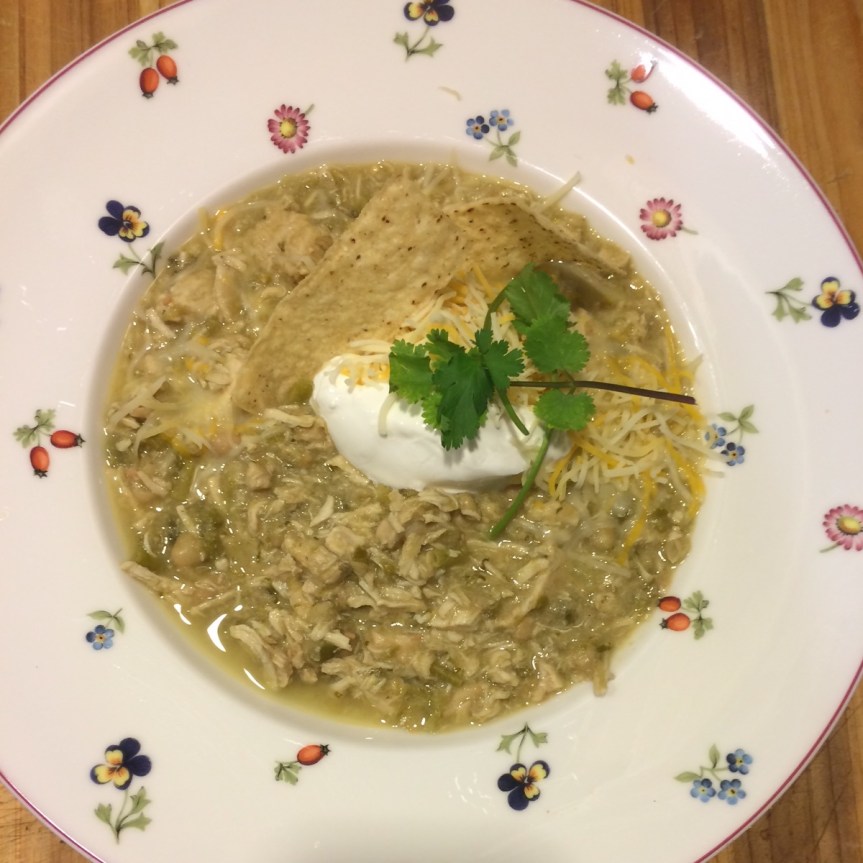
Chicken Chili II (Updated Version)

Recipes change over time.  As we spend more time in the kitchen and become better cooks, we learn new things; as we learn new things, we incorporate them into the dishes we already know how to make.  That’s ultimately how a dish becomes “ours” – when we’ve come to know it so well through years of making it that is truly our own.  In my mind, though, even when a dish has become “ours” it has never reached perfection – and even after nearly 20 years, I’m still learning new things.
This has the same ingredient list (with the addition of 3 TBSP of flour, a couple of other spices, and some celery) as my original recipe, but the ingredients are treated differently and cooked differently to maximize depth of flavor.  The primary difference is that this method involves browning the chicken breasts first along with a spice mixture whereas in the original the chicken is not browned and the spices are dumped in just prior to adding the broth and reducing liquid.
This is how I’m making my chili these days:

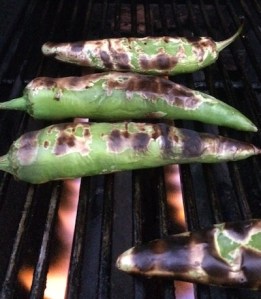
The Prep time in this dish is a bit long since there’s a lot of chopping involved; use a sharp knife to make things a bit easier.  As always, give yourself a good head start on the prep.  If you have, say, 15 extra minutes, roast your chiles (only the Hatch/Anaheim ones) ahead of time.  It will bring out their sweet smokey spicy flavor.

Time: 60 – 90 Minutes
Level: Easy
Cost: $6-8/plate
Serves: 4-6

Ingredients:

  • 3 lbs boneless, skinless chicken breasts (about 6 breasts)
  • 3 TBSP flour
  • 3 TBSP cumin powder (you read that right, it’s not a typo, I mean Tablespoons)
  • 1 TBSP paprika
  • 2 tsp cayenne pepper
  • Salt and pepper
  • 2 TBSP vegetable or canola oil
  • 2 TBSP olive oil
  • 1 large Spanish or yellow onion
  • 4 jalepeño peppers, stems and seeds removed, minced
  • 1 large green bell pepper, diced
  • 1 cup celery, diced (about 3 stalks)
  • 5-6 cloves garlic, peeled and minced
  • 4 TBSP (about half a bunch, not including stems) fresh cilantro, finely chopped
  • 4 Hatch Chile Peppers (Anaheim Chile Peppers will also work), roasted and peeled (optional), diced.  Note:  Alternatively, pre-diced, canned green chilies work fine as well – you’ll need 3, 3.5oz cans 
  • 1-2 tsp hot sauce (or to taste, optional – I use Dave’s Insanity Sauce because I like it spicy!)
  • 1  can/box (32oz) of low-sodium chicken broth
  • 2 cans (14oz each) white beans (NOT cannellini!), drained.
  • Optional: For serving – tortilla strips, corn bread, sour cream, shredded Mexican Cheese

Optional Preparation Step (not required but it makes a big difference): 

chilesRoast your Hatch/Anaheim chiles over high heat on the grill, or under a broiler set on high – I do mine on the grill over Mesquite wood.  Wait for the skins to blister and are mostly blackened (yes, don’t be afraid to burn them, that skin is coming off anyhow), then flip and repeat on the opposite sides.  Once thoroughly roasted, place them in an airtight container (Tupperware, or simply a large bowl with a plate on top)- this will steam them in their own heat.  After about 20 minutes, remove the chiles from the container and transfer to a cutting board.  Peel the skins off and remove seeds and stems; if you blackened your chiles well, the skins should come off quite easily; if not, you can try peeling them under cold running water.  Consider using rubber gloves for the peeling process if you’re using Hatch Chiles- hot pepper hands are the worst!
 

Main Preparation Instructions

  1. Dice onion, jalepeños, green bell pepper and celery; combine in a medium bowl and set aside.
  2. Mince garlic and chop cilantro – combine and reserve in a small size bowl and set aside.
  3. Dice Hatch (or Anaheim) chiles and reserve in a separate bowl (or open cans thereof).
  4. Open two cans of white beans, drain.
  5. Get chicken broth ready.
  6. In a large tossing or mixing bowl, add chicken breasts (whole).  Drizzle with olive oil and toss to coat.  Add flour, cumin, paprika, cayenne, a pinch of kosher salt and a few generous grinds of fresh black pepper.  Toss to coat again.

Cooking Instructions

In a large stock-pot (or very large skillet or saucepan), add vegetable and olive oil and heat over medium heat.  When oil is hot and shimmering, but not quite smoking,  Carefully add 2 -3 of the coated chicken breasts and brown, 3-4 minutes on each side, without overcrowding the pan – you will probably need to work in batches.  Once all the chicken breasts are nicely browned, remove them from the pan and transfer to a carving board (note I did not say cutting board).  The chicken does not need to be cooked through at this point.  You will now have a beautiful, spicy fond on the bottom of your pan.

Lower the heat and add onion, celery, green bell pepper and jalapeño peppers to the pot (make sure the pan isn’t too hot when you do this).  Sauté over medium heat, stirring to prevent burning.

Note:  If you don’t have a lot of experience gauging how hot the pan is, you can test it by dropping ONE tiny piece of the diced onion into the pan.  If it sizzles loudly, crackles, or jumps out of the pot spattering hot oil everywhere, it’s too hot.  The onion should only react slightly.  If it turns out it’s too hot, remove the pan from the heat for a minute or two until it cools down a bit.

As the vegetables sweat out their moisture, scrape up the fond in the bottom of the pan and incorporate into the mixture.

Once vegetables have sweat out most of their moisture and most of the fond is incorporated, carefully add the cilantro and garlic to the mixture.  Continue to sauté until very fragrant, 2-3 minutes.


Add Hatch/Anaheim Chiles and hot sauce, if using.  Stir well to combine and lower the heat to low, stirring occasionally to allow flavors to marry, 5-7 minutes.

Meanwhile, while flavors are marrying, dice chicken breasts into cubes on cutting board (this may be a bit messy due to liquid having been released, so use a cutting board to catch the juices).

Add chicken to pot, along with any juices accumulated on the cutting board.

Add chicken broth and beans and stir well to combine – there should be enough liquid to cover everything in the pot once it’s been stirred together.  If there isn’t, add a bit of water until everything is covered by at least 1/4 inch of liquid.

Cover, and bring to a rolling boil.

Remove cover, reduce heat to medium-low, and allow to simmer down, 1 hr and 20 minutes, or until desired consistency is achieved.  Stir occasionally to prevent anything from sticking to the bottom of the pan.  If a lot of fat begins to accumulate on the top, you may wish to skim some of it off.  (Now is a good time to crack open a beer).

Just prior to serving, turn the heat off and stir continuously for 10 minutes, or until your arms fall off.  This will make it so that the chili is cool enough to eat; it also will break down the chicken into nice ‘strings’ giving it the consistency of pulled chicken.  It also aids in the final thickening to give it that nice chili texture.

Serve with Tortilla strips, sour cream, cheese and cornbread.


Traditional Coq Au Vin

This beautiful French classic is rustic country farmhouse cooking at its best.  While many of the recipes on this blog feature quick, 1 hour prep-and-cook dishes suitable for a weeknight when the temptation is just to grab fast food on the way home from work, the recipe in this post isn’t one of them.  To the contrary, this is a step-by-step (and there are a lot of steps) method for preparing a traditional French dish that has graced many a farmhouse table in France – and in America, thanks to Julia Child – for decades.  To that end, a few words are in order here:

First, don’t skim past this recipe.  I know, I know, the temptation is to just ‘swipe left’ and move on.  I do that when I’m researching recipes online too, but please, give this a try.

That being said, do wait until you have an afternoon off to try this – and you definitely SHOULD try this.  This recipe is a great way to experiment with all kinds of techniques – how to break down a whole chicken, sautéing, braising, deglazing, reducing, flambéing, thickening a sauce.

I’ve categorized this recipe as “Advanced” because of the sheer number of steps, but actually none of them are that hard – read the instructions over a few times to get a picture of the game plan and you’ll be fine.  However, there is quite a bit of prep and a lot of different pieces that have to come together in order for this dish to turn out right, so leave yourself a bit of time.  Cooking is supposed to be a joy, not a burden – so make this when you’ve got some time and are in the right frame of mine to spend a few hours in the kitchen.

Second, while the origins of this dish come from the days when some old rooster had outlived his usefulness and therefore in order to be made edible he would need to be braised for hours on end, this recipe only requires about 90 minutes of (inactive) braising time in a 350°F oven.  The reason for this is because the young chickens we buy in the grocery store these days are already so tender that if we were to braise them for 8 hours, they’d turn into mush.

Third, because this is rustic country cooking, there are no set rules on exactly what must (or must not) go in this dish.  Julia Child’s recipe doesn’t include carrots; Paul Bocuse’s recipe does include carrots; I like carrots, so I included them.  Julia Child calls for cooking the mushrooms, aromatics and onions separately, and then mixing them all into the dish at the end as a sort of garnish.  This makes sense if you’re going to be braising your tough old rooster for 8 hours – the mushrooms and onions would never survive – but we’re not using an old rooster here so in this recipe I recommend just cooking all the stuff in the pot at the same time to achieve a better marrying of flavors.

And so on – the point here is that this post is as much of a method as it is a recipe.  Learn the method and you can make all kinds of amazing stews, using whatever you have laying around – and that, at its heart, is what rustic country cooking is all about.

Lastly, the good news here is that this dish is cheap.  If you are an efficient shopper, you can probably get everything you need here to feed 8 people (or four people twice, or yourself for a week) for about $15.00.

Let’s get cooking!

Time: 3.5 hours (90 minutes inactive)
Level: Advanced
Cost: About $2.00 per plate
Serves: 8

Ingredients

For the Stew:

  1. 2 whole chickens, roughly 3-4lbs each, broken down into 8 parts
    • This is not that hard to do – don’t get scared, go for it!  Watch this this video a couple times and you’ll be fine.
  2. Approximately 3/4 of a bottle of drinkable red wine
    • 2 buck chuck is fine – it just has to be something you’d drink.
  3. 2 -3 sprigs fresh thyme
    • If you don’t have fresh thyme, make a little pouch using a coffee filter and some cooking twine.  Tie bay leaves (ingredient #4) and 2 TBSP dried thyme up in the coffee filter – you want the flavor of these herbs in your sauce, but you don’t want them IN the sauce per se
  4. 2 bay leaves
  5. 1 small shallot, minced
  6. 12-16 oz Crimini or brown mushrooms, quartered
  7. 6 carrots, roughly julienned
  8. 3 cloves garlic, minced
  9. 4 0z bacon, sliced into lardons
  10. 2-3 TBSP olive oil
  11. 1 lb boiler or pearl onions
  12. 1 140z can low sodium chicken broth
  13. 1/3 cup brandy
  14. 4 TBSP butter, divided (one set of 3 TBSP plus 1 TBSP)
  15. 6 TBSP flour, divided (two sets of 3 TBSP each)
  16. 2 TSP paprika
  17. Salt and Pepper
  18. 1 TBSP tomato paste

For Serving:

  1. 1 package egg noodles, prepared according to package directions.
  2. Crusty, rustic loaf of French bread

Part 1:  Prep

  1. Break down chickens into 8 parts; marinate chicken parts in red wine along with two sprigs thyme and two bay leaves, refrigerated, for about 1 hour (probably about how much time it will take you to complete steps 2-5 here in the Prep section and steps 1-5 in the following Cook section).
  2. Prepare veggies: Mince shallot, quarter mushrooms, julienne carrots, mince garlic
  3. Slice bacon into lardons
  4. Pearl Onions: Remove root end and slice a small X into the cut end (the same end you just removed) – this will help keep them in one piece
  5. Locate and prep: Chicken stock; brandy; pearl onions, butter
  6. In a small bowl, mix 3 TBSP butter and 3 TBSP flour into a fine paste and set aside.

Part 2:  Cook

  1. Preheat oven to 350°
  2. In a 2 quart sauce pan, bring 1 quart water to a rolling boil. Add the onions and boil for two minutes. Remove with a slotted spoon and rinse in a colander under cold water. When they are cool enough to handle, peel them by squeezing the intact end – the soft onions should slide right out of their skins.  Set aside.
  3. Blanch your bacon lardons in the boiling water – you want to remove the smoky flavor from the bacon or it will overpower the gentle flavor of the chicken (I skip this step when making beef stew, which is heartier and less delicate).  So, add your bacon lardons to the boiling water and while you are peeling the onions, allow bacon to boil for 10 minutes. Remove with a slotted spoon, pat dry, and transfer to a large heavy bottomed sauté pan.
  4. Remove chicken from wine and pat dry with paper towels.  Reserve wine and herbs – do not discard.   In a large tossing bowl, season chicken with salt, pepper, paprika, 3 TBSP flour; toss to coat and set aside.
  5. Sauté bacon in sauté pan; once fairly browned and most fat has rendered, remove with a slotted spoon and transfer to a large, oven-safe Dutch oven, leaving bacon fat in sauté pan.  You should have about 1/8 inch deep fat in the pan; if not, add vegetable oil or clarified butter to get fat to 1/8 inch depth.
  6. In the same sauté pan, brown chicken on all sides (start skin-side down) in bacon fat, working in batches, about 5 minutes per side, and transferring to Dutch oven once browned.
  7. Fish thyme and bay leaves out of reserved wine and set aside.
  8. Deglaze the pan: Lower heat and slowly add reserved wine to pan. Add 14oz can chicken stock as well.  Bring liquid to a boil and scrape up any remaining fond (the brown bits on the bottom of the pan).
  9. Stir in 1 TBSP tomato paste and stir to incorporate, 3 minutes
  10. Dump liquid from pan into Dutch oven with chicken and bacon. Wipe pan dry.
  11. Add 2-3 TBSP olive oil to the pan and heat over medium heat
  12. Add carrots and onions and sauté, stirring occasionally until browned around the edges, about 10 minutes, then lower the heat.
  13. Add shallots and sauté until translucent, 3-5 more minutes, being careful not to brown.
  14. Add garlic and sauté until fragrant, 2 more minutes, being careful not to brown.
  15. Transfer carrots, onions, shallots and garlic from pan to dutch oven with chicken, bacon and wine.
  16. Add mushrooms and 2 TBSP butter and sauté until browned and the mushrooms have absorbed most of the liquid in the pan (the pan should look fairly dry), 2 -3 minutes.
  17. Add 1/3 cup brandy and flambé
  18. Transfer mushrooms and any liquid in the pan to the Dutch oven with chicken, bacon and wine.
  19. Give everything a good shake to settle.
  20. Add reserved thyme and bay leaves.
  21. Mostly cover (IMPORTANT:  Leave lid slightly askew with about a 1/4-1/8 inch gap on one side to allow steam to escape, which will prevent liquid from boiling over in oven), and cook in 350°F oven for 90 minutes.
  22. Intermission:  While the chicken braises, treat yourself to a glass of wine (possibly that last 1/4 bottle?) or a beer, and possibly some nuts or a nice hunk of brie – if you made it this far, you’ve earned it!
  23. After 90 minutes, carefully remove from oven. Remove lid and fish out thyme and bay leaves; discard.
  24. Using the lid as a strainer (so, slightly askew with about a ¼ inch gap), pour liquid in pan through a wire mesh into a saucepan. Return any little pieces caught in the strainer to the Dutch oven. Leave covered at room temperature.
  25. Bring braising liquid in the saucepan to a boil; reduce to a simmer, skim off any fat that accumulates at the top (alternatively, use a fat separator in step #24).
  26. Stir in butter/flour mixture (from step 6 in the prep section, remember that?) to thicken, 10 minutes. Taste for seasoning and make sure raw flour taste is gone.
  27. Add thickened sauce back to Dutch oven. Allow to sit at a bare simmer while preparing noodles and bread

To Finish:

Serve stew over egg noodles with a generous ladle full of sauce and bread on the side.  Serve with a robust red wine.


Truffle Infused Steak Tartine, Brandy Mushroom Cream Sauce, Homemade Onion Rings

This is not as hard as it looks.  Seriously: it sounds impressive; it tastes professional; it is guaranteed to wow anyone who eats it (even if that person is just you).  There are quite a few steps here, so read carefully, but you’ll be surprised how easy this is.
Let’s dive in.

Time: 90 minutes – 2 hours
Level: Intermediate
Cost: About $7.50 per plate
Serves: 4

Ingredients

For the Onion Rings

  1. 1.5 cups all purpose flour
  2. 1 12oz can beer
  3. 1/2 TSP baking powder
  4. 1 egg
  5. 2 cups vegetable or canola oil
  6. 2 large onions, cut into rings

For the steaks and mushroom-cream sauce:

  1.  4 boneless New York Strip Loin Steaks
  2. Salt & Pepper
  3. 2-3 TBSP clarified butter (also known as ghee, recommended), canola oil, avocado oil, or bacon fat – hell whatever you want as long as it has a smoke point of over 400°F
  4. 1 medium shallot, diced
  5. 3 cloves garlic, minced
  6. 80z whole mushrooms, quartered
  7. 1 TBSP unsalted butter
  8. 1/3 cup brandy, for flambé
  9. 1 140z can beef broth
  10. 1/4 cup heavy whipping cream

For the Toast:

  1. 1/4 cup good olive oil
  2. 1 TSP Truffle Oil (optional, but worth it if you have it.  Truffle oil is available from Amazon, Sprouts and Whole Foods for not too much and since a little bit goes a LONG way it’ll last you)
  3. 8 thick (1/4 – 1/2 inch thick) slices sourdough bread

Instructions

Preheat an oven to 275°F.

Place steaks on a wire rack over a lined baking sheet.  Rub steaks on both sides with a drizzle of olive oil.  Season both sides aggressively with kosher salt and freshly ground black pepper.  Tent loosely with foil to prevent excessive browning and place them in the oven.  Bake in oven until internal temperature is about 115°F.  This will take about 20-30 minutes, but remember:  Cook with temperature not time.  Use an instant read thermometer to verify temperature.

While steaks are coming up to temp in the oven, do three things:

  1. Prep Onion Rings:  Mix ingredients 1-4 in a medium bowl and whisk thoroughly to create a batter.  Slice onions into rings and add to batter.  Stir to incorporate.  Cover and set aside to let rest at room temperature.
  2. Prep Ingredients for Brandy Cream Sauce:  Dice shallots, mince garlic, and quarter mushrooms.  Get brandy, beef broth and cream ready to go.
  3. Prep Toast:  Slice sourdough bread into thick slices.  Add 1 TSP truffle oil to 1/4 cup olive oil and stir gently to combine, set aside and allow flavors to meld.

Once the steaks have reached an internal temperature of 115°F, remove them from the oven and pat dry with paper towels and allow to rest.

Increase oven temperature to 500°F for toast.

While steaks are resting and oven is coming up to temp, heat fat (ghee, clarified butter, avocado oil etc) over medium-high heat in a large sauté pan until almost smoking (about 400°F).  Once fat is up to temperature, carefully place steaks in the pan and sear until dark golden brown, about 3 minutes per side.  You should develop a beautiful fond on the bottom of the pan.  Don’t overcrowd the pan – two steaks at a time is probably good.  Once steaks are seared, remove them and set them back on the wire rack to rest, covered loosely with aluminum foil.  Reduce heat to medium-low.

Carefully add shallots and sauté until mostly translucent, 3-4 minutes.

Note:  Don’t burn the shallots.  If you’re not sure if the pan is too hot, test for temp by tossing 1 little shallot piece into the fat.  If it sizzles and crackles loudly or burns, turn down the heat. 

As the shallots sweat out their moisture, scrape up any fond left behind by the steaks to incorporate.  Once shallots are translucent, add garlic and sauté until fragrant, 1 -2 minutes longer.

Add mushrooms and continue to sauté until mushrooms have absorbed most of the liquid in the pan and the bottom of the pan begins to look a bit dry, 1-2 minutes.  Add 1 TBSP butter to mixture and continue to cook, continually scraping and stirring so as not to burn your fond, until the butter is absorbed into the mushrooms.

Note:  Mushrooms are flavor sponges.  Give them time to absorb the deliciousness in the pan.

Once the mushrooms have absorbed most of the liquid and butter in the pan, and the bottom of the pan is starting to look a bit dry once more, crank the heat up to high for about 20 seconds.  Lower the heat, add the brandy, and flambé.  Once the flames have subsided, add the beef stock and bring to a boil, scraping up whatever brown bits might be left at the bottom of the pan to fully incorporate fond.  Add the heavy cream, reduce heat to medium-low, and allow to simmer until sauce has thickened to a gravy-like consistency.  Stir or shake occasionally to prevent burning.

For the Onion Rings

While sauce is reducing, heat olive oil for onion rings in a large saucepan until it reaches a temperature of about 375°F.

Note:  If cream sauce ends up finishing while onion rings are still being made, don’t worry.  Just off the heat and cover, then continue as follows; it will keep warm long enough for you to finish the other steps. 

Once oil is up to temp, use tongs to remove onion rings from batter one at a time, shaking off the excess.  Fry in oil a few at a time, until golden brown, 3-5 minutes per batch.  Using a slotted spoon, remove and allow to drain on paper towels.

For the Toast:

Brush sourdough slices lightly on both sides with oil mixture.  Place on an ungreased baking sheet and bake in 500°F oven for five minutes or until beautifully golden brown.

Final Assembly:

While toast is browning in oven do two things:

  1. Strain the mushroom cream sauce into a bowl through a fine mesh strainer to separate the mushrooms from the liquid.  Reserve mushrooms.
  2. Slice steaks into thin-ish strips on the bias.

When toast is finished, remove from the oven and plate – two slices per plate to make four plates.

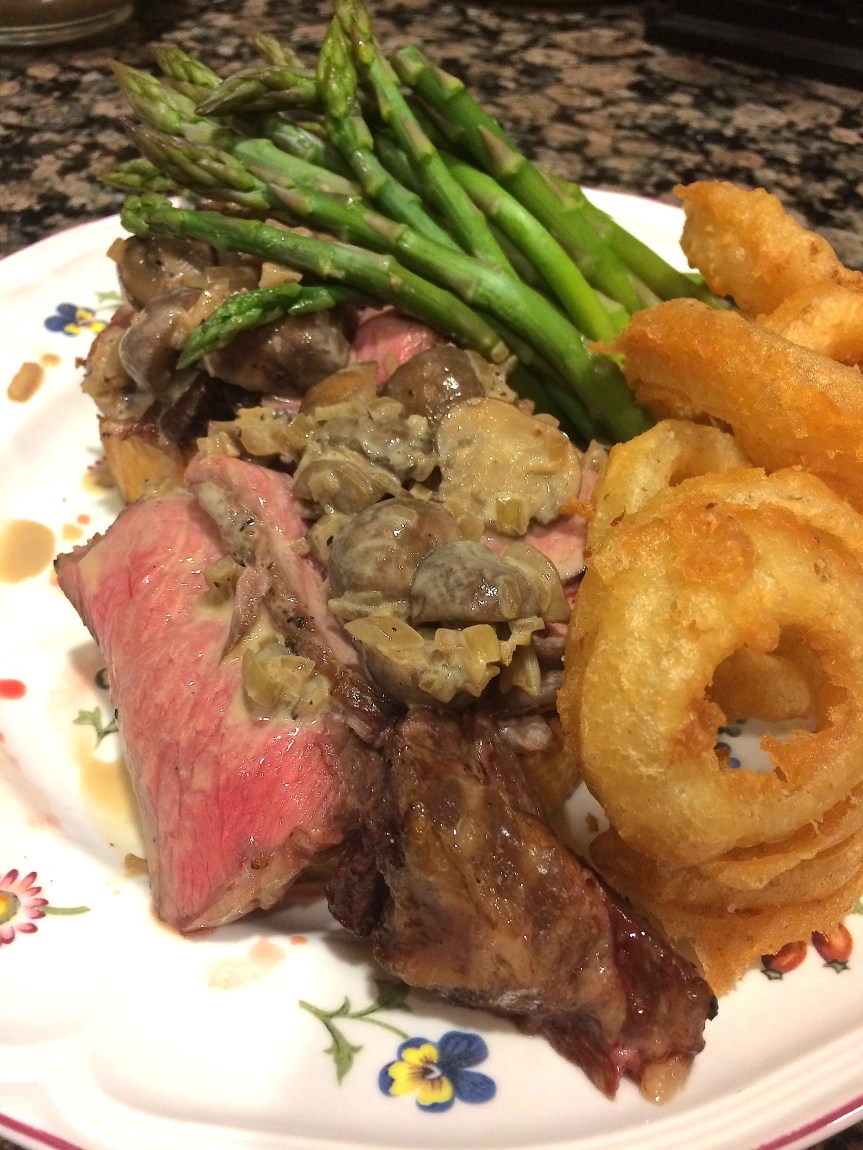
Place 4-6 strips of steak on top of each piece of toast, followed by reserved mushrooms, followed by a generous drizzle of brandy cream sauce (Don’t be shy!).  Fan additional slices of steak around toast to look cool, if you like, totaling about 1 steak per person.

Serve with onion rings, steamed asparagus (or any other green vegetable) and a robust red wine.