
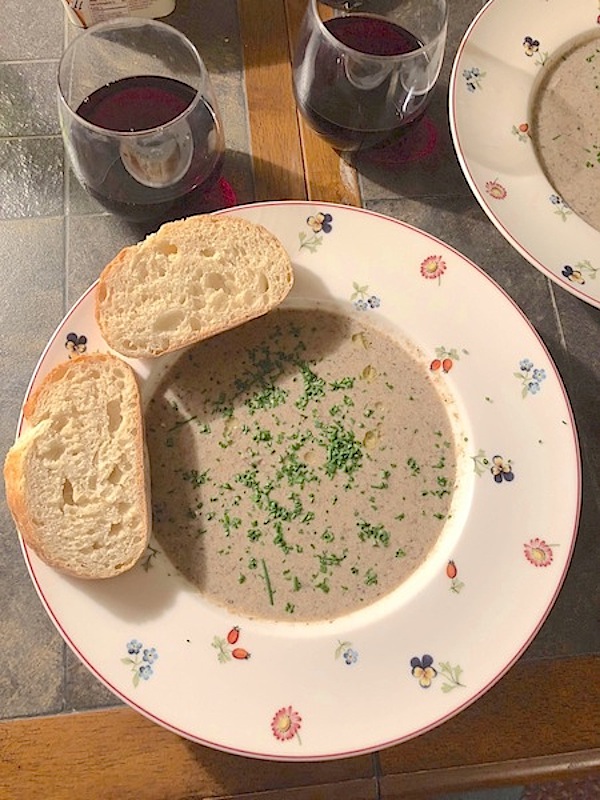
Vegan Mushroom Bisque

Photo Credit: Lucas Scott Wright

I’ve been trying to make one vegan/vegetarian dish each week to cut down a bit on my meat consumption.  The secret ingredient to this dish is homemade cashew cream which, in the finished product, you wouldn’t know isn’t dairy.  You could make this recipe using heavy cream rather than the cashew cream for a vegetarian version, but I highly recommend using the cashew cream because its light nuttiness truly compliments the gentle earthy flavor of the mushrooms.

Time:  1 hour
Difficulty:  Easy/Intermediate
Cost:  $5.00/plate
Serves: 4

Ingredients:

  1.  Vegetable oil, for frying mushrooms, approximately 3-4 tablespoons
  2. 3/4 lb crimini mushrooms, chopped
  3. 1/2 lb shiitake mushrooms, chopped, stems discarded
  4. Salt and pepper
  5. 4 small shallots, finely minced
  6. 3 cloves garlic, finely minced
  7. 1/2 cup sherry wine, plus 1/2 teaspoon
  8. 4 cups vegetable broth (32oz box)
  9. Chopped chives (for garnish)
  10. 1/4 cup brandy
  11. White truffle oil or olive oil (for garnish)
  12. 8oz can raw cashews (i.e., unsalted and not roasted)
  13. Approximately 1 cup cold water

Instructions:

Note:  The reason we’re doing the mushrooms in batches here is because each batch serves a different purpose.  The first batch (step 2) will create and nice mushroom fond in which to sauté our aromatics (the shallot and garlic). The second batch (step 5) will absorb the flavor of the aromatics.  The third batch (step 8) will add a chunky texture and earthy flavor to the bisque.

  1. Begin by making the cashew cream.  Dump the entire 8oz can of cashews into a blender and pulse a few times to finely chop.  Add half the water and pulse a few more times.  With the motor running, add the rest of the water and blend until a thick, smooth cream begins to form.  This took about 5 minutes with my Ninja blender.  You will need to stop a few times to scrape down the sides of the blender with a spatula.  Add a bit of water, a couple of tablespoons at a time, if creamy texture isn’t achieved after 5-7 minutes of blending.  It should have the texture and consistency of créme fraîche .  Once cream is finished, set aside in a bowl and cover; allow to rest at room temperature.
  2. Chop all mushrooms and combine into a large bowl.
  3. Heat 2 tablespoons vegetable oil over medium-high heat in a sauté pan or large frying pan.  Once pan is quite hot, add 1/3 of the mushrooms.  Sauté until most of their water is given up and they release a slightly nutty aroma, approximately 5 minutes.  Remove with a slotted spoon and transfer to an appropriate pot for making soup (a small stock pot or large 4-6 quart sauce pan would be appropriate).
  4. Add shallots and sauté until translucent, 5-7 minutes.  Add a bit of vegetable oil and lower the heat if they start to brown.
  5. Add garlic and sauté with shallots until very fragrant, 1-2 more minutes
  6. Add second third of mushrooms and sauté with shallots and garlic until pan is looking somewhat dry, 3 -4 minutes
  7. Add sherry wine to deglaze the pan.  Flambé if you like.  Bring to a boil and allow any remaining raw alcohol to cook off, 3 minutes.  The aroma will change from pungent and sharp to gentle and sweet.  Transfer contents of pan to pot with first batch of mushrooms.
  8. Add vegetable stock to pot and bring to a boil.
  9. Add the last 1/3 of mushrooms to the sauté pan along with a little oil if there isn’t enough oil left in the pan.  Sauté for 2 minutes over high heat.  Add 1/4 cup brandy and Flambé.  Reduce until liquid in the pan is evaporated and off the heat.
  10.  Off the heat on the pot and using an immersion blender, pureé the contents until very smooth.  Return to a simmer and stir in cashew cream, a few spoonfuls at a time, until desired color and texture is achieved.  Season to taste with salt and pepper (Note:  You’re probably going to need a lot of salt since none of the ingredients have any natural saltiness to them).
  11. Once seasoned to taste, stir in flambéed mushrooms.  Bring to a simmer and then off the heat
  12. Stir in 1/2 teaspoon raw sherry wine to brighten the sauce and add acidity
  13. Serve with a garnish of chives and truffle or olive oil.

Jalapeño Cheddar Soup

Ah, fall.  Labor Day festivities over, it’s finally time to embrace the fact that summer has finally drawn to a close.  Now is the time to embrace leaves turning color, a crispness to the air, a change in the light.  Fall is a time for flannel shirts, cooler days – and of course soup.
Of course here in SoCal that’s all mostly a fantasy; it’ll be triple digits – or at least mid-90s – most days here through at least Halloween, if not Thanksgiving.

But that isn’t going to stop me from making soup.

Several years ago, I had the opportunity to spend quite a bit of time in a town called Big Bear up in the mountains of the San Bernardino National Forest, where autumn came early up at elevation and you could almost forget that you were only a couple hours away from the screaming urban sprawl that is Los Angeles.  My wife and I frequented a restaurant up there called Madlon’s (now closed) which was run by a couple of Cordon Bleu trained chefs.  Their food was amazing.  One of the best things on the menu was their Jalapeño Cheddar Soup.  The chef-owners of the restaurant, Rob and Chelsea, became friends and they were generous enough to share their recipe with me.

The recipe that they gave me was designed to make about 5 gallons of the stuff, so I’ve adapted it here for the home kitchen.  I share it here with their permission and with gratitude for their generosity.

Time:  90 minutes
Cost:  About $15 (for the whole pot)
Difficulty:  Easy

Ingredients:

  1.  2 tablespoons bacon fat, clarified butter, or regular unsalted butter
  2.  2 tablespoons olive oil
  3. 1 medium yellow onion, finely diced
  4. 3 ribs celery, diced
  5. 3 jalapeño peppers, minced, seeds and ribs removed
  6.  2 cloves garlic, minced
  7.  2 8oz cans tomato sauce
  8.  1.5 cups dry white wine
  9.  16oz grated cheddar cheese
  10.  2 tablespoons cornstarch + 2 tablespoons cold water
  11.  Approximately 1 pint heavy cream (to taste preference)
  12. 1 teaspoon white-wine vinegar or sherry vinegar

Instructions

  1.  In a heavy-bottomed sauté pan or large skillet, melt fat and oil over medium high heat.  Add onion, celery and jalapeños and sweat until onions are translucent and celery and jalapeños are soft, 3-5 minutes.  Add garlic and continue to cook, stirring constantly, until very fragrant, 1-2 minutes more.
  2.  Add white wine and deglaze the pan
  3.  Add tomato sauce and bring to a boil, then reduce to a simmer.  Cover (or mostly cover) and allow soup to simmer 30 minutes until vegetables are very tender and flavors have developed.
  4.  Using an immersion blender, purée the contents of the pot until very smooth
    1.   NOTE:  Make sure the head of the immersion blender is fully submerged before turning it on, unless you like hot soup explosions.
    2.   NOTE:  You can purée the soup in batches in a regular blender, but be careful.  Make sure that (1) you don’t fill the blender more than half way and (2) make sure that you leave adequate venting at the top of the blender.  If you don’t the steam will create a pressure monster and hot soup will be all over your kitchen in a hurry.  Most blenders have a removable stopper in the lid.  I recommend removing this and covering the hole with a kitchen towel.
  5. Once the soup is puréed, transfer soup to a small stock-pot or large saucepan.  Bring to a simmer and stir in cheese.  Allow cheese to fully melt, stirring occasionally.
  6.  Stir in heavy cream, a little at a time, until desired texture and color is achieved.  Return to a simmer.
  7. If the soup still isn’t thick enough (which it probably won’t be), add a slurry consisting of 2 tablespoons cornstarch and 2 tablespoons cold water.  Add and stir to thicken.
  8. Remove soup from heat and stir in vinegar.
  9. Serve with grilled cheese, crusty bread, or enjoy on its own.


Steak Fajitas

Steak soaked in a zesty citrus marinade and then grilled to perfection; serve with pico de gallo, homemade gaucamole, sour cream, roasted peppers and onions and Mexican cheese.  Easy, cheap and delicious.

Ingredients:

For the Steak

  1. 2.5lb London Broil or Tri-Tip Roast
  2. 1/2 cup orange juice
  3. 1/2 cup lime juice (approximately 6 limes)
  4. Zest of 1 lime
  5. 3-4 cloves garlic, minced
  6. 2 tsp chile powder
  7. 1/2 tsp cayenne pepper
  8. 1 TBSP kosher salt
  9. 1 TBSP coarsely ground black pepper.
  10. 1 cup mesquite wood chips (optional)

For the Pico de Gallo

  1. 1 Large yellow onion, finely diced
  2. 2-3 Roma tomatoes, finely diced
  3. Large pinch Kosher salt
  4. 2 jalapeño peppers, minced
  5. juice of one lime
  6. 2-3 TBSP cilantro, finely chopped

For the Guacamole

  1. 3-4 large, ripe Haas avocados (or 6-7 little organic ones)
  2. 1 jalapeño pepper, minced
  3. 1 3.5oz can hatch green chiles (optional)
  4. 4 TBSP pico de gallo (above)

For the Fajita Mix (peppers and onions)

  1. 2 TBSP olive oil
  2. 3-4 cloves garlic, minced
  3. 1 each: Red bell pepper, green bell pepper, yellow bell pepper
  4. 1 large yellow onion, halved and sliced into half-rings

For Serving

  1. Medium size yellow corn tortillas, 3-4 per person
  2. Freshly grated Cotijá cheese
  3. Shredded Mexican Cheese
  4. Sour Cream

Prep:

For the Steak

  1.  Whisk ingredients 2-9 together in a medium size mixing bowl.
  2. Transfer steak to large 1-2 gallon ziplock bag.  Add marinade to bag with steak and massage to incorporate well.  Refrigerate for 2-4 hours, or up to 8 hours.  Flip bag over half way through marinating process if possible.

For the Pico de Gallo

  1. Dice tomatoes first.  Add to colander and sprinkle with Kosher salt.  Toss gently to season and allow to sit in the sink 20 minutes.  Tomatoes will give up much of their moisture making your pico less watery.
  2. Prepare onions, jalapeños, lime and cilantro.  Stir to combine.
  3. Add tomatoes to mixture and stir to combine again.  Cover and refrigerate until ready to serve.

For the Guacamole

  1.  Halve avocados and remove pits.  Spoon avocado out of shells into a medium to large mixing bowl.
  2. Add ingredients 2-4 and mash well using a potato masher.  (Note:  Guacomole is best served right away.  If left in contact with air too long it will oxidize and turn brown.  If preparing a couple hours in advance, smooth guacomole in bowl, drizzle with lime juice, and cover with plastic wrap with the plastic wrap in full contact with the guacamole).

For the Fajita Mix (peppers and onions)

  1. Prepare all ingredients as directed
  2. Add to a 10-12 inch cast iron skillet and stir (or toss if you’re strong enough; cast iron is heavy) to combine.

Cook

  1. Light 1 or 2 burners if using gas; if using charcoal light 1 chimney starter full of lump charcoal and set grill up for 2-zone cooking.  Make sure the grill is good and hot.  Just prior to grilling steak, add 1 cup mesquite wood chips, if using.  Click HERE for more information on grilling and smoking.
  2. Remove steak from marinade and pat dry.  Discard leftover marinade.
  3. Place steak down on hot side of grill and sear, approximately 5 minutes per side, until nicely browned.  Transfer to cool side of grill.
  4. Add cast iron skillet to hot side of grill and close the lid.  Sauté fajita mixture in cast iron until nicely caramelized and soft, 15 – 20 minutes.  Stir occasionally.  Steak and vegetables should finish at roughly the same time, but if they don’t just remove the one that is done and tent with aluminum foil.
  5. Once steak and Fajita mixture are done, remove and allow to rest for a few minutes
  6. Warm tortillas on a griddle or in a frying pan.  Sprinkle with cotijá cheese and continue to toast until cheese is melted.
  7. Slice steak thinly across the grain on the bias using a sharp knife

Serve

Plate Steak, Pico de Gallo, Guacamole, Fajita mixture, shredded Mexican cheese and sour cream together.  Have eaters assemble fajitas at table as desired.


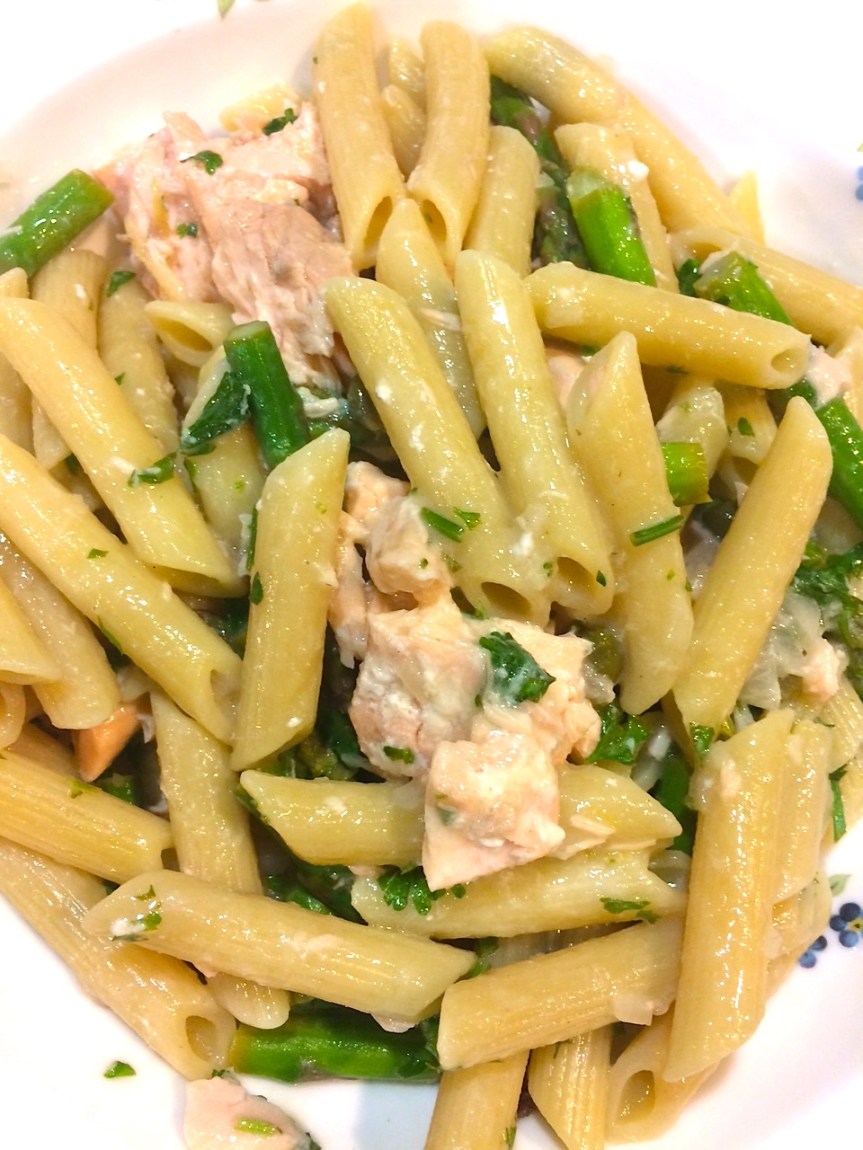
Salmon Poached in White Wine with Penne and Asparagus

This delicious seafood pasta dish comes together in about 45 minutes, is simple to make and relatively inexpensive.  Its clean, bright flavor profile yields a result greater than the sum of its parts and it is therefore both perfect for a weeknight dinner and elegant enough for a romantic dinner for two.

Time: 45 minutes
Level: Easy
Cost: Approximately $4/plate
Serves: 4

Ingredients

  1. 1 large salmon filet, approximately 1lb, cut into four pieces and skin removed
  2. 2 TBSP Kosher salt
  3. 2 cloves garlic, minced
  4. 1 small shallot, minced
  5. 1 TBSP unsalted butter
  6. 1 TBSP olive oil
  7. zest of 1 lemon
  8. 1 TBSP capers (optional)
  9. 1lb asparagus, cut into 1 inch pieces
  10. 1/3 bottle cheap but drinkable dry white wine
  11. 1 box (1lb) penne pasta, cooked according to package directions
  12. Handful (approximate 1/3 – 1/2 cup) fresh parsley, finely chopped
  13. juice of two lemons
  14. grated parmesan cheese (optional, for serving)

Instructions

  1. Begin by heating water for pasta and blanching asparagus.  Make sure it is at a rolling boil and then add a good 2 TBSP of Kosher salt.  Blanching the asparagus will turn the water green, but also impart a vegetal favor to your pasta which is subtle and quite nice.
  2. Heat butter and olive oil in a large sauté pan until melted over medium low heat.  While butter is still foamy, lower the heat to low and add the shallots, garlic and lemon zest.  Cook until fragrant and shallots are soft, 2-3 minutes.  If the garlic starts to brown, you’ll have to start over, so go slowly and use very low heat.
  3. When aromatics (shallot, garlic, lemon zest) are just barely sizzling, add white wine and capers, if using.  Bring to a boil and then reduce heat to a simmer.  Add the salmon filets to the liquid, cover the pan, and allow to sit at a bare simmer for 15-20 minutes, or until salmon reaches an internal temperature of 130°F.  If you are using a very good pan with excellent heat retention, you may be able to off the heat entirely and allow the salmon to poach in the residual heat.  Bottom line:  The lower and slower the better.
  4. While salmon is poaching prepare asparagus and pasta.
    1. Add asparagus to boiling water, return to a boil, and cook 3-4 minutes.  Remove with a slotted spoon and rise immediately under cold running water (or shock them in an ice bath) to stop the cooking process.  Set aside.
    2. Cook pasta according to package directions.  If salmon is still not done once pasta is finished, drain in a colander and set aside.  Be sure to reserve 1/2 cup of pasta water.
  5. Once salmon is up to temp, carefully remove to a cutting board and allow to rest.  Be careful, it will be very tender and flakey and you don’t want it to fall apart just yet.
  6. Add penne and asparagus to sauté pan and toss in the sauce until well combined.  Add a couple tablespoons of pasta water to thicken the sauce if neccessary.
  7. Slice salmon filets into small, bite-sized pieces and add to the pan with the sauce, asparagus and penne.
  8. Squeeze the juice of two lemons into the pan and add a handful of chopped parsley.  Use salad tongs to gently toss until combined and serve.  Pass parmesan at the table.