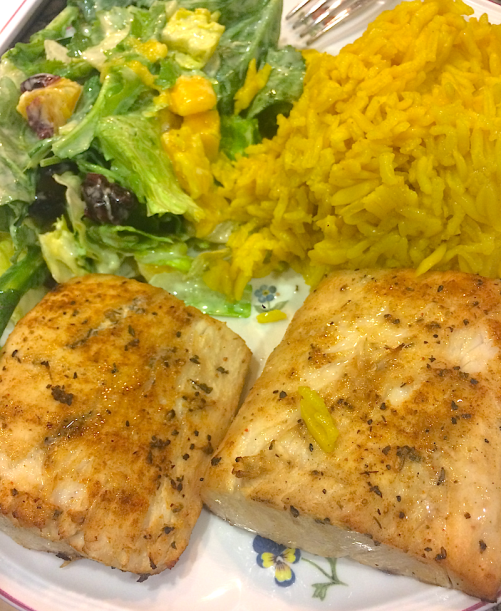
Grilled Mahi Mahi with Rice Pilaf and Summer Greens

Other than salmon, Mahi Mahi is my favorite fish to cook with.  It is firm, but not too firm, flaky, but not too flaky.  Meaty like swordfish but tender like cod.  Really, it’s the perfect fish.  Perhaps most important, it is currently not over-fished and is therefore a sustainable option.  It works well pan fried, crusted – however you want it; it work’s so well it really deserves a blog post all of its own.  But this post is on grilling – in and out in 30 minutes or less, the perfect dinner for a summer evening.  The main point of this post?  This is a hard one to screw up, so exercise those creative genes and do what makes you happy.

Ingredients

For the Pilaf

  1. 2 cups white rice
  2. 1/2 cup orzo (it’s pasta, technically, but it looks like rice – you’ll find it with pasta in the grocery store)
  3. 1-2 tablespoons butter or oil
  4. 1 small shallot, minced
  5. 2 cloves garlic, minced
  6. 1 tsp turmeric (or whatever other combination of herbs and spices make you happy).
  7. 2 teaspoons Kosher salt
  8. 5 cups liquid (water, chicken stock, whatever)

For the Summer Greens

I like a mixture of whatever mixed greens look good at the store – baby spinach, arugala, kale… whatever works.  To these I would add something on the order of 1/4 cup of dried cranberries, 1/4 cup chopped walnuts, perhaps some sliced oranges and this chili-lime and mango dressing – whatever makes you happy.

For the Mahi Mahi

  1. Mahi Mahi steaks (figure on 1-2 per person, depending on their appetites)
  2. 1 tablespoon olive oil
  3. You favorite fish seasoning (the poultry rub found in this post works surprisingly well on a lot of things, including fish.  Or you could use your favorite cajun seasoning for a blackened version.  Point is – do whatever makes you happy.  You’re getting this gist of this post now =D).

Method

For the Pilaf

  1. Heat oil and butter in whatever saucepan you’re going to use to make the rice.  Once butter is melted but still foamy, add shallots.
  2. Add garlic and sauté, 30 seconds
  3. Add orzo and, stirring constantly, toast until aroma is lightly nutty, 30 seconds to 1 minute
  4. Add liquid
  5. Add salt
  6. Add Turmeric, or whatever other herbs you’re using
  7. Add rice, cover and bring to a boil.
  8. Reduce to a simmer and simmer, covered, until all the liquid is absorbed, approximately 25 minutes

For the Summer Greens

Mix all dry ingredients together.  Dress salad right before serving.

For the Mahi Mahi

  1. Preheat grill to high heat.  Make sure the grill grates are clean.  Fish is notorious for sticking to the grill.
  2. Lightly brush mahi mahi steaks on both sides with olive oil
  3. Season steaks with seasoning of choice on both sides
  4. Lay steaks on hot grill, presentation side down, and grill for 3-5 minutes.  Using a metal spatula (use a fish spatula if you have one), turn the steaks over and grill for another 2-3 minutes, or until internal temperature reads 140°F.  Do not overcook.
  5. Remove from grill and place on platter; tent loosely with foil and allow to rest, not more than 5 minutes.
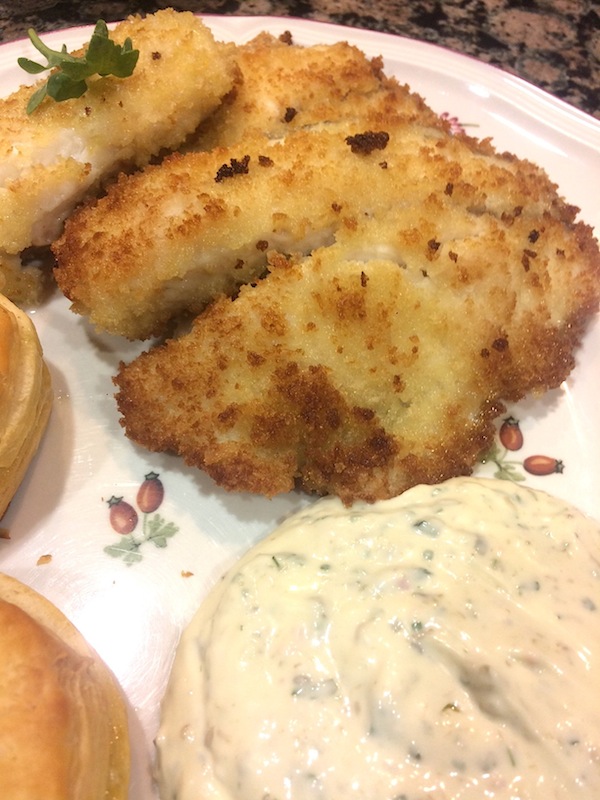
Panko Fried Fish Fillets with Homemade Tartar Sauce

Once fried golden brown, pop the fillets in the oven to cook them through.  This is a healthier alternative to deep fried battered fish and the results are fabulous.
Active Time:  15-20 minutes
Inactive Time:  15-20 minutes
Level: Easy
Serves: 4-6

Ingredients

For the Fish Fillets

  1.  6-8 firm white fillets (cod, tilapia or swai are all good choices), fresh or thawed from frozen
  2. 1/4 cup flour
  3. 1/4 cup cornstarch
  4. 1 TBSP Paprika
  5. Salt and Pepper
  6. 2 eggs
  7. 1 TBSP vodka (optional, adds crunch!)
  8. 2 TBSP cream or milk
  9. 1 cup Panko bread crumbs
  10. 1 TBSP butter (or clarified butter, which you can buy at Trader Joe’s, also called ‘ghee’)
  11. 2 TBSP regular butter
  12. 1-2 TBSP olive oil

For the Tartar Sauce*:

  1. 1 cup mayonnaise (or 1 egg, 3/4 cup vegetable or canola oil, and 2 TBSP olive oil, for Method 2, below)
  2. 2 TBSP sour cream
  3. 1/3 cup minced dill pickles
  4. 3 tablespoons minced shallots
  5. 2 tablespoons drained capers, minced
  6. 2 tablespoons finely chopped cilantro
  7. 1 tablespoon freshly squeezed juice from 1 lemon
  8. 1 1/2 teaspoons Dijon mustard
  9. 3/4 teaspoon freshly ground black pepper
  10. 1/2 teaspoon Kosher salt
  11. 1/4 teaspoon hot sauce

Instructions

For the Fish Fillets:

Preheat oven to 300°F

Set up your dredging station.  You’ll need two, wide shallow dishes and one medium sized bowl.

  • Put the flour and cornstarch in one of the wide, shallow dishes.  Season aggressively with salt and pepper; add paprika and whisk together.
  • In the second wide, shallow dish add Panko bread crumbs.  Crush lightly with the back of a wooden spoon.
  • Crack two eggs into the medium sized bowl; add vodka (if using) and cream/milk.  Whisk together until slightly foamy.
  • Set them up in this order:  Flour mixture, egg wash, bread crumb mixture

Heat olive oil and 1 TBSP clarified butter (or ghee) in a large skillet or sauté pan over medium heat and gently stir to coat the bottom of the pan.  Dredge a fillet first in the flour mixture (shaking of excess), then dip into the egg wash, and then dredge in the breadcrumb mixture, pressing firmly to adhere to each side.

Note:  If you want exceptionally crispy breading that is almost guaranteed not to fall off your fillets, do this:  Dredge in this order – Egg Wash, Flour, Egg wash, Panko Mixture.  Once breaded, place them on a baking sheet and refrigerate them for 30 minutes before continuing to the next step.

Add 2-3 fillets to skillet and fry 3-4 minutes on each side until golden brown.  Repeat with remaining fillets.

Note:  You  can fry more than one at a time, but you’ll probably need to work in batches – every time a fillet is added to the skillet, it will reduce the over-all temperature, which will hinder browning and increase the possibility of soaking the breading in oil rather than frying it.  I’ve found that 3-4 fillets at a time is a good number, depending on their size.  You may also need to add more fat to the pan between batches; this is also okay.  If you do, try to keep the olive oil-to-butter ratio at roughly 1:1.

When all the fillets are browned, place them on a wire rack set on a baking sheet, (or alternatively place them directly on a lightly greased baking sheet, although be warned: skipping the wire rack will make them mushy on the bottom, so seriously, use the wire rack!) and bake them in the preheated oven for about 10 minutes minutes until cooked through, with an internal temperature of at least 145F.

For the Tartar Sauce:

Method 1:  Combine all ingredients and refrigerate for at least 30 minutes.  Will keep for two days in the fridge.

Method 2:  Add all ingredients to the bottom of a jar or cup EXCEPT the oils.  Float the vegetable or canola oil on top of the ingredients.  Using an immersion blender, place the head of the blender all the way at the bottom of the container.  Pulse a few times to begin, then turn the blender on.  Allow a vortex to form to emulsify the sauce.  Once all the oil has been incorporated, stir in the 2 TBSP olive oil.  Refrigerate for 30 minutes; will keep for two days in the fridge.


*Tartar Sauce Recipe courtesy of Serious Eats.  I subbed out their parsley for cilantro and added the olive oil in method 2, but it’s basically their recipe.  Check out that post HERE.


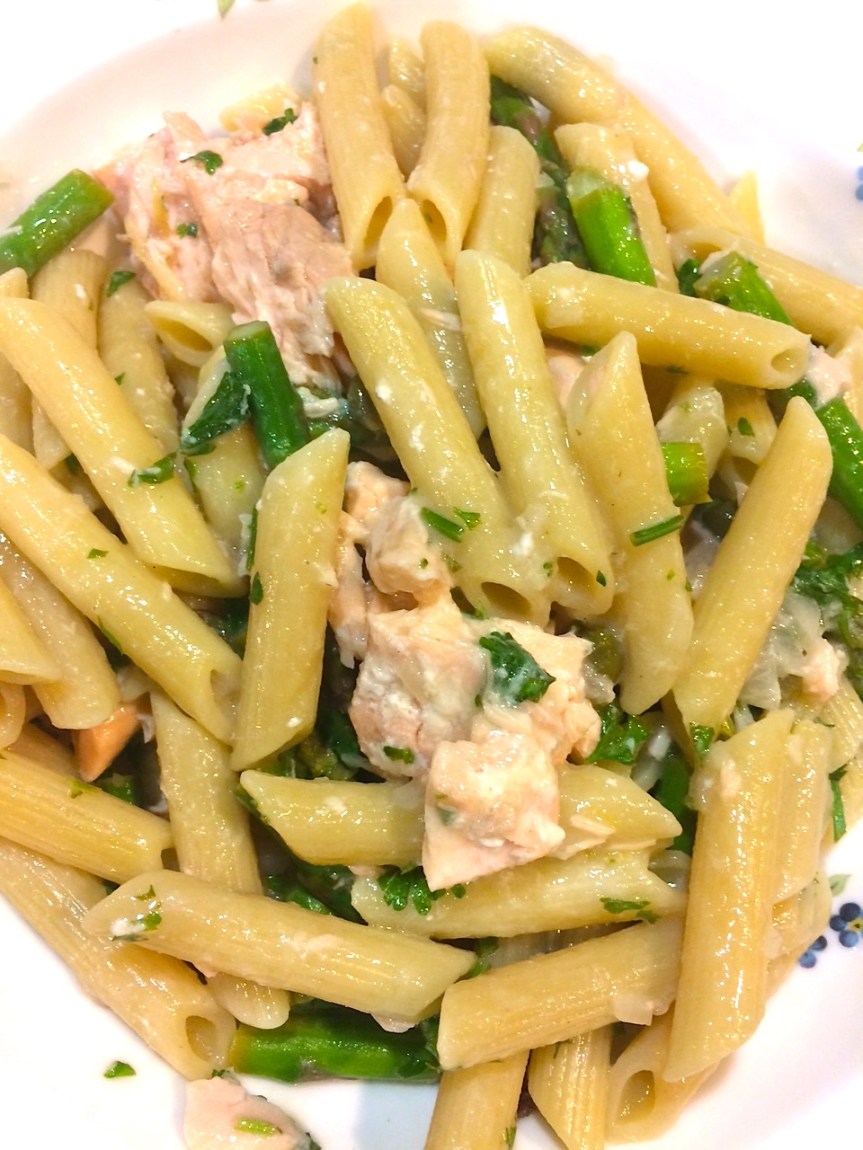
Salmon Poached in White Wine with Penne and Asparagus

This delicious seafood pasta dish comes together in about 45 minutes, is simple to make and relatively inexpensive.  Its clean, bright flavor profile yields a result greater than the sum of its parts and it is therefore both perfect for a weeknight dinner and elegant enough for a romantic dinner for two.

Time: 45 minutes
Level: Easy
Cost: Approximately $4/plate
Serves: 4

Ingredients

  1. 1 large salmon filet, approximately 1lb, cut into four pieces and skin removed
  2. 2 TBSP Kosher salt
  3. 2 cloves garlic, minced
  4. 1 small shallot, minced
  5. 1 TBSP unsalted butter
  6. 1 TBSP olive oil
  7. zest of 1 lemon
  8. 1 TBSP capers (optional)
  9. 1lb asparagus, cut into 1 inch pieces
  10. 1/3 bottle cheap but drinkable dry white wine
  11. 1 box (1lb) penne pasta, cooked according to package directions
  12. Handful (approximate 1/3 – 1/2 cup) fresh parsley, finely chopped
  13. juice of two lemons
  14. grated parmesan cheese (optional, for serving)

Instructions

  1. Begin by heating water for pasta and blanching asparagus.  Make sure it is at a rolling boil and then add a good 2 TBSP of Kosher salt.  Blanching the asparagus will turn the water green, but also impart a vegetal favor to your pasta which is subtle and quite nice.
  2. Heat butter and olive oil in a large sauté pan until melted over medium low heat.  While butter is still foamy, lower the heat to low and add the shallots, garlic and lemon zest.  Cook until fragrant and shallots are soft, 2-3 minutes.  If the garlic starts to brown, you’ll have to start over, so go slowly and use very low heat.
  3. When aromatics (shallot, garlic, lemon zest) are just barely sizzling, add white wine and capers, if using.  Bring to a boil and then reduce heat to a simmer.  Add the salmon filets to the liquid, cover the pan, and allow to sit at a bare simmer for 15-20 minutes, or until salmon reaches an internal temperature of 130°F.  If you are using a very good pan with excellent heat retention, you may be able to off the heat entirely and allow the salmon to poach in the residual heat.  Bottom line:  The lower and slower the better.
  4. While salmon is poaching prepare asparagus and pasta.
    1. Add asparagus to boiling water, return to a boil, and cook 3-4 minutes.  Remove with a slotted spoon and rise immediately under cold running water (or shock them in an ice bath) to stop the cooking process.  Set aside.
    2. Cook pasta according to package directions.  If salmon is still not done once pasta is finished, drain in a colander and set aside.  Be sure to reserve 1/2 cup of pasta water.
  5. Once salmon is up to temp, carefully remove to a cutting board and allow to rest.  Be careful, it will be very tender and flakey and you don’t want it to fall apart just yet.
  6. Add penne and asparagus to sauté pan and toss in the sauce until well combined.  Add a couple tablespoons of pasta water to thicken the sauce if neccessary.
  7. Slice salmon filets into small, bite-sized pieces and add to the pan with the sauce, asparagus and penne.
  8. Squeeze the juice of two lemons into the pan and add a handful of chopped parsley.  Use salad tongs to gently toss until combined and serve.  Pass parmesan at the table.

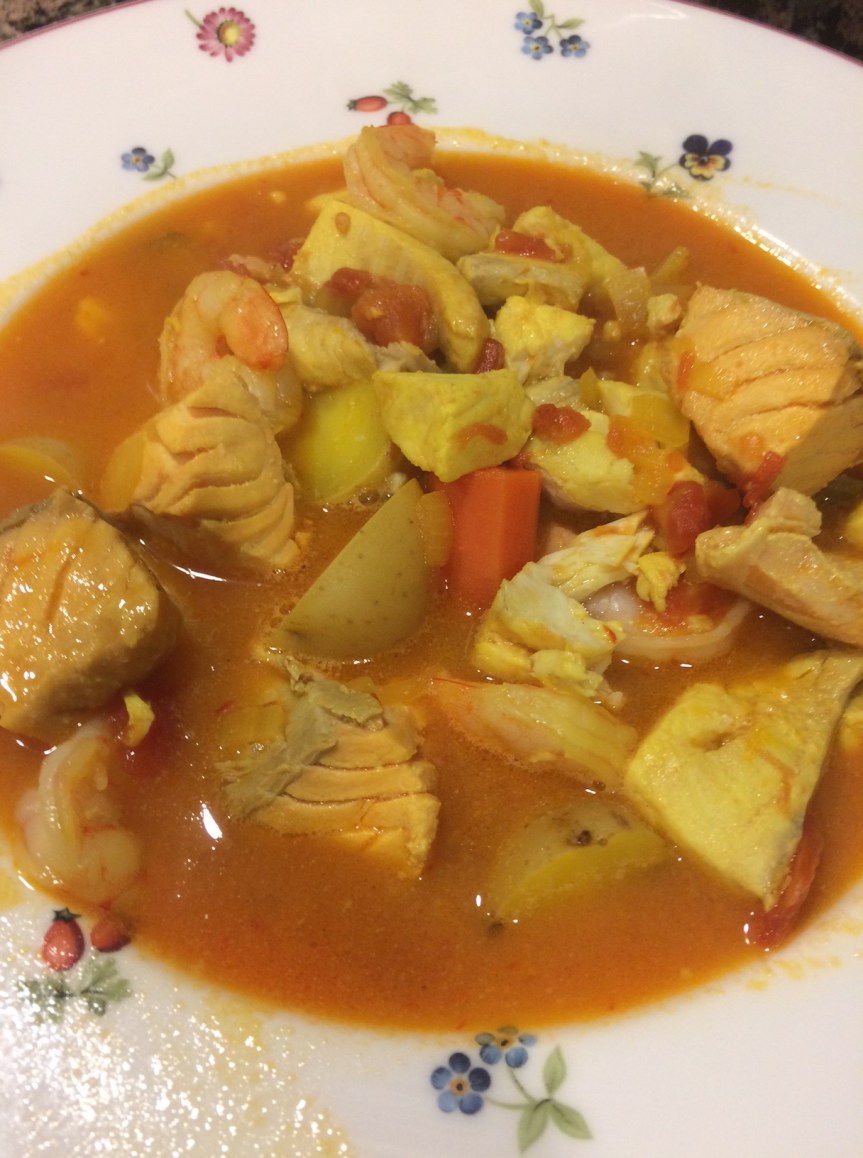
Bouillabaisse

This delicious seafood stew hails from the French port city of Marseilles and represents the best of Provençal cooking: A mirepoix of onions, carrots and celery is sautéed in butter and oil, savory aromatics are added to the base along with white wine, stock and saffron and then a variety of fresh fish is gently poached to perfection.  This is not a cheap dish per se, but given all that goes into it it’s not horrendously expensive either.  The total ingredients should cost less than $40 and the dish easily serves 4-6.

Time:  60 – 90 minutes
Level: Easy
Cost: $10/plate
Serves: 4-6

Ingredients

  1. 2 TBSP olive oil
  2. 2 TBSP butter
  3. 1 medium yellow onion, diced
  4. 4 celery stocks, diced
  5. 6-8 large(ish) carrots, peeled and chopped into 1 – 1.5 inch pieces
  6. Approximately 1lb yellow or red potatoes, cut into 1 inch cubes
  7. 2 oz canned anchovie filets, drained
  8. 4 cloves garlic, finely minced
  9. 3-4 Roma tomatoes, diced and seeds removed if necessary (some tomatoes are juicer than others)
  10. 1 14oz can chicken or seafood stock (I use chicken stock, this dish is seafoody enough for me already, but do what you want)
  11. 1 package unflavored powdered gelatin (optional, to be added to stock)
  12. 1.5 cups dry white wine (about half a bottle, cheap is fine as long as you would drink it)
  13. Juice of 2 lemons
  14. 3 orange peel strips, 3-4 inches long, orange parts only (use vegetable peeler)
  15. 3 bay leaves
  16. Several sprigs fresh thyme
  17. .02oz, about 1/2 a gram, saffron threads (Trader Joe’s sells just this amount for $5.99)
  18. 1/2 teaspoon cayenne pepper
  19. 1/2 teaspoon powdered oregano (optional)
  20. 2lbs firm fresh fish of at least two types (salmon, red snapper, talapia, cod and tuna are all good choices), cut into chunks
  21. 1lb uncooked shrimp, peeled and deveined.

Prep and Mis-En-Place

  1. Dice onion, celery and carrots and combine in a medium sized bowl (this is your mirepoix)
  2. Slice potatoes into cubes that are approximately 1 inch in diameter
  3. Dice (and de-seed, if necessary) Roma tomatoes and place in a medium bowl
  4.  Mince garlic, and then, using a mortar and pestle or bowl and spoon, smush (that’s the technical term) garlic and anchovie filets together to form a paste
  5. Locate white wine and and chicken stock
    • Pro Tip:  I also add one package of unflavored powdered gelatin to my stock at this time; it makes for a richer, thicker sauce – I’ll explain why in another post
    • Pro Tip:  Since you’re going to dump the stock and wine into the pan at the same time, when it comes time to cook, dump the stock first and then use the empty can to measure out the wine.  For now, just make sure you’ve got the wine withing arm’s reach.
  6. Locate lemons and halve
  7. Tie orange peel strips, bay leaves and fresh thyme together using cooking twine to make a sachet
    • Pro Tip:  If you don’t have fresh thyme, use dried and tie the items up in a coffee filter or piece of cheese cloth.  You want the flavor of these items in your stew, but you don’t want them in your stew.
  8. Locate saffron, cayenne and oregano
  9. Prep fish:  Chunk firm fish into cubes and pieces; peel and devein shrimp

Cook

In a large sauté pan, melt butter in olive oil over medium heat.  Add celery, onion and carrots and sauté, stirring occasionally, until carrots are relatively soft and just barely beginning to brown around the edges, 10 minutes.

Add garlic and anchovie paste and stir to combine.  Sauté until fragrant, 1-2 minutes.

Add tomatoes and continue to cook gently.  Reduce heat if things are beginning to brown too much.  Cook, stirring occasionally, until all ingredients are incorporated, approximately 5 more minutes.

Add stock, wine and lemon juice and stir.  Add sachet (the orange peel/bay leave/thyme thing), oregano (if using) and saffron to the pan and stir to incorporate.  Add potatoes.  Increase heat and bring to a boil, then lower heat to a simmer.  Continue to cook until potatoes are soft, 20 – 30 minutes and liquid has reduce by 1/3 – 1/2.

Once potatoes are soft, reduce heat to a bare simmer, add fish to the pan and cover.  Allow fish to cook for 5 minutes, then add the shrimp and cover again, cooking for five minutes more or until shrimp are no longer translucent.  Off the heat and allow to rest, covered, 5 minutes more.

Serve with crusty french bread and a nice wine.