What is Fond?

Truth be told, I’m quite fond of fond.  But what it is?

Properly pronounced, the word is fahn, which is French for “base.”  (Ask my wife and she will tell you that I butcher French pronunciations, but that’s neither here nor there.)  But that fond – that base – is that beautiful brown stuff you often find stuck to the bottom of a pan after searing meat, or even vegetables, over very high heat.  Especially for many beginning cooks, the temptation is to wash that stuff out before beginning the next phase of cooking.  I mean, look at the picture in this post – unless you know what you’re looking at, it doesn’t look very appetizing.  But believe it or not, if you do know what you’re looking at your mouth might be watering just a little bit.

Fond is a magical, secret ingredient.  You will never know it’s there in a final dish, but its presence packs a powerful burst of deep flavor which cannot be otherwise achieved.  It is the result of two chemical reactions present in the process of cooking food over fairly high heat – the Maillard reaction and caramelization.  Both reactions are similar in that they are a form of non-enzymatic browning, but with the Maillard reaction you have amino acids involved with reducing sugars which gives food that distinctive nutty, savory flavor whereas with caramelization you actually have sugars burning – which makes things taste like, you guessed it, caramel.  The Maillard reaction happens at a slightly lower temperature than caramelization (about 310°F and 330°F, respectively) but that is mostly irrelevant because when you sear a steak (or whatever) in a hot pan you’re likely above both of those temperatures so you’re going to get both reactions.

Anyhow, if you’ve read many of the recipes on this blog, or others for that matter, you’ve likely read things in the instructions such as “Deglaze the pan with ________, bring to a boil and stir constantly, scraping up any brown bits stuck to the bottom of the pan.”

Deglazing is simply the action of adding some kind of liquid (wine, stock, spirits – even water) to a hot pan to act as a solvent into which your fond will incorporate itself.  Bringing that deglazing liquid to a boil, and then stirring and scraping up the fond helps accelerate the process of dissolving the fond into the liquid in the pan; as it reduces due to evaporation it thickens, becoming a pan sauce.

Thus, this process of (A) browning protein or vegetables, thus creating a fond and then (B) deglazing the pan with liquid, and then (C) allowing the liquid to thicken is process of making a basic pan sauce to be served over a main dish, or building a base sauce for a more complex sauce, such as Classic Marinara Sauce.

There is an optional step between steps (A) and (B) which is often employed to add even more depth and complexity of flavor to a final product:  the flambé.  When you add a higher-proof alcohol to a hot pan and ignite it, you are doing several important things.  First, you are beginning the deglazing process (although a second deglazing liquid will likely be needed).  Second, you are adding the kiss of flame to whatever is in the pan (increasing caramelization, which adds sweetness and depth of flavor).  Third – and most importantly – you are actually ensuring that the beautiful fond you have in the bottom of your pan doesn’t burn.  It seems totally counter-intuitive that setting something on fire would prevent it from burning, but it does.  Here’s why:  The boiling temperature of alcohol is actually lower than the boiling temperature of water (173°F, to be exact).  By igniting the alcohol, you keep the temperature at the bottom of the pan right at that temperature – too low for anything to burn.  A few inches above the bottom of the pan, however, where the flames are, the temperature is higher – right around 330°F, the perfect temperature for a bit of caramelization.

So, what’s the takeaway here?  First, don’t throw all that brown stuff in the bottom of your pan out.  Figure out a way to use it – make a pan sauce with it, or use it to make a more complex sauce.  Second, don’t be afraid to add a flambé to your cooking process at some point – you will taste the difference.  Third, don’t be afraid to experiment – get out there and make something delicious!
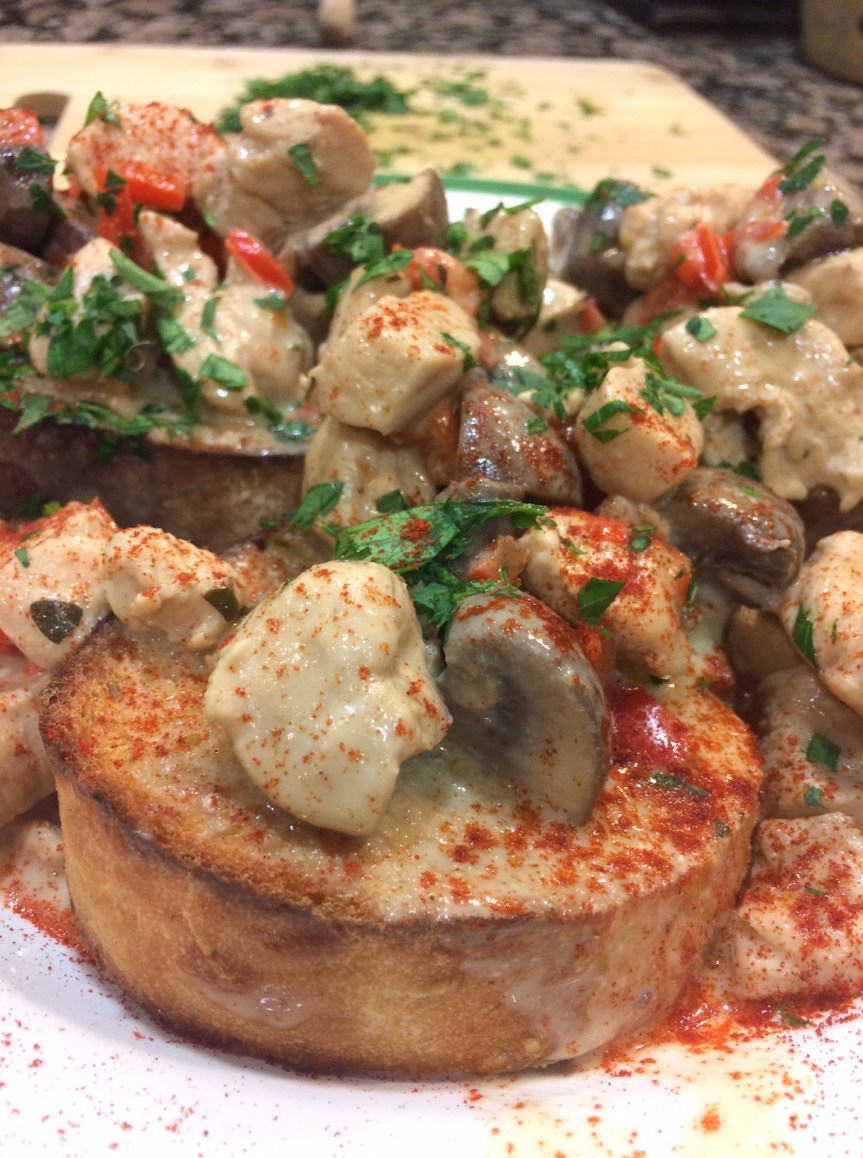
 

Chicken A La King

I know what you might be thinking.  For many, the thought of Chicken A La King conjures up the worst of that era of the 50s and 60s when everything came from a can.  When people couldn’t figure out what to do with leftover chicken,  they smothered it in cream with canned mushrooms – or worse, just doused it in cream of mushroom soup (shudder).  But Chicken A La King is a misunderstood dish.  Before it was hijacked by the 50s canned-everything era, it enjoyed a place on the menus of some of the finest restaurants in the world – including the Delmonico Steak House in New York City and the Claridge Hotel in London – as far back as the late 19th century.  This version is devoid of canned mushrooms, cream of mushroom soup, jarred pimentos, patty shells and leftovers; rather, it is a bright and fresh version closer to the originals from over a century ago that more closely resembles an elegant version of gravy on toast.

Time: 30 – 45 minutes
Level: Easy
Cost: About $3 per plate
Serves: 4- 6

Ingredients

  1. 1.5 – 2lbs chicken breast, cubed
  2. 8oz Crimini or Baby-Bella mushrooms, quartered
  3. 2 TBSP olive oil
  4. 1-2 cloves garlic, finely minced
  5. 2 TSP fresh thyme (or 1 TSP dried)
  6. 1 red bell pepper, finely diced
  7. 1/4 TSP cayenne pepper, or to taste
  8. 2 TBSP butter, diced
  9. 3 TBSP all purpose flour
  10. 1 cup Sherry wine
  11. 1/4 cup Brandy (for flambé, optional)
  12. 1/4 – 1/2 cup heavy cream, or half-and-half
  13. 3 TBSP fresh parsley, minced
  14. Dash of Paprika, garnish
  15. Rustic loaf of bread

Instructions

Prep all your ingredients and get ready to cook – this dish moves pretty fast.

After you’re finished prepping, preheat oven to 500°F for toast (this will take about the same amount of time as it will to cook the rest of the dish).

Heat olive oil in a large skillet or sauté pan over medium-high heat.  When oil is shimmering, add mushrooms and sauté until they begin to caramelize just a bit, 2-3 minutes.  Add diced butter and continue to cook, stirring constantly, until the butter is mostly melted.  Add bell pepper and continue to cook until soft, 2-3 minutes more.  Add garlic, thyme and cayenne pepper and sauté until very fragrant, about 2 more minutes.

Optional:  Add 1/4 cup Brandy and flambé

Add cubed chicken and stir to incorporate.  Stir in flour and continue to cook chicken until it is white all around and no pink is visible (it doesn’t need to brown, and it doesn’t need to be cooked through – it will finish cooking in the sauce).

Add sherry wine, bring to a boil, and reduce until the raw alcohol is cooked off, 2-3 minutes.  Reduce heat to medium, stir in cream and reduce until sauce is thickened to a gravy-like consistency, 5-7 minutes over medium heat.

Meanwhile, while the sauce is reducing, thickly slice several pieces of rustic bread – about 1 or 1.5 inches thick – figure on two pieces per person.  Drizzle both sides with olive oil and place them on a baking sheet.  Place them in the 500° oven for about 5-6 minutes or until beautifully golden brown.

Remove toast from oven and plate.  Ladle chicken and sauce generously over the toast.  Garnish with fresh parsley and a dusting of paprika.  Serve with steamed broccoli or asparagus.

Cook’s Note:  Due to the richness of this dish, it can come across as a bit overly decadent (even though this version isn’t too bad for you).  But the garnish here isn’t really optional – the parsley and paprika will brighten it up significantly.


Five Reasons Why You Should Learn To Cook

Some of you may be asking this question: Why should I learn to cook? It takes time. It takes money. It means I have to go to the grocery store. It takes practice. I have so little free time in my life – why should I spend time every day, or a few days a week, working in the kitchen? It’s so much easier just to eat out or order take-out.
If you’ve had these thoughts, or others like them, I want you to know something: You’re not wrong. These are legitimate questions. But I believe that, despite some of the trepidation you might have about getting started in the kitchen, there are a lot of good reasons why you should make the leap. Here are a few of them:

Reason #1:  Cooking is an Expression of Love.

One of my all time favorite food quotes is by renowned activist and author Cesar Chavez who said “If you really want to make a friend, go to someone’s house and eat with them… the people who give you their food give you their heart.” In my experience – both in the kitchen and in life – I have found very few things to be more true. When you invite someone into your home and cook for them (or go to their house – either way) you are bringing important things to the table.

If you really want to make a friend, go to someone’s house and eat with him… the people who give you their food give you their heart.

Cesar Chavez

Cooking for another person is possibly the most basic expression of kindness, hospitality, generosity and care. When you cook for someone, you are bringing your talent, your practice and your ability together in such a way as to serve another person. When you cook, a little piece of yourself goes into each dish you prepare (hopefully not literally; that’s where basic knife skills come into play, but that’s another topic). In other words, when you serve someone something you have made, you are making a gift of not only your food but yourself. Whether that person be a significant other, your family, a close friend or two – or even yourself – cooking is one of humanity’s most basic expressions of love, care and affection.

 
Reason #2:  Cooking is Cool.

What’s that you say? You don’t think cooking is cool? Well, it is. What I mean by this is that cooking is sexy; cooking is attractive; cooking is admirable.  Being able to cook shows that you have the discipline and the means to learn to do something well. Cooking is an art form, like learning to play the guitar.  It requires patience and practice to develop the skill.  It doesn’t happen over night.  Like all forms of art, cooking is a form of self-expression that can by enjoyed by both the artist and those who take the time to appreciate the artwork.  Not long ago, it used to be that an apron or a chef’s coat was a symbol of servitude – something that indicated that someone was lower class – but those days are over.  Today, the apron and the chef’s coat symbolize the same kind of thing as the guitar or the paintbrush.


Another thing:  Cooking is also like learning to play the guitar in that learning to strum a few basic chords won’t take you that long but will take you a lifetime to master.  But you don’t need to be a master to entertain and improve the quality of life for a few people around you – you just need to learn some basic chords and go from there.  Once you learn just a few basics, a whole new world is opened up to you and it is actually a lot of fun.


Reason #3:  Cooking is a Basic Life Skill


I know, adulting is hard. But as Anthony Bourdain points out, in an ideal society, everyone would be able to cook one or two things well and be able to feed themselves and a few other people.

In an ideal society, everyone over 12 should be able to cook a few basic things reasonably well. They should be able to feed themselves and a few friends, if called to do so, both as a kindness, and as a basic life skill.

Anthony Bourdain

I’m not talking about being able to whip up a gourmet meal for 12 people at the drop of a hat – I just happen to agree with Bourdain that everyone should know how to cook pasta, grill and rest a steak, roast a chicken, make an omelette – or at least make scrambled eggs and toast without burning either one. Bottom line here? Cooking teaches us a modicum of self-reliance, a trait that is all too often left by the wayside in our instant-microwave-amazon-easy-is-best society. Learning to cook demonstrates that you have the ability to do something for yourself.

Reason #4:  Cooking is Healthy

Learning to cook for yourself gives you control over what you choose to put in your own body.  If you are always eating out, you really don’t know exactly what it is you are putting into your body.  Fresh ingredients from the grocery store are definitely healthier for you than whatever crap that is they serve at McDonald’s – and it’s probably healthier than what you would be served at a higher end restaurant.  But just as important as the ingredients themselves is that you get to choose exactly what you are consuming.  Even if you choose to make recipes that call for a lot of butter and cream, chances are you’re using less of it than you would inadvertently get while eating out.

People tell me that one of the reasons they don’t want to cook at home is because the food they make at home doesn’t taste as good as restaurant food.  I assure you, once you practice just a little bit, you will begin to turn things out of your kitchen that taste as good as or better than most restaurants, and your body and your taste buds will thank you.

Reason #5:  Cooking at Home Saves Money

It is true that if your kitchen is like that of Old Mother Hubbard (i.e., completely bare) you’re going to need to spend some money up front to get the basic gear you will need. But the start-up cost of a basic, functional home kitchen is nothing compared to the amount of money you will save in the long run.  You will probably make your money back in a month’s time.

Consider the recipes in this blog; most of them, if you’re willing to do just a little bit of comparison shopping, will cost you in the four-to-six dollar range per plate.  I’ll admit: on my way to work the other day I was in a rush, so I stopped by the drive-thru at McDonald’s.  I got some chicken nuggets, some fries, and a diet coke.  Total cost:  $7.54.  To feed four people that would be a total cost of $30.16.  With an hour’s worth of work and a visit to the grocery store, I can feed a house of four people for half that AND have leftovers.  Plus, what I make at home won’t poison anyone and isn’t crap.

Let me explain.  No, there is too much… Let me sum up.

Whatever it is that is holding you back from getting started in the kitchen – those obstacles are possible to overcome.  That’s why this blog exists.  If you have questions, don’t know where to start or would like some encouragement, please feel free to contact me.  Learning to cook is worth your time, and your friends, your family and your own body will be the better for it.

Chicken Dijonnaise with Brandy Mustard Cream Sauce

This tangy, zesty, creamy dish comes together in a little less than an hour.  It is simple enough to make on a weeknight (with a little hustle) and elegant enough for a dinner party.  Serve with homemade Caesar Salad, because the flavor profiles of the classic Caesar are the perfect compliment to Chicken Dijonnaise.

Time: 45-60 minutes
Level: Intermediate
Cost: About $4 per plate
Serves: 4- 6

Ingredients

For the Chicken Dijonnaise:

  1. 4-6 chicken breasts (1 per person), butterflied but not sliced through
  2. 3 TBSP flour
  3. Salt and pepper, to taste
  4. 3 TBSP ground dried Dijon mustard (available in the spices section of most supermarkets)
  5. Olive oil  (and clarified butter, optional)
  6. 1 shallot, minced
  7. 4 cloves garlic, minced
  8. 8oz brown mushrooms (Baby Bellas or Crimini would work best), sliced
  9. 1/3 cup brandy, plus 1 TSP
  10. 1 cup low sodium chicken broth
  11. 1/4 cup heavy cream
  12. 1/4 cup prepared coarse-ground or stone-ground Dijon Mustard
    • Cook’s Note:  both Safeway and Grey Poupon make this (I believe Grey Poupon calls theirs ‘Country Mustard’ but whatever); any brand will do, and hell, in a pinch, any quality prepared mustard will do as long as you don’t use any of that horrible yellow crap such as French’s (if you use French’s or any other yellow mustard, you are dead to me.  Moving on…)

Instructions

Optional Step:  Brine your chicken breasts by soaking them in a solution of 1/4 cup kosher salt dissolved in 4 cups luke-warm water.  Refrigerate in the brine for as little as 30 minutes or as long as 2 hours.  This will lead to a juicer end product.

In a small bowl, mix flour, dried mustard, salt and pepper.  Whisk to combine well.  (Omit salt if you brined ahead of time).

Pat butterflied chicken breasts dry and place in a large mixing or tossing bowl, making sure that they are fully opened to maximize surface area.  Drizzle lightly with olive oil and toss to coat.  Pour seasoned flour mixture over chicken and toss again until chicken is well coated on all sides.

Heat 2 TBSP olive oil (or 1 TBSP clarified butter and 1 TBSP olive oil) large sauté pan over medium-high heat until shimmering but not quite smoking (about 375°F).  Add chicken to oil, presentation side down, and cook without moving, 3-5 minutes, until well browned.  Flip chicken over and continue to cook until chicken is cooked through 80-90% (it will finish in the sauce).

Cook’s Note:  Don’t overcrowd the pan.  Every time you add a chicken breast it reduces the heat in the pan which means that less browning will occur.  I find that about 3-4 chicken breasts is a good number in my 12-inch sauté pan.  Work in batches if you have to.

Remove chicken from pan and reserve on a plate; cover to keep warm.

In the same pan, add shallots and sauté until a bit translucent, 1-2 minutes.  Add garlic and sauté with shallots until very fragrant, 1-2 more minutes.  Add mushrooms and continue to sauté until liquid is absorbed into mushrooms and mushrooms begin to lightly caramelize.  Carefully pour in brandy and ignite by slowly moving a lit grill lighter over the pan.  You will get flames; they will be large – so make sure loose clothing, hair, and other flammables are well out of the way.  Keep a lid nearby in case things get out of control (which they probably won’t).

Cook’s Note: It helps to have the brandy measured out in a container such as a measuring cup or glass.  You should be holding the container of brandy in your non-dominant hand and be holding the grill lighter in your dominant hand.  Never pour alcohol into a hot pan directly from the bottle, unless you want to risk blowing the bottle up in your hands.  Anyway, holding the grill lighter in your dominant hand, light it.  Keeping it lit, use your other hand to pour the brandy into the pan.  Wait about 2 seconds for the alcohol to begin to vaporize and slowly move the lit lighter to about 2 inches above the pan to ignite the alcohol – don’t stick the lighter in the pan or it will go out – remember:  You’re igniting the vapors not what’s in the pan.  If you don’t get flames or everything fizzles out, that’s okay.  Just add the chicken stock and cook everything down for 3 or so minutes until the raw alcohol has cooked off.  See How to Flambé for more information.

Add the chicken stock and cream and stir to combine.  Bring to a boil and then reduce heat to medium-low and simmer to reduce sauce, 5-10 minutes.  Once the sauce has thickened a bit, stir in 1/4 cup of coarse-ground prepared mustard.  Add chicken and any juices on the plate back into sauce and flip a few times to coat.  Off the heat and cover to allow chicken to finish cooking in the sauce, 7-10 minutes.  (Verify that the internal temperature of the chicken is at least 155°F using an instant-read thermometer before serving.  If after 15 minutes or so the chicken still isn’t up to temp, slowly warm chicken in sauce over a bare simmer until cooked through.)

Just before serving, having removed the chicken from the pot to serving plates, stir in final 1 TSP of brandy to brighten the sauce.  Spoon sauce over chicken and serve with a crusty french baguette and Caesar Salad.


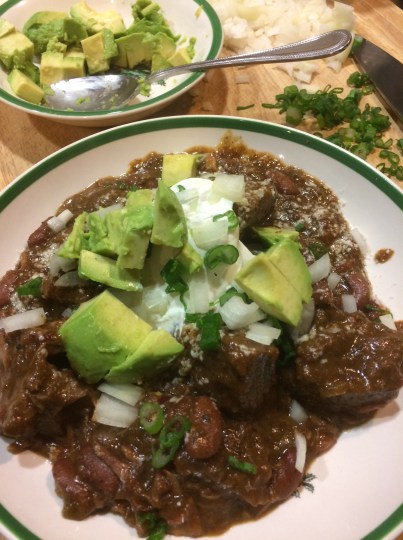
Chunky Beef Chili

This delicious chili requires minimal effort and can be made on the stove top or in a slow-cooker.  It is spicy, rich and perfect for a cold winter night.  Serve with extra jalapeños, avocados and diced white onions as well as a dollop of sour cream and Mexican cheese.  This chili can be made a day ahead of time, refrigerated and reheated.  It’s even better after all the flavors have had a chance to meld together.  Also, remember:  This is frontier food – it was originally cobbled together from whatever was laying around when high-end ingredients were scarce, so feel free to experiment and have fun.  This recipe is a jumping off point to highlight the basics, where you go from here on your chili adventure is up to you!


Time: 2 hrs on stove top; 4 hrs slow-cooker on HIGH; 8 hrs slow-cooker on LOW
Level: Easy
Cost: About $5 per plate
Serves: 4-6

Ingredients

  1. 3 lbs beef chuck roast or stew meat, cut into 1 or 1.5 inch cubes
  2. Kosher salt and Pepper, to taste
  3. 8 oz bacon, diced into lardons
  4. 1 cup celery (about 4 stocks), diced
  5. 1 large white onion, diced
  6. 4-6 cloves garlic, minced
  7. 4 jalapeño peppers, diced
  8. 1 large green bell pepper, diced
  9. 1 6oz can Chipotle chilés in Adobo sauce, minced
  10. 1 TBSP Worcestershire sauce
  11. 3 TBSP flour
  12. 1 cup chicken broth ( or 1 14oz can if finishing on stove top)
  13. 1/2 cup coffee (liquid, not grounds… I used what was left in my cup from this morning)
  14. Optional (Beans and Tomatoes in chili are actually somewhat contentious.  Read more about the debate here, but remember:  Cooking is about experimentation, having fun, and doing what you want.  So do as you will.

    • 2 14oz cans red kidney beans
    • 1 14oz can petite diced tomatoes
  15. 1/4 cup (or more) Masa Harina (instant cornflour – the key thing here being ‘instant’)

Instructions

Add bacon lardons to a large sauté pan or dutch oven, and cook over high heat until crisp and most of the bacon fat has rendered, about 10 minutes.  Remove with a slotted spoon and reserve.

Season beef cubes aggressively with kosher salt and pepper and cook in the bacon fat until nicely browned.  Remove with a slotted spoon and reserve.

Drain off all the fat in the pan except 1-2 TBSP, reduce heat to medium.  Carefully add celery and onion (take care that the pan is not too hot; you don’t want this stuff to burn!) and sauté until fragrant and onions are mostly translucent, 3-5 minutes.  Add garlic and continue to sauté until fragrant, 1-2 more minutes.  Add jalapeños, green bell pepper, Adobo chiles and Worcestershire sauce and cook another 3-5 minutes, stirring constantly, until peppers are soft.

Add 14oz can chicken broth, kidney beans and tomatoes (if using), and coffee.  Stir in flour and mix everything well.  Add bacon and browned beef.  Liquid should be almost covering the contents of the pot but not quite.  Stir once more to incorporate.

If finishing in the oven:

Preheat oven to 325°F.  Bring chili to a boil and then reduce to a simmer.  Place chili into oven with lid on but slightly ajar (perhaps 1/4″ – 1/2″ gap) and cook until beef is tender, about 4 hours.

If finishing in a slow cooker:

Coat the inside of the slow cooker with cooking spray.  Add all items to a slow cooker; cover completely and cook on LOW for 8 hours or HIGH for 4 hours until beef is tender and falling apart.

To Finish:

In the last 10-15 minutes of cooking, stir in 1/4 cup (more or less) of masa harina until desired texture is achieved.  It should be thick and chunky, not watery soup.  Any Texan will tell you this is the ONLY way to thicken your chili, but if you don’t have masa harina available a slurry of 1/4 cup cornstarch and 1/4 cup cold water will work just fine.

Serve with sliced avocado, diced onion, green onions, fresh minced cilantro, shredded cheddar cheese (or my favorite, finely grated Cotija cheese) and warm corn tortillas