Steaks Sous Vides – The Perfect Steak

It doesn’t get much better than this people.

If you’ve spent much time reading this blog, you know that I’m all about temperature, because temperature is the only reliable way to gauge how your food is going to turn out.

Of course temperature and heat are different things.  Heat is about how much energy you’re putting into your food whereas temperature is a way to read how much heat is in food already.

Think about it like this:  If you decide to slow-roast a piece of meat on your smoker or in your oven at a low temperature over a period of hours, you’re putting a little bit of heat into it over a long period of time.  Conversely, if you sear a steak over a hot grill or in a hot cast iron pan, you’re putting a lot of heat into it very rapidly.

The reason it’s hard to cook that perfect steak, which is medium rare bumper to bumper with a crusty, golden edge is because there’s almost no way to cook it on low enough heat for it to turn out truly perfect.  Even slowly bringing your steak up to temperature in a 200°F oven before searing it (the method I generally recommend) is going to leave striations of doneness to a small degree.  Put too much heat in and it’ll be a bullseye of doneness with only the very center cooked correctly.

Enter the Sous Vide cooker – the solution to all of your protein problems.  No more striations of doneness, no more raw centers, no more accidentally-well-done food.  Just perfect, all the time.

How does this work?  Basically, when you cook something sous vide you hold the entire piece of protein at exactly the temperature you want for an extended period of time so no matter how much time it takes, you never overcook it.

So, what exactly is sous vide?  Sous vide is the process of cooking something in a water bath which is set to an exact temperature.  Essentially, what you do is you vacuum seal you protein in a plastic bag, either using a vacuum sealer or the water displacement method (I use the latter method; it’s cheaper and has never caused me any problems) to get all the air out of the bag and drop it in a pot of water that’s being held at a constant temperature until it’s cooked through; then you simply finish it off over high heat to sear the outside and there you have it – perfectly cooked food.

This is, in fact, the way high end steakhouses typically cook their steak.  Ever wonder how a table of five can order three different cuts of steak, one rare, two medium-rare, one medium, and one medium-well and they all arrive at the table at the same time, perfectly cooked, exactly as ordered, edge to edge?  The answer is sous vide.  They’ve had those steaks sitting in different water baths at different temperatures for hours, waiting to be finished off on a hot grill and brought to your table.

That’s the secret.

You can achieve these results at home too.  There are three ways to do this:

  1. Stove top method.  Heat water in a large pot to exactly the temperature you want, verify using a thermometer, and constantly fiddle with the temperature for hours until you’ve got whatever it is you’re making cooked through.  Forget it.  Too much time, too hard.
  2. Beer Cooler method.  This works astonishingly well.  Essentially, you get your water bath to a few degrees higher than your cooking temperature and the insulated walls of the cooler should hold your water at a relatively constant temperature for a few hours; long enough to cook a steak.  J. Kenji Lopez-Alt describes the process here.
  3. Purchase a sous vide immersion circulator.  It used to be that these things were too pricey for the average home cook, but due to the popularity of the sous vide method of cooking they are becoming increasingly affordable.  Generally, they’ll run you anywhere from $75-$150.  I got mine at Aldi for $49.99.  So far so good.

No matter what method you use, you really owe it to yourself to try cooking something sous vide the next time you have a couple hours.  Here’s a short recipe for the steak featured above.

Ingredients

For the Garlic-Herb Butter:

  1. 1 stick salted (yeah, i know) butter, room temperature
  2. 3 tablespoons fresh parsley, minced
  3. 2 tablespoons fresh basil, minced
  4. 3 sprigs fresh thyme, minced
  5. 2 cloves garlic, smashed into a paste (or squished in a garlic press)

For the Steak:

  1. 2 steaks (filet, strip, or ribeye), 1.5 – 2 inches thick (the thicker the better, ask your butcher to cut you a few steaks if the ones in the case are less than 1.5 inches thick – remember, you’re searing these off at the end and it is possible to overcook your steak during that process).
  2. 2 cloves garlic, smashed
  3. Fresh herbs (such as rosemary, thyme, etc), optional
  4. Kosher salt and freshly ground black pepper

Instructions:

For the Garlic-Herb Butter:

  1. Mix all ingredients together in a small bowl until very well combined.
  2. Using plastic wrap, roll the butter into a log shape and twist the ends off (like a tootsie roll)
  3. Refrigerate until needed.

For the Steak:

  1.  Heat a water bath to 130°F for medium rare (135° for medium, anything past that forget the whole sous vide thing and just incinerate it on your stovetop; it’s easier that way).
  2. Season steaks generously with salt and pepper.  Toss each steak individually in a food-grade gallon size freezer bag along with the smashed garlic clove and herbs, if using.
  3. Using the water displacement method, seal the steaks in their bags.
  4. Introduce steaks to water bath and make sure they’re fully submerged, weighing them down if necessary.
  5. Hold steaks in the water bath at a constant temperature for at least 2 hours and not more than 4 hours.
  6. Remove steaks from bags and pat very dry with paper towels (Note:  they will look really weird – grayish brown and mushy – after coming out of the water bath; don’t worry, all is well).
  7. Sear the steaks over high heat, either in a cast-iron pan or ripping hot grill (surface temperature of heating surface should be 400°F – 500°F), 15-30 seconds per side.
  8. Remove steaks from heating surface and allow to rest; while resting, top steaks with sliced rounds of garlic herb butter and tent lightly with foil until butter is melted, 3-5 minutes
  9. Slice and serve


The Best, Easiest Roast Chicken


Stick with me on this one people:  Trust me.

If you do, you will be rewarded with the juiciest, tenderest most succulent chicken with the crispiest, most delicious crackling skin you’ve ever had.

A good roast chicken should be both simple and delicious rather than fussy and difficult.  The method described in this post is, in my opinion, hands down the best way to roast a chicken.  In fact, it’s so easy, so good and so delicious that it is now the only way I roast a chicken.  Here’s the how and the why:

The traditional method of roasting a chicken involves stuffing the cavity, trussing the bird, and placing it breast side up in a deep roasting pan and roasting it at 325°F for about two hours.  This method is time consuming, and poses an additional problem:  Uneven cooking. 

You see, you want the chicken breasts to be moist and delicious, and you don’t really want pink thighs and drums.  But when you place a whole chicken in a roasting pan, the breasts are exposed to the full force of the oven’s heat, while the drums and thighs are deep in the roasting pan.  This means that the breasts are getting incinerated into dry stringy bits of grossness while the thighs and drums take their sweet time coming up to temp. 

I’ve seen all kinds of attempts to solutions to the problem, all the way from icing down the breasts first to constantly rotating the bird in the oven (which, by the way, every time you open the oven door your oven loses 25° worth of heat and you extend the process to like 3 hours or more).

What if I told you there was a way to perfectly roast a chicken in less than an hour? Well, there is…

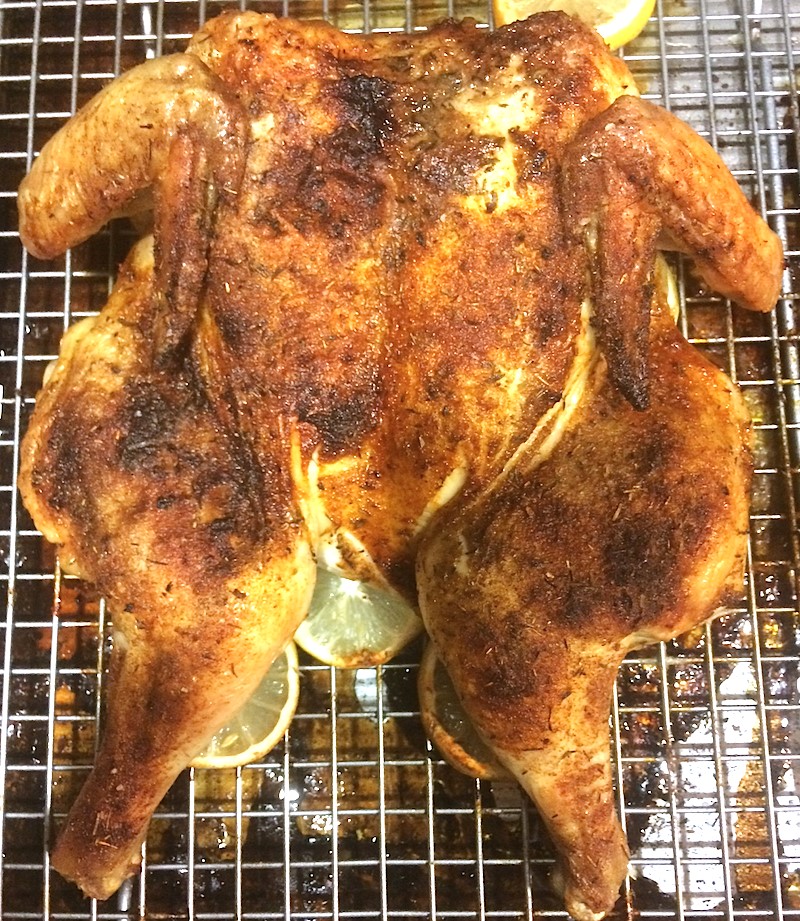
You may observe that the chicken in the cover picture looks a bit… flat.  That’s because it is.  In fact, it’s had its backbone removed and it’s been flipped over, breast-side up. 

A lot of people refer to this process as butterflying or spatchcocking.  It’s very simple to do. 

To spatchcock your chicken, use the following procedure:

  1. Remove your chicken from its bag and retrieve giblets and whatever else might be hiding in the cavity of the chicken.  Pat the chicken dry and transfer it to a large cutting board.
  2. If there are any giant pieces of skin or blobs of fat protruding from the tail end or neck end, trim them off.
  3. Place the chicken breast-side down on the cutting board, with the neck closest to you.
  4. Locate the chicken’s neck and tail, and feel along the back of the chicken to get an idea of where the backbone is (measure twice, cut once).
  5. Using a sharp boning knife or a sturdy set of kitchen or poultry sheers, remove the backbone from the chicken by starting on one side of the neck and snipping all the way down the spine to the tail.  Repeat on the other side.
  6. Snip the backbone into three pieces and reserve for making stock or a pan sauce
  7. Flip the chicken over breast-side up, and make sure the legs and thighs are flipped in such a way as to be fully exposed (like in the picture), not under the chicken.
  8. Using firm pressure, press down with your palm on the center of the chicken’s breast until it’s pretty flat, like you’re giving it CPR.  You may or may not hear the breastbone pop, but the idea here is to get it as flat as possible.
  9. Place your chicken breast-side up on a wire rack over a rimmed baking sheet that has been lined with aluminum foil.  You can put some lemon wedges under your chicken if you like.

Now, you ask, why have you gone to all the trouble of doing this?  Well, aside from making carving a cinch, having this nice flat chicken sitting on top of a wire rack rather than deep in a roasting pan means that the whole bird will come up to temperature at roughly the same rate.  In fact, pop the chicken into a 400°F – 450°F oven for about 45 minutes and, lo and behold, the breasts will be getting finished right around the time the thighs are up to temperature.  You’ve just saved yourself at least 90 minutes and your chicken will be juicy through and through.

A Word on Chicken and Temperature

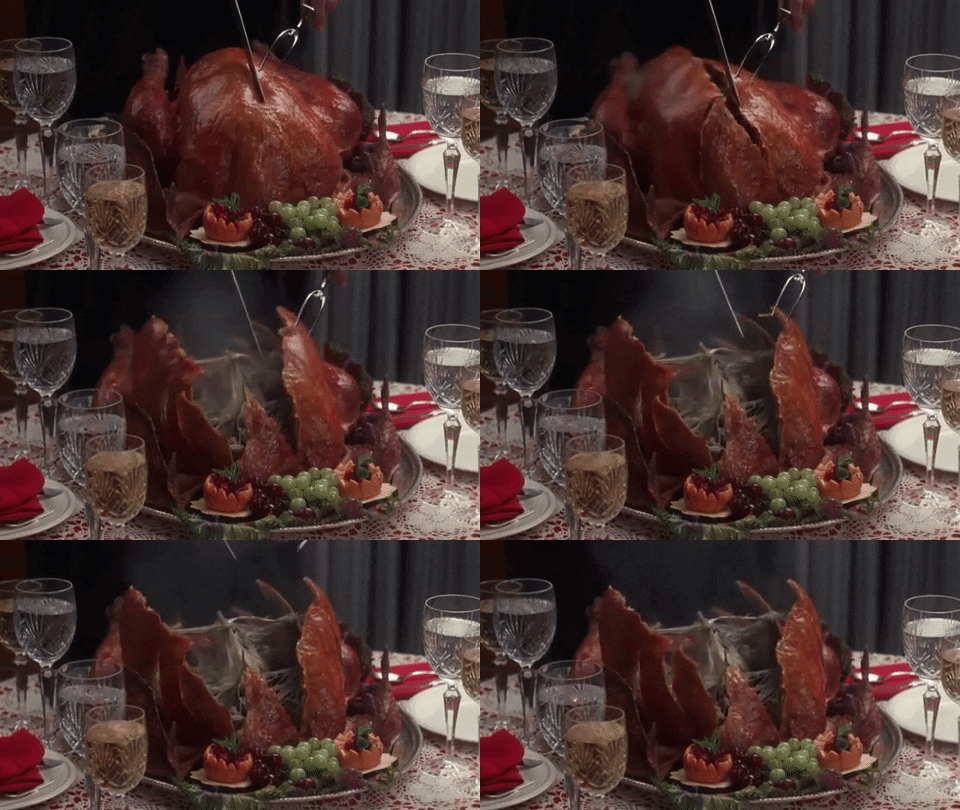
If you’ve read enough of the posts on this blog you should have figured out by now that we always cook using temperature not time.  Speaking of temperature, the poor chicken is probably the most overcooked item on anyone’s regular rotation.  The reason for this is that chickens can house some really nasty bugs, not the least of which are salmonella and e. coli, both of which will leave you wretching up your guts for a few days – best case scenario.  Because we’re aware of this, we generally follow the USDA guidelines and roast our chicken until the internal temperature of the breast is 165°F and the thighs are 180°F – meaning that they are dry and sad and horrible, like this guy:

It does also, however, mean that even a total idiot can cook a chicken or a turkey and not poison anyone.  And that’s the audience that the USDA is shooting for: the general public, the total idiots, the lowest common denominator.  And that’s fine, because as a government organization, that’s their job – to protect the general public from themselves.

However, that is not my job.  My job is to help you get the juiciest, most delicious, succulent bird on the table that you can.  If you’re reading this blog, I’m assuming that you’re not a total idiot (if you are, and you’re still reading this blog, God help you).

So here’s the thing:  It’s not like salmonella (or anything bacteria, virus, amoeba, what have you) are alive at one temperature and then suddenly dead at the next.  The process of pasteurization, that is, the process of ensuring that food born pathogens are eliminated from food, is a matter of both time and temperature.  So the FDA (also a government organization whose job is to keep us safe from ourselves, but in this case it applies to restaurants and food vendors and producers, not individuals) has this to say about pasteurization and poultry:

FDA Pasteurization Time for Poultry

Temperature (°F)

Chicken

Turkey

13663.3 Minutes64.0 Minutes
14025.2 Minutes28.1 Minutes
1458.4 Minutes10.5 Minutes
1502.7 Minutes3.8 Minutes
15544.2 Seconds1.2 Minutes
16013.7 Seconds25.6 Seconds
165Instant<10 Seconds

What you will notice here is that the USDA recommends going all the way to 165°F because at that temperature, it’s a pretty much guaranteed fail-safe.  It’s also guaranteed nasty, dried out bird.  Bottom line here?  According to the FDA, a chicken that’s been held at 145°F for 8.4 minutes is every bit as safe to eat as a bird roasted to within an inch of incineration to 165°F.

Of course, 145°F for a chicken is a little on the rare side; it’ll still be a bit pink and gelatinous and people will know it isn’t cooked – at least to what they’re used to.  My recommendation is to insert a probe thermometer into the thickest, coldest part of your chicken when you put it into the oven, wait for it to hit 150°F, set a timer for 5 minutes, then pull it out of the oven.  That way, you’re well within FDA recommendations and just in case your probe thermometer is off by a degree or two or you didn’t get it all the way into the thickest, coldest part of your bird, you’ll still be fine.  I’ve been doing it this way for years and I’ve never poisoned anyone.  Do verify, using an Instant Read Thermometer, that BOTH the breast AND the joint between the leg and thigh BOTH read at least 150°F.

Okay.  With all that out of the way, here’s the recipe:

Ingredients:

For the Chicken:

  1. 1 Whole Chicken approximately 5 lbs (you can do two if you like, just make sure they’re about the same weight)
  2. Olive oil


For the Poultry Rub

  1. 2 teaspoons Kosher Salt
  2. 2 teaspoons coarsely ground black pepper
  3. 2 teaspoons MSG (yeah, yeah, it’s not gonna kill you, it’s perfectly safe, omit if you like, just double the salt… but trust me on this, use the MSG, sold as Accent and available in the spices section of most grocery stores)
  4. 2 teaspoons granulated garlic
  5. 2 teaspoons dried mustard
  6. 2 teaspoons dried powdered oregano
  7. 1 teaspoon dried thyme
  8. 1 teaspoon dried basil
  9. 1 teaspoon paprika
  10. 2 teaspoons baking powder (optional, for extra-crispy skin)

Special Equipment

  1. Wire rack set above baking sheet.  (Line baking sheet with foil for easy clean up.  No wire rack?  Use a grill grate).
  2. Probe thermometer
  3. Poultry sheers, sharp boning knife, or really sturdy scissors

Instructions

  1. Preheat oven to 450°F.  Arrange rack to be in the upper two-thirds of the oven.
  2. Combine poultry rub ingredients and whisk or shake to combine thoroughly.
  3. Spatchcock chicken according to instructions at beginning of post.
  4. Gently separate skin from breasts, thighs and legs by working your fingers underneath.  Leave in place though, do not remove.
  5. Drizzle chicken with olive oil; just enough for there to be something for the rub to stick to.  Season chicken with poultry rub from Step 2, above.  Be sure to get some of the rub underneath the skin also.
  6. Transfer chicken to wire rack on rimmed baking sheet.  Use an instant read thermometer to find the coldest part of the chicken breast.  Insert probe thermometer here.
  7. Place chicken into the oven, legs toward the back, and roast for 10 to 15 minutes.  Reduce oven temperature to 400°F and roast chicken until probe thermometer reads 150°F.  Turn off oven, set timer for 5 minutes.  Remove chicken and verify that the other breast and the joint between the thighs and legs on both sides are also at least 150°F.
  8. Let rest 10 minutes, then carve and serve.  Carry over cooking will bring your bird up to at least 155°F while resting, and that’s good enough for me.

Just look at the finished product:

BUT WAIT! THERE’S MORE!

If you’d like to make a pan sauce, do the following while your chicken is in the oven:

Ingredients (This is more of a method than anything else, use what you like or what you have on hand):

  1. 1 tablespoon butter
  2. 2 tablespoons olive oil
  3. Kosher Salt and Freshly Ground Black Pepper
  4. 3 chicken backbone pieces
  5. A few shallots, or 1/2 of a minced onion
  6. 2-3 cloves garlic
  7. 1 cup dry white wine or chicken stock
  8. Handful of fresh herbs
  9. Juice of 1 lemon

Instructions:

  1. Melt 1 tablespoon butter and 2 tablespoons olive oil in a 10-12 inch stainless steel skillet or sauté pan over medium-high heat.
  2. Season the chicken backbone pieces aggressively with Kosher salt and freshly ground black pepper.
  3. Once the pan is hot, add the chicken backbone pieces (remember those?) skin side down and sear until golden brown.  Allow to cook in the pan, undisturbed for 4-5 minutes – brown means brown.
  4. Once well browned, flip the backbone pieces over and continue to cook another 2-3 minutes and allow fat to render.
  5. Remove backbone pieces – you should now how some lovely fond built up in the bottom of your pan
  6. Add a few shallots or 1/2 a minced onion to the pan and sweat, scraping up the fond as the onion releases its moisture
  7. Add 2-3 minced garlic cloves and sauté with onion until fragrant
  8. Deglaze the pan with a cup or so of dry white wine or chicken stock and allow to reduce by 2/3
  9. Add a handful of fresh herbs (parsley, cilantro, thyme, whatever) along with the juice of a lemon (for acid) and continue to cook for another 2 minutes over low heat, or until sauce coats the back of a spoon and streaks the bottom of the pan when a spoon is dragged through it.
  10. Serve sauce over chicken.

New Mexico Sopapillas

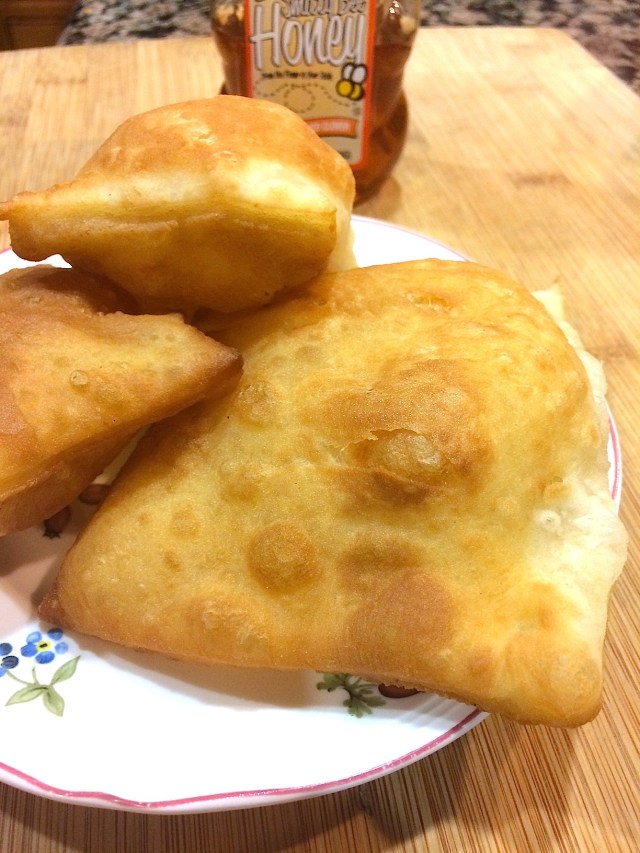
I love these guys – puffy, airy little pastries designed to do one thing: be a delivery mechanism for awesome flavors.  They are a staple of New Mexican cuisine, and as far as I can tell, almost exclusive to it as well.
Sopapilla literally means “little soup pillow” and that’s what they are best at – sopping up delicious sauce from the plate, or soaking in delicious chili.  My first encounter with a sopapilla was at a Sadie’s in Albuquerque, NM back when I was in high school.  This was also the first time I encountered Chili Verde, chili in general, and food that was legitimately spicy.  I had been wanting to try to make these for years, but for a whole variety of reasons never got around to it until the other night, and they were amazing.  Sprinkled with a bit of cinnamon sugar or a drizzle of honey, they also make an awesome breakfast.  Also, this was REALLY easy.

Time: 30 minutes
Level: Easy
Cost: Really, really cheap seeing as they’re made from stuff you probably have on hand
Makes:  Approximately 18-24 sopapillas

Ingredients

  1. 3 cups all purpose flour, plus perhaps 1-2 TBSP
  2. 2 tsp double-acting baking powder
  3. 1 tsp salt
  4. 1 cup whole milk
  5. 1/4 cup warm water
  6. 6 TBSP unsalted butter, melted
  7. 1.5 quart (48 oz) vegetable or canola oil, for frying

Instructions

  1. Combine dry ingredients (1-3) in a large mixing bowl and whisk to combine.
  2. Create a well in the bowl using the dry ingredients, it should look like a little volcano; a mound of ingredients with a little hole, perhaps 2 inches in diameter, in the top.
  3. Combine wet ingredients (4-6) in a 2 cup measuring cup and whisk briefly to combine.
  4. Add about half of the wet ingredients to your flour-mixture volcano.  Using your hands, begin scooping the dry ingredients from the edges of the volcano into the wet ones on top.  Add the rest of the wet ingredients and continue to mix until a rough dough has formed.  If your dough is super sticky, coat it with 1 TBSP flour.  Once the dough is fairly consistent, coat with 1 more TBSP flour and cover with plastic wrap or a clean towel.  Punch down and fold a few times to make sure everything is really worked together.  Allow dough to rest for 20 minutes.
  5. Once dough is rested, remove it from the bowl and divide into two parts.  Place one part back in the bowl and cover while you work with the other part.  On a lightly floured work surface, use a rolling pin to roll the dough out to about 1/8 inch thick, trying to get it as consistent as possible.  Cut off rounded edges to make a rectangular piece of dough and discard the trimmings.  Cut dough into rectangles approximately 1.5″ x 2″.  Repeat with the remaining dough.
  6. Heat oil in a large pot to 375°F – 400°F
    • Cook’s Note:  When frying stuff, I’ve found that my 5qt sauté pan is actually the perfect size.  480z of oil comes do about 2″ deep, which is all you really need to fry just about anything.  The fact that it’s fairly wide (12″ across) means that the oil will come up to temperature more quickly and I can fry things in larger batches.  There’s only one serious drawback:  A sauté pan has a handle, and handles can be accidentally knocked, and the potential for knocking a large volume of 400°F oil onto yourself or the floor is a VERY bad thing.  So, if you use your sauté pan for this, PLEASE make sure the handle is pointed AWAY from you, toward your stove, and well away from any place it could be inadvertently knocked.
  7. Once oil is up to temp, carefully slide a sopapilla into the oil.  It will submerge, sizzling quite a bit, and then float to the top.  Then the magic happens:  Before your very eyes, it will puff into a beautiful little pillow.  Continue to fry for 2-3 minutes until golden brown, and the flip with a slotted spoon to brown the other side.  Once you’ve done one as a tester, you can probably do 3-4 at a time.
    • Cook’s Note:  If your sopapilla doesn’t puff, chances are your oil isn’t the right temperature.  It’s got to be hotter than 350°F but no hotter than about 410°F.  Remember:  Every time you add a sopapilla to the oil, it’s going to bring the overall oil temp down a couple of degrees.  This is why I recommend starting with your oil somewhere between 375°F – 400°F.   Either that or you’re trying this at high-altitude.  In either case, if after a few test batches your sopapillas don’t puff, don’t worry – they’re still tasty.
  8. Once fried, remove sopapillas to a plate lined with a paper towel to drain.  Repeat until all sopapillas are fried.  They can be kept warm in a 200°F oven for 30-45 minutes.  Also, they refrigerate pretty well and can be gently reheated in a 325°F oven until just warmed through, about 5 minutes.

Cook Like a Peasant: 5 Ways to Eat Like a King During Lean Times

The kitchen table has always been a place where we nourish not only our bodies, but our souls.

Let’s be real people:  Times are tough right now and it doesn’t look like it’s going to get a whole lot easier any time soon.  But that doesn’t mean we’re stuck eating McDonald’s and Spaghetti-O’s.  It has often been said that necessity is the mother of invention – never has this been more true than in kitchens across the globe and throughout history.

This post is going to explore how we can continue the time honored tradition of making great food for cheap in our current economic and social climate.  Lean times have always led cooks to find inventive ways to create dishes that are filling, satisfying, simple and delicious.  The best foods from around the world are often so-called ‘peasant dishes’ because they were cobbled together from what people had laying around.

In the Old World, country farmhouses in France brought us the likes of Coq Au Vin, Coq Au Riesling, Chicken Dijonnaise and Beef Bourguignon; Italy exported classic dishes like Spaghetti and Meatballs, Classic Marinara Sauce and Linguine Con Le Vongolé; not to mention many ways to prepare the humble chicken in glorious pan sauces: Piccata, Marsala and Parmesan.  Spain gave us Paella and  Ireland gave us Corned Beef and Cabbage; Scotland the noble Haggis (okay, maybe forget about that last one).

Lest we forget, in the New World in America, as Westward expansion progressed, the culinary landscape progressed with it; from the chuckwagons of the Great American West came chili – made from both beef and chicken.  Meanwhile, deep in the steamy bayous of Louisiana a whole culture emerged – Cajun – and with it unique and delicious foods such as jambalaya and gumbo.  And how could we fail to mention Barbecue – tough cuts of meat cooked low and slow over smoldering coals, bathed in smoke for hours on end from the Coast of California in Santa Maria to Texas to Tennessee, Kentucky, the Carolinas and Alabama.

All this goes to show that with a little planning and a little extra work, it is still possible to eat well and live well despite the financial and economic hardships afflicting millions of Americans today – I’m one of them.  I would be lying to you if I didn’t say that it’s tough out there; sometimes it’s scary and there have been times when I’ve had less than 10 bucks in my checking account with pay-day several days off.  But so far, I’ve got a roof over my head and my family and I have eaten well even when funds were nearly non-existent.

People have almost always found ways to feed themselves in tough economic times and 21st century America should be no different.  Even though we live in an era where income inequality is a real problem and many Americans barely make enough money to pay rent (and it’s only getting worse) we must remember that we are in good company throughout history – and that the kitchen table has always been a place where we nourish not only our bodies, but our souls.

Without further ado, here are a few tips that I humbly offer to you in hopes that, no matter what you’re going through, you will find the time to cook a few times this week thereby eating a little better and saving a little money in the process.

Number 1:  Comparison Shop.  Download a few apps and don’t be afraid to hit multiple grocery stores to get the best prices.  Going to only one grocery store is a sure-fire way to make sure you’re spending too much on groceries.  Most major grocery stores have their own apps these days where you can see what is on sale in any given week.  Here in California, price changes happen on Wednesdays.  There are also several apps out there that let you compare prices across several grocery stores at once – so far, I’ve found Favado to be the most helpful.

Also – all that junk mail you throw away?  Look through it to see if there are coupons or advertisements for what might be on sale near you.  Be on special lookout for coupons where you get a dollar discount for spending a certain amount (such as $10 off a minimum purchase of $30).

Number 2:  Shop at Discount Grocery Stores.  You wouldn’t believe how much money you can save by shopping at either Aldi and/or Grocery Outlet.

Number 3:  Plan ahead and keep your pantry well stocked.  Figure out what you are going to do for each meal this week and plan at least one or two meals to generate some leftovers.  Make a list of exactly what you need and stick to it.  Certain things I always try to keep on hand are:  beef and chicken stock, canned diced tomatoes, tomato paste, pasta of several sorts, onions, and garlic.  When you begin to run low on a certain pantry essential (say, chicken stock), write that down somewhere – I keep a list on a whiteboard in my kitchen.

Number 4:  Buying in bulk can save you money.  This doesn’t mean that you have to go to the nearest wholesaler such as Costco or Sam’s Club and buy a bunch of stuff you won’t use (hey, look, a twelve pack of watermelons!), but there are a lot of coupons out there where you get a certain dollar amount or percentage off a minimum purchase amount or a quantity discount for buying multiples of something you WILL use.  Keep an eye out for those and utilize them.

Number 5:  Remember to live a little.  Indulging a little bit on a few simple pleasures can actually save you money and improve your quality of life.  Treat yourself to some cheese or some nuts once in a while before dinner as well as a beer or an inexpensive glass of wine; not only is there something very pleasant about having a bit to drink and some light appetizers before dinner (or while making dinner), you won’t come to the table so ravenous that you overeat and spoil any chances of having enough leftovers to form a complete meal later on.  Believe it or not, there are many perfectly serviceable table wines out there for less than $5 a bottle, especially at Trader Joe’s and Aldi.  Try a few of them and figure out which ones don’t suck.  You can also find some pretty decent beers at Trader Joe’s and Aldi.

All in all, remember this:  The best food in the world came from places and times of scarcity.  It doesn’t need to be fancy or expensive to be good.  You are not alone in the world – and sometimes, all it takes to remember that fact is gathering around the kitchen table on a cold night with family or a few friends to share a light pasta dish tossed in a simple sauce, a rustic hunk of bread, a wedge of cheese, and a glass or two of rough red wine.