Panko Crusted Chicken Cutlets

Although this recipe is already contained in a number of other recipe posts on this blog, I thought it was worth sharing by itself because making these crispy, golden cutlets opens up a world of creativity in terms of what you do with your pan sauce.  Once fried golden brown, you pop them in the oven to cook them through, and while they are finishing you can use the fond in the pan as a base to create any number of sauces.  The chicken itself can then be served over rice, pasta, potatoes, bread – whatever you fancy – with your sauce drizzled on top.

Ingredients

  1. 2 or 3 Chicken breasts, sliced in half lengthwise to make two, thinner cutlets – so, you’ll end up with 4 – 6 cutlets total
  2. ½ cup flour
  3. Kosher Salt
  4. Black Pepper
  5. Pinch Paprika
  6. 3 Eggs
  7. 3 tablespoons vodka (alcohol is a binding agent)
  8. 3 tablespoons milk, cream or water
  9. 1½ cups panko breadcrumbs
  10. ⅓ cup parmesan cheese
  11. Zest of 1 lemon
  12. 1 cup or so vegetable oil, ghee or any other high smoke-point fat: enough to get about 1½ inches deep in a cast iron or other suitable pan for frying

Prep

  1. Using a Meat Mallet, pound each chicken cutlet to even thickness (the wider end will need more pounding than the narrow end) – you’re shooting for ¼ to ⅓ inch thickness… so pretty thin. This is important to ensure that chicken is cooked through during the frying process.
  2. Set up your dredging station.  You’ll need two, wide shallow dishes and one medium sized bowl.
  3. Put the flour in one of the wide, shallow dishes.  Season aggressively with salt and pepper; add paprika and mix until seasoning is well distributed.
  4. In the second wide, shallow dish add Panko Bread Crumbs, Parmesan Cheese, and Lemon Zest.  Whisk together until well mixed.
  5. Crack three eggs into the medium sized bowl; add vodka and water.  Whisk together until slightly foamy.
  6. Set them up in this order:  Flour mixture, egg wash, bread crumb mixture
  7. Dredge a chicken cutlet first in the flour mixture (shaking of excess), then dip into the egg wash, and then dredge in the breadcrumb mixture, pressing firmly to adhere to each side and flipping a few times as needed.
  8. Transfer to a baking sheet.
  9. Repeat this process with all the chicken cutlets. Cover and refrigerate for a minimum of 30 minutes, and up to 8 hours

Instructions

  1. Fill a A 12″ Cast Iron Skillet about 1½ – 2 inches deep with a high smoke-point fat (I like to use vegetable oil and maybe ¼ cup of duck fat or ghee for a little extra flavor)
  2. Heat oil to 375°F as measured with an Instant Read Thermometer.
  3. Safety Notes:
    • You’ve got super hot oil in a skillet that probably has a handle. Point that handle toward the rear of the stove, angled away from the edges of the stove where it could accidentally be knocked
    • Keep kids/pets and things you can trip over out of the kitchen during this time
  4. Carefully lay two or three of the breaded chicken cutlets into the hot oil. A few important notes here:
    • Lay the cutlets away from you so if there’s any splashing it doesn’t go in your direction
    • Lay cutlets in oil slowly – don’t be afraid of it; dropping things in quickly will lead to more spattering/splashing. If you’re nervous, use tongs.
    • Do not overcrowd – you don’t want to drop the oil temperature too much
    • Right when you lay the cutlets in the oil, they’ll sink to the bottom, so use tongs to gently wiggle each cutlet to ensure it isn’t sticking to the bottom of the pan
    • It’s okay if the cutlets aren’t fully submerged – you’re going to turn them over once in a while anyway (see next step)
  5. Cook until deeply golden brown on all sides, turning occasionally, around 5-6 minutes (approximately 3 minutes per side)
  6. Once cutlets are beautiful, golden, stiff, and crunchy, transfer them to a Rimmed Baking with oven safe wire rack
  7. Repeat with remaining cutlets, and transfer to 170°F oven to keep warm 

Not sure what sauce to make?  Try one of these!

Chicken Parmesan

Chicken with Italian Red Sauce; i.e., Marinara Sauce

Chicken Marsala

Chicken in a mushroom Marsala reduction sauce

Chicken Piccata

Chicken in a lemon butter pan sauce with capers and white wine

What is Fond?

Truth be told, I’m quite fond of fond.  But what it is?

Properly pronounced, the word is fahn, which is French for “base.”  (Ask my wife and she will tell you that I butcher French pronunciations, but that’s neither here nor there.)  But that fond – that base – is that beautiful brown stuff you often find stuck to the bottom of a pan after searing meat, or even vegetables, over very high heat.  Especially for many beginning cooks, the temptation is to wash that stuff out before beginning the next phase of cooking.  I mean, look at the picture in this post – unless you know what you’re looking at, it doesn’t look very appetizing.  But believe it or not, if you do know what you’re looking at your mouth might be watering just a little bit.

Fond is a magical, secret ingredient.  You will never know it’s there in a final dish, but its presence packs a powerful burst of deep flavor which cannot be otherwise achieved.  It is the result of two chemical reactions present in the process of cooking food over fairly high heat – the Maillard reaction and caramelization.  Both reactions are similar in that they are a form of non-enzymatic browning, but with the Maillard reaction you have amino acids involved with reducing sugars which gives food that distinctive nutty, savory flavor whereas with caramelization you actually have sugars burning – which makes things taste like, you guessed it, caramel.  The Maillard reaction happens at a slightly lower temperature than caramelization (about 310°F and 330°F, respectively) but that is mostly irrelevant because when you sear a steak (or whatever) in a hot pan you’re likely above both of those temperatures so you’re going to get both reactions.

Anyhow, if you’ve read many of the recipes on this blog, or others for that matter, you’ve likely read things in the instructions such as “Deglaze the pan with ________, bring to a boil and stir constantly, scraping up any brown bits stuck to the bottom of the pan.”

Deglazing is simply the action of adding some kind of liquid (wine, stock, spirits – even water) to a hot pan to act as a solvent into which your fond will incorporate itself.  Bringing that deglazing liquid to a boil, and then stirring and scraping up the fond helps accelerate the process of dissolving the fond into the liquid in the pan; as it reduces due to evaporation it thickens, becoming a pan sauce.

Thus, this process of (A) browning protein or vegetables, thus creating a fond and then (B) deglazing the pan with liquid, and then (C) allowing the liquid to thicken is process of making a basic pan sauce to be served over a main dish, or building a base sauce for a more complex sauce, such as Classic Marinara Sauce.

There is an optional step between steps (A) and (B) which is often employed to add even more depth and complexity of flavor to a final product:  the flambé.  When you add a higher-proof alcohol to a hot pan and ignite it, you are doing several important things.  First, you are beginning the deglazing process (although a second deglazing liquid will likely be needed).  Second, you are adding the kiss of flame to whatever is in the pan (increasing caramelization, which adds sweetness and depth of flavor).  Third – and most importantly – you are actually ensuring that the beautiful fond you have in the bottom of your pan doesn’t burn.  It seems totally counter-intuitive that setting something on fire would prevent it from burning, but it does.  Here’s why:  The boiling temperature of alcohol is actually lower than the boiling temperature of water (173°F, to be exact).  By igniting the alcohol, you keep the temperature at the bottom of the pan right at that temperature – too low for anything to burn.  A few inches above the bottom of the pan, however, where the flames are, the temperature is higher – right around 330°F, the perfect temperature for a bit of caramelization.

So, what’s the takeaway here?  First, don’t throw all that brown stuff in the bottom of your pan out.  Figure out a way to use it – make a pan sauce with it, or use it to make a more complex sauce.  Second, don’t be afraid to add a flambé to your cooking process at some point – you will taste the difference.  Third, don’t be afraid to experiment – get out there and make something delicious!


Hack Your Gas Grill: Use it as a Smoker

If you’ve got a gas grill, you can still turn out some truly amazing, authentic BBQ.  Here’s how.

I know there are those people out there who are going to hate this post.  Trust me, I understand.  But ultimately, I’m about results – And if the technique yields sound results, then it’s a sound technique.  I have a BBQ smoker, and I love it – but most of the time I don’t have 12 or 15 hours to sit around and fiddle with a fire, and I if I can bring a 12 hour cook down to a 5 hour cook and turn out some BBQ that’s nearly indistinguishable from what I produce on my smoker, I’m down.  Also, many people may not have room for two or three cookers in their back yard (like I do).   This post is dedicated to BBQ lovers who want more of that smoke-kissed flavor in their lives.

In this post, we’ll be exploring two things:  First, how to use your gas grill as a smoker – and some of the sciencey stuff that goes on behind the scenes when using smoke.  Second, we’ll talk briefly about what types of wood to use and how.

Things You’ll Need

Grill

Smoker Box and/or Cast Iron Skillet

Wood Chunks

Stand Alone Oven Thermometer

Decent Instant-Read Thermometer

Meat

BBQ Rub (try Classic BBQ Rub, if you like).

The Key

Basically, the key to this whole thing is this:  You’ve got to learn to think of your grill as an oven.  That’s it.  Most of the time, we think of our grills as… grills.  In other words, we sear food (burgers, steaks, whatever) directly over high heat until it’s done.   We’re using primarily conduction and some convection to get heat into the food. When you roast or bake something, you’re using a little bit of convection and mostly radiation.  In other words, it’s heat in the form of waves penetrating your food.

Smoking is simply baking and/or roasting something in the presence of smoke.

I remember one Thanksgiving, the oven caught fire.  Faced with trying to figure out how to cook a 15lb turkey with no oven, I turned to my grill.  I lit one burner and plonked the bird down on the cool side of the grill and everything turned out fine, albeit a little dry.  That’s where the lightbulb went on.  Since then, I’ve developed a technique that I think is pretty damn solid.

The Technique

They say a picture is worth a thousand words, and Bon Appetit has a great picture to explain this, so I’m just going to use theirs:

grilldiagram

A:  Single Burner Lit, B:  Pan for catching drippings, C:  Smoker Box, D:  Smoke, E:  Meat

All that being said, there’s a few modifications I’d make to the picture above:

  •  Remove all but one of your grill grates so you can slide the food from hot to cold without picking it up, if need be.
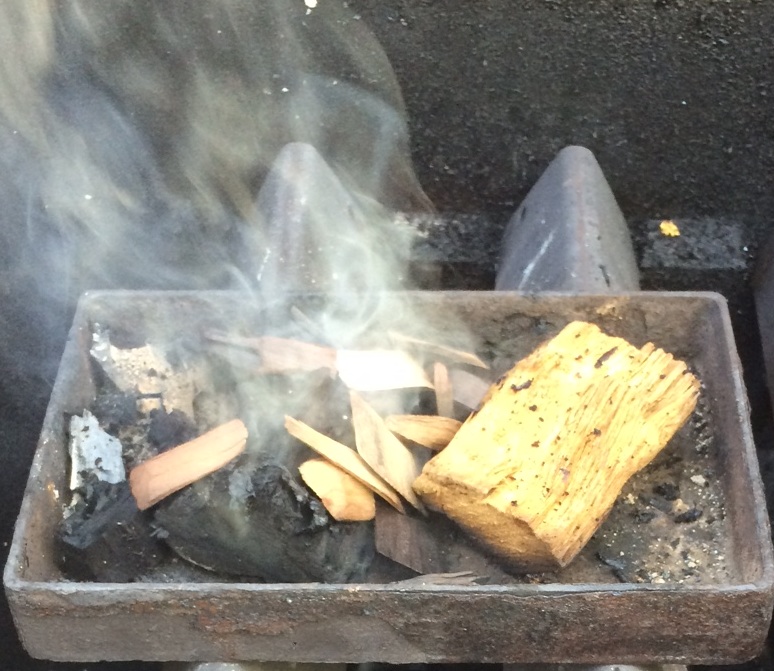
  • Place the smoker box directly on the flavorizer bar (as in the cover photo for this post), NOT on the grill grate.  Basically, I’ve never been able to get anything to smoke on the grill grate – not enough conductive heat.
  • Leave the lid off the smoker box, or simply use a small cast iron pan.
  • Use wood chunks instead of chips.  Chips burn up way too fast, whereas chunks will smolder for an hour or more.  The only time I use chips is as a starting agent; i.e., place some chips down on the smoker box with a few chunks on top just to accelerate the process a bit.
  • Don’t bother to soak your wood chunks (or chips) ahead of time.  This does nothing, other than make it take longer for them to start smoking.  I’ve timed, by weight, how long it takes wood chunks soaked for 24 hours, 1 hour, and not at all, from the time they start smoking to the time they burn up, and it’s the same.  What’s not the same is the amount of time it takes for them to start smoking.  Soaking wood chunks just extends your pre-heating phase.  Trust me, don’t waste your time.
  • Do keep a trigger spray bottle handy.  Sometimes when you open the lid (which you shouldn’t do too often) a lot of oxygen will very suddenly make its way to the wood chunks and they will burst into flame.  No need to soak them – just a couple squirts to calm them down again and shut the lid… continue on your merry way.
  • Invest in a $5 stand-alone oven thermometer to place on the grill grates.  Chances are the thermometer built into the hood of your grill (if you have one) reading as much as 50F different than the actual temperature at grate-level.
  • Shoot for 275F at grate level.  Actually, anywhere between 275F and 300F is fine.  275F is my go-to temperature for smoking just about anything, even if I’m using a traditional smoker.  Many people will say that’s high, but it’s basically been proven that the only difference between 225F and 275F is the amount of time it takes to get something up to temperature (duh), but might mean more time in the presence of smoke.  However, competition BBQ teams these days are sometimes smoking brisket at north of 300F.  The reason?  Once something has been basking in smoke for more than three hours, any appreciable difference thereafter begins to fade in a damned hurry.
  • Put about an inch or so of water into the drip pan beneath the meat.  This will eliminate the possibility of any flare ups from rendered fat, and keep everything underneath the hood nice and moist.

How to Smoke Stuff:  Cooking Times and Temps

These are fairly rough – but predictable – cooking times for various meats I’ve done using this technique.  Make sure to generously season your meat with a good BBQ Rub so that there’s something for the smoke to stick to.

I always use a two-step process.  During the first phase (three to four hours) you get smoke onto the meat.  During the second phase, you finish getting the meat up to temp (190F – 205F) by wrapping it in foil.  It’s such a common practice that it actually has a name – the Texas Crutch. I won’t go into a lot of detail here, but in between the two phases you’ll meet the nemesis of every BBQ Pitmaster – the Stall.  It basically happens at about 165F for most meats and basically, for an extended period of time, your meat will just sit there and do nothing at 165F.  Wrapping your meat at this point will help speed up the process.

Pork Butt (5-7lb): About 5 hours, 3.5 hours in the smoke, 1.5 hours wrapped in foil on the grill.  Wrap at about internal temp 165F, place it back on the grill for another and pull when internal temp is 190F – 205F

Brisket (6lb):  About six hours.  Wrap at 4 hr mark (roughly 165F), finish off for 2 hrs.  Pull at 190F.

Turkey Breasts X 3 (1lb each):  About 2.5 hours.  No need to wrap in foil (i.e., “crutch”) while cooking, just pull them at 165F, wrap them up in foil with some butter and let them rest for 20 minutes.

Types of Wood to Use

BBQ wood falls into two categories:  hard woods and fruit woods.  My go-to combination is equal parts Pecan (a hard wood) and Apple wood (a fruit wood), but I also use oak, hickory, cherry, peach and mesquite.  Here’s a basic run-down on some basic types of wood and how to use them, organized from strongest to weakest flavor:

Mesquite (hardwood).  Hot temperature, fast burn time. The mother of all hard woods, mesquite has a strong, earthy, leathery flavor.  It’s really only useful for very short cooks (less than 30 minutes).  Nothing can ruin a piece of meat quicker than too much mesquite.  However, it’s quite good on lamb, burgers and roasted green chiles and other veggies.  It quickly overpowers poultry, pork, and fish.

Hickory (hardwood).  Hot temperature, long burn-time.  The most commonly used hardwood, it’s pretty safe to use on anything other than fish.  Be warned:  It makes everything taste like bacon (which is either good or bad, depending on how you look at it).

Oak (hardwood).  Hot temperature, medium burn time.  Not as strong as hickory, and slightly sweeter.  Safe for use on anything except fish.  Good for slightly longer cooks as it’s flavor is more mild.  Post Oak is the go-to in Texas BBQ, and for Santa Maria BBQ the go-to is Red Oak.  White Oak is the mildest and is slightly reminiscent of Pecan.

Pecan (hardwood).  Medium temperature, medium burn time.  Mild, sweet and yet strong enough to stand up to even the gamiest of meats.  Great on anything.  Imparts a slightly nutty flavor.  If I had to use only one wood for the rest of my life, this would be it.

Cherry (fruitwood).  Medium temperature, long burn time.  The strongest of the fruitwoods, it penetrates meat fairly quickly and imparts a rich, earthy flavor.  It also tends to turn meat dark pretty quickly.  Good on poultry and fish, and as a mixer with another hardwood.  In my opinion, it makes beef too sweet.

Apple (fruitwood).  Medium temperature, medium burn time.  My go-to fruitwood.  It takes a long time for it to penetrate meat, so it works well in combination with another hardwood.  That being said, it’s awesome on fish by itself.

Peach (fruitwood).   Low temperature, long burn time.   Probably the mildest of the fruitwoods, peach is good for cold smoking fish and cheese, but not much else, in my opinion.

Note:  Never, ever use pine or anything coniferous – the resin will ruin your grill and impart a nasty, acrid taste to everything.  The one exception to this is if you’ve got some cedar planks that you have soaked for a while, they can be used to make some damned fine salmon – but that’s a whole other technique on a whole other post.

Happy Smoking!

The Intrepid Gourmet



Cooking 101: Using Heat

Cooking is about heat.  Being able to control heat , understanding how heat enters food, and what happens to food when it does, is a fundamental skill to master if you want to learn to cook. Fortunately, once you’ve got an understanding of what’s going on, it’s not that hard to figure out.

If you’ve cruised around this website much, you’ve probably gotten the picture that I have a horror of things that are burnt on the outside and gelatinous raw in the middle – that’s because figuring out how to use heat was one of the biggest hurdles I had to jump in order to become a decent cook.  For me, figuring it out it was a lot of trial-by-fire (sometimes literally).

I’m willing to bet that the #1 reason people struggle with cooking is the inability to control heat which stems from a lack of understanding the basics of what it is and how to use it.  I myself struggled with this for a long time – sometimes I still do if I’m not paying attention – but I hope that this post will shed some light on a few techniques that will improve your hand in the kitchen.

To get started, let’s get some definitions out of the way:

Types of Heat Transfer

  1. Conduction happens when heat is transferred through direct contact.  Thermal energy (the jiggling of molecules) being transferred through molecular contact.  This usually happens pretty quickly.  So, for example, if you have something with a lot of thermal energy stored in it (say, a hot cast iron skillet that’s been sitting on the stove for a few minutes), and a good conductor (say, olive oil), and you throw a steak on there, it’s going to cook pretty quick; i.e., a lot of the thermal energy stored in that skillet is transferred rapidly to the outside of your steak.
  2. Convection is when molecules that that have a lot of thermal energy trade places with ones that don’t, and take that energy with them when they move around.  For example, if you’re trying to boil some water on the stove, the molecules closer to the heat source will have more thermal energy transferred to them than the ones that are farther away.  If you stir a pot as it’s reaching boiling temperature, the whole thing will come up to temp more quickly.
  3. Radiation is when heat waves (i.e., infrared waves, or microwaves) penetrate a material and cause thermal energy to build up inside the material.  For example, when you throw a steak or a burger on the grill, you’re probably getting a little bit of conduction from the hot grill grates as it comes into contact with the food, but the majority of heat transfer into the food is coming directly from the heat source – your charcoal or your gas flavor bars.

Techniques Using Heat

There are a lot of ways to transfer heat into food: Steaming, boiling, sous-vide, sautéing, baking, smoking, broiling, grilling, pan frying, deep frying – even microwaving – but the thing is that most of these techniques fall into one of three categories:

  1. Low and Slow.  Low cooking temp, long cooking time.  Primarily radiation in the form of infrared waves and convection.  This includes techniques such as baking and smoking (which is essentially baking something in the presence of smoke; smoke does little to aid in heat transfer, but it does impart a wonderful flavor).
  2. Hot and Fast.  High cooking temp, short cooking time.  Conduction and radiation.  This includes techniques such as broiling, grilling, sautéing, pan frying and steaming.
  3. Immersion.  Medium cooking temp, medium cooking time, requires liquid.  Primarily conduction; includes boiling and deep frying.

As I discussed in last week’s Technique of the Week, the key to cooking almost anything is to get it to come up to temperature evenly and uniformly throughout – whether it be a 4lb roast beef in the oven (baking) or some minced onions in a frying pan with some oil (sautéing).

Okay, so, how is any of this useful?  Because precise heat control means precise cooking.

Example #1 If you’re going to cook a 4lb roast, you’re going to want to sear it using conduction (i.e. broiling or grilling), and then use radiation (i.e., baking) to bring it up to the desired temp in a uniform fashion.

Pro Tip:  Think of your grill as an oven.  Always use the ‘two-zone’ technique – one side for hot-and-fast conduction, the other side for low and slow radiation.

Example #2  Let’s say you’ve got some burgers you want to throw on the grill.  No need to low and slow them – just use high heat and a good conductor (cast iron skillet), or a lot of radiation (hot grill).  See 8 Tips for Making the Perfect Burger.

Example #3  Let’s say you’re making chili.  You’re essentially using immersion – you’ve got a lot of liquid in the pot, and it’s going to boil down over time to the desired thickness.  You’ve got to watch the heat, because as the chili thickens up, it will absorb heat more easily.  If you’re not careful, conduction will take over and you’ll burn stuff to the bottom of the pot.

Remember, practice makes perfect.  I’ve burned or under-done my fair share of things, but once I got the hang of controlling heat and more often than not using a 2-stage process (searing in one phase and essentially baking in another phase) everything became easier.  Hopefully this will make it easier for you too.

Otherwise, we’re all just stuck eating salads.

Good luck!

——————–

*The cover photo and featured photo for this post: courtesy en.wikipedia.org s.v. ‘grilling’

The Secret to Perfect Beef Roasts and Steaks

Anyone can cook a hunk of meat.  But doing it to perfection?  That’s the tricky part.  So what’s the secret?

I’ll always remember the first time I saw The Matrix my junior year of high school.  The special effects, the amazing “bullet-time” cinematography, the unprecedented martial arts and the gripping plot.  But there was something else in that movie that stuck with me all these years.  The steak.  If you’ve seen this movie, you know what I’m talking about.  (If you haven’t, you really should.) Anyhow, that’s right, the steak scene:

Hello gorgeous!  Oh, that elusive, perfectly cooked hunk of beef.  Amidst the amazing displays of Kung-Fu and fast paced action, my mouth watered.  I wanted to eat that.  And whether it be a steak, a roast, or something in between – when it comes to beef, the Holy Grail of beef is prepared one way:  Perfectly, crustily seared on the outside and then medium rare, through and through.

We’re probably all too familiar with a beef coming out looking like this:

Roast beef, way overdone through top 1/3 of roast. (photo courtesy en.wikipedia.org, s.v. 'Beef'
Roast beef, way overdone through top 1/3 of roast. (photo courtesy en.wikipedia.org, s.v. ‘Beef’)

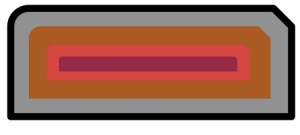
This, my friends, is not a good thing; at least 50% of this roast is basically inedible.  Note how the very outside is a sooty black, followed by the top 1/3 of the beef being totally gray and completely overdone, followed by a bit of pinkish, followed by some pink and a gelatinous, bloody raw at the bottom.  In other words (forgive the ‘artwork’ here), it looks like this:

badbeef
FIGURE A:  Ring 1 – Black and sooty; ring 2 – gray and tough; ring 3 – medium well; ring 4, medium rare and the only part worth eating; ring 5 – gelatinous raw center.

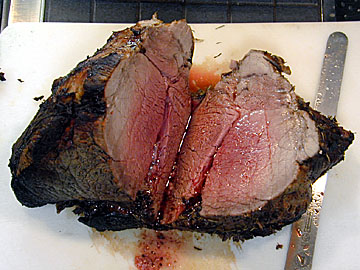
This is not what we want.  What we want is something that looks like the steak in the cover-photo of this post, or the steak in the Matrix clip from above.  In other words, we want a steak that is delicious and crusty on the outside, and a perfect medium rare through and through.  We want our steak to look like this:

goodbeef
FIGURE B: Crusty on the outside, perfectly medium-rare throughout.

And how do we achieve this thing of beauty?

Here’s the secret:  It’s got to be the same temperature through and through when it begins cooking, and it’s got to come up to temperature evenly during the cooking process.

The #1 reason for winding up with striations of doneness (Figure A) is that the beef is super cold (if not still frozen) in the middle, and the temperature goes up a few degrees for each layer until you hit the outside.  How does this happen?

Because 99% of recipes I’ve read for how to cook a roast beef or a steak recommend taking your beef out of the fridge 20 to 60 minutes before cooking.  BAD IDEA.  A while back, I had a beautiful New York Strip Roast that was in the 4lb range.  I took it out of the fridge and stuck an instant read thermometer in it right away; and it was about 40F through and through.  After being out on the counter for 1 hour, the outside was up to room temperature, the first inch or so was about 60F, the second inch was about 55F, the third inch was about 45F and most of the middle was still the same temp, about 40F.  In other words, the way it was on the counter-top mirrored the way it came out of the oven, less 90F.  So the middle was a perfect medium-rare at 130F; the next layer was a nice medium at 135F, the next layer was well-done at 145F, and the rest of it was about 155-160F (i.e., ruined).

The #2 Reason is using a roasting pan.  A roasting pan will cause the roast to cook unevenly because the inside of the pan will trap heat while the outside won’t.  Your oven might be the same temperature inside, but the roasting pan won’t be.  So, instead of using a roasting pan, place a spare grill grate or cooling rack on top of a disposable drip pan filled with about 1/2 of water, and place your beef on top of that.

So here’s the thing:  Whether it be a 4lb roast or a nice steak, you’ve got to either (A) leave it out on the counter long enough for the whole thing to reach room temperature (which in most cases, and especially in the case of a large roast “Ain’t nobody got time for that!”)… or (B) forget that whole warming up on the counter thing and just start cooking it as soon as it comes out of the fridge.  Yes, it’s going to take longer to cook that way, but at least it will cook evenly.  (And besides, it takes a long time for meat to reach room temperature on the counter top, so you’re either waiting while it’s on the counter, or waiting while it’s cooking.)

The Technique

Okay, so you’ve just pulled your beef out of the fridge and you’re going to cook it.  It’s going to be a two-stage process:  In one phase, you’re going to sear the meat to form a nice delicious crust on the outside; in the other phase you’re going to let the whole thing come up to your desired temperature (130F) at the same time.  During the “sear phase” you’re going to use screaming high heat (500F) and during the “cooking phase” you’re going to use seriously low heat (275-300F).

The vast majority of the time, I do this in the traditional order – Sear first, warm second.  The only time I use a ‘reverse sear’ (bring the beef up to temperature and then searing the outside) is if I’m doing a steak or beef tenderloin roast in the kitchen on a pan with the end in mind of making a pan sauce – in that case I’ll warm the beef up at 275F in the oven and finish it off on a super hot cast iron skillet (a more specific recipe will be in another post).

Summary

For an Oven Roast Beef: 

Preheat your oven to 500F.  When it’s up to temp pull your roast out of the fridge, rub the top with olive oil, season generously with kosher salt and freshly cracked pepper, and place it on your grill grate or cooling rack which should already be on top of your drip pan.  Place the whole thing in the center of the oven and shut the door.  Roast for at 500F for 10 to 12 minutes or until a nice crust has formed on the outside.  Pull the roast out of the oven, and let the oven come down to 275-300F.  When it’s down to temperature, stick it back in the oven roast until an instant read thermometer yields a reading of 120-125F.  For a large roast, carry-over cooking will bring the roast up another 10F while it rests, meaning that at serving time it will be a perfect 130-135F (the larger the roast, the greater the carry-over).

For a steak on the grill:

If using gas, light two burners on one side for the ‘hot side’ and leave the other side as the ‘cool side’ – if using charcoal, bank your coals to one side.  Pull your steaks out of the fridge and rub with olive oil and then season generously with kosher salt and fresh ground pepper.  Place them on the hot side of the grill, about 2-3 minutes per side with the lid open, and then place them on the cool side of the grill with the lid shut.  Pull them when an instant read thermometer reads 130-135F (for steaks, the carry-over effect is much less, because they’re much smaller).

To pan fry a steak in the kitchen:

Preheat your oven to 275 – 300F.  Pull your steaks out of the fridge, rub them with olive oil, and then season generously with kosher salt and fresh ground pepper.  Place them in the oven on a baking sheet for about 15-20 minutes, or until internal temp is around 110-115F.  While the steaks are warming up in the oven, heat a cast iron, stainless steel, or copper skillet to screaming stupid hot.  When the steaks come out of the oven, place them in the pan for 1-2 minutes per side to sear and form a nice crust.  Remove steaks from pan and set aside.  If you wish, you can use the remaining bits in the pan to make a nice pan sauce for your steaks.

Also, you could always try your hand at sous vide which takes this principal to its maximum, ultimate conclusion.  No matter what you try, follow these tips and get ready to up your red meat game!