

Panko Crusted Chicken Cutlets
Although this recipe is already contained in a number of other recipe posts on this blog, I thought it was worth sharing by itself because making these crispy, golden cutlets opens up a world of creativity in terms of what you do with your pan sauce. Once fried golden brown, you pop them in the oven to cook them through, and while they are finishing you can use the fond in the pan as a base to create any number of sauces. The chicken itself can then be served over rice, pasta, potatoes, bread – whatever you fancy – with your sauce drizzled on top.
Ingredients
- 2 or 3 Chicken breasts, sliced in half lengthwise to make two, thinner cutlets – so, you’ll end up with 4 – 6 cutlets total
- ½ cup flour
- Kosher Salt
- Black Pepper
- Pinch Paprika
- 3 Eggs
- 3 tablespoons vodka (alcohol is a binding agent)
- 3 tablespoons milk, cream or water
- 1½ cups panko breadcrumbs
- ⅓ cup parmesan cheese
- Zest of 1 lemon
- 1 cup or so vegetable oil, ghee or any other high smoke-point fat: enough to get about 1½ inches deep in a cast iron or other suitable pan for frying
Prep
- Using a Meat Mallet, pound each chicken cutlet to even thickness (the wider end will need more pounding than the narrow end) – you’re shooting for ¼ to ⅓ inch thickness… so pretty thin. This is important to ensure that chicken is cooked through during the frying process.
- Set up your dredging station. You’ll need two, wide shallow dishes and one medium sized bowl.
- Put the flour in one of the wide, shallow dishes. Season aggressively with salt and pepper; add paprika and mix until seasoning is well distributed.
- In the second wide, shallow dish add Panko Bread Crumbs, Parmesan Cheese, and Lemon Zest. Whisk together until well mixed.
- Crack three eggs into the medium sized bowl; add vodka and water. Whisk together until slightly foamy.
- Set them up in this order: Flour mixture, egg wash, bread crumb mixture
- Dredge a chicken cutlet first in the flour mixture (shaking of excess), then dip into the egg wash, and then dredge in the breadcrumb mixture, pressing firmly to adhere to each side and flipping a few times as needed.
- Transfer to a baking sheet.
- Repeat this process with all the chicken cutlets. Cover and refrigerate for a minimum of 30 minutes, and up to 8 hours
Instructions
- Fill a A 12″ Cast Iron Skillet about 1½ – 2 inches deep with a high smoke-point fat (I like to use vegetable oil and maybe ¼ cup of duck fat or ghee for a little extra flavor)
- Heat oil to 375°F as measured with an Instant Read Thermometer.
- Safety Notes:
- You’ve got super hot oil in a skillet that probably has a handle. Point that handle toward the rear of the stove, angled away from the edges of the stove where it could accidentally be knocked
- Keep kids/pets and things you can trip over out of the kitchen during this time
- Carefully lay two or three of the breaded chicken cutlets into the hot oil. A few important notes here:
- Lay the cutlets away from you so if there’s any splashing it doesn’t go in your direction
- Lay cutlets in oil slowly – don’t be afraid of it; dropping things in quickly will lead to more spattering/splashing. If you’re nervous, use tongs.
- Do not overcrowd – you don’t want to drop the oil temperature too much
- Right when you lay the cutlets in the oil, they’ll sink to the bottom, so use tongs to gently wiggle each cutlet to ensure it isn’t sticking to the bottom of the pan
- It’s okay if the cutlets aren’t fully submerged – you’re going to turn them over once in a while anyway (see next step)
- Cook until deeply golden brown on all sides, turning occasionally, around 5-6 minutes (approximately 3 minutes per side)
- Once cutlets are beautiful, golden, stiff, and crunchy, transfer them to a Rimmed Baking with oven safe wire rack
- Repeat with remaining cutlets, and transfer to 170°F oven to keep warm
Not sure what sauce to make? Try one of these!
Chicken with Italian Red Sauce; i.e., Marinara Sauce
Chicken in a mushroom Marsala reduction sauce
Chicken in a lemon butter pan sauce with capers and white wine
Cajun Chicken and Sausage Gumbo
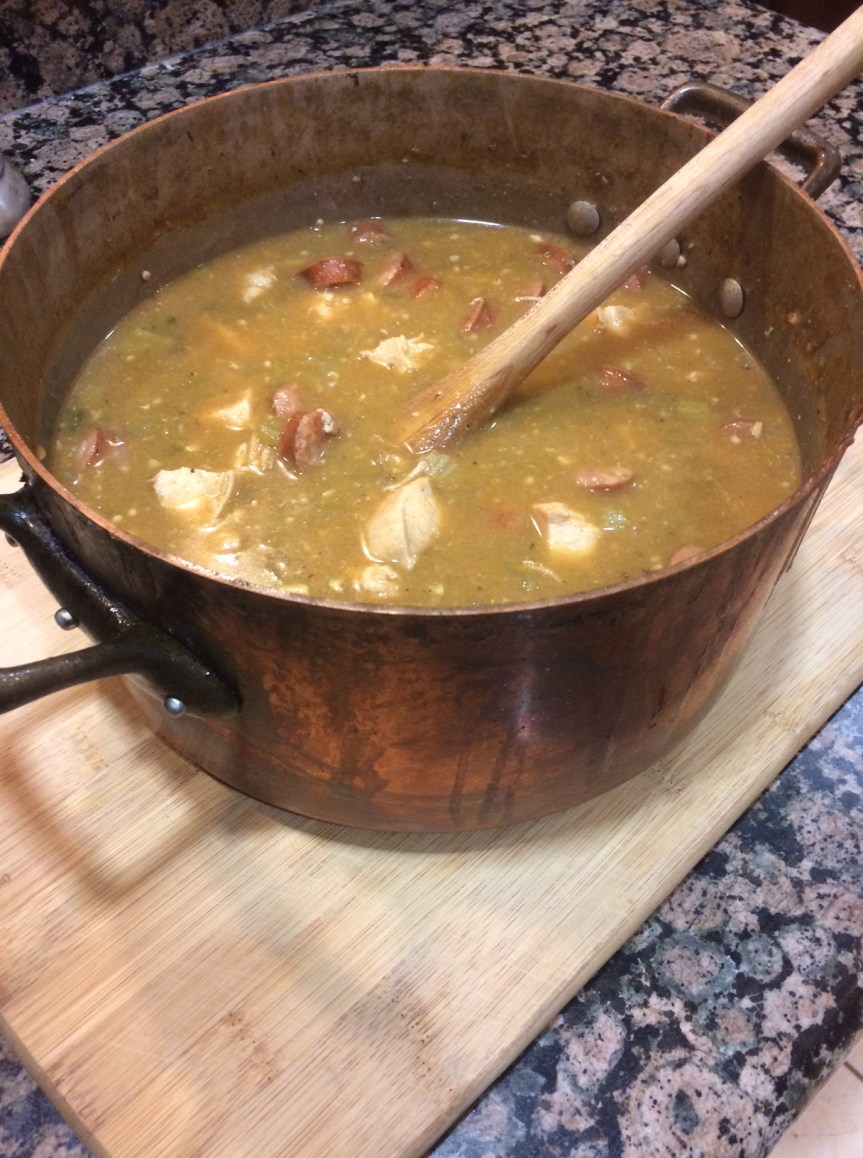
This classic Cajun stew is perfect for a cold winter’s night – or pretty much any time. The flavor profile is totally unique; if someone were to ask “What does gumbo taste like?” the answer is “It tastes like gumbo!” And it is totally delicious.
Time: 90 minutes – 2 hours
Level: Intermediate (bordering on advanced, depending on your roux making skills)
Cost: About $4 per plate
Serves: 4- 6
Ingredients
- 4-6 chicken breasts, 2-3lbs package weight
- 12oz Cajun Andouille Sausage (I like Aidell’s brand), sliced into 1/4 inch thick rounds (or “coins”)
- 1 cup all purpose flour, plus 2 TBSP, divided
- 3 TBSP Creole Seasoning
- Note: You can use any store bought brand such as Tony Cachere’s, but I prefer “Emeril’s Essence” (also referred to as “Bayou Blast) which you can buy in stores or make it yourself. When opting to make it myself, I usually make it by the teaspoon rather than tablespoon, but the key is just to keep the ratios the same.
- Olive oil: 2 TBSP, plus a few drizzles to coat chicken for dredging
- 1 cup vegetable oil
- 1 large green bell pepper, diced
- 1 large yellow onion, diced
- 4 ribs celery, diced
- 4 cloves garlic, minced
- 3/4 cup okra (optional, some people don’t like it, but it’s what makes gumbo authentic)
- Dash Worcestershire sauce
- 2 140z cans low sodium chicken broth
- Cooked white rice, cooked according to package directions, for serving
Instructions
Add 2 TBSP olive oil plus sausage rounds to a dutch oven or large sauté pan and heat over medium-high heat. Sauté until sausage is well browned and most of the fat from the sausage has rendered, 5-7 minutes. Remove sausage with a slotted spoon and reserve in a medium size bowl.
In a another medium bowl, mix 3 TBSP all purpose flour with 3 TBSP creole seasoning. Whisk to combine thoroughly. Pat chicken breasts dry and rub each breast with a drizzle of olive oil. Dredge the chicken breasts in the seasoned flour mixture and add to pan with sausage fat. Fry breasts in sausage fat on each side, 2-3 minutes or until well browned. Remove to a cutting board and reserve.
Note: Don’t overcrowd the pan with the chicken; work in batches if you have to. Add more fat to the pan between batches if you have to, either by adding extra olive oil, extra sausage fat from the bowl of reserved sausages, or both. You want to develop a nice fond on the bottom of the pan, but you don’t want to burn anything.
Add onion, green pepper and celery to the pan (this combination is known as the Trinity of Cajun Cooking) and sauté until the vegetables and onion have released most of their moisture and the onions are mostly translucent, 5-7 minutes. Stir constantly, scraping up any fond (brown bits) from the bottom of the pan to combine with the mixture.
Add garlic and sauté until very fragrant, 1-2 minutes.
Add okra (if using), and dash of Worcestershire sauce. Add chicken broth to deglaze the pan and stir, scraping up any remaining brown bits on the bottom of the pan. Add sausage and any drippings to the pot. Cube chicken breasts on the cutting board (it’s okay if they’re still raw in the middle, they’re going to cook in the pot), and add to the pot.
Give everything a few good stirs to combine and bring to a boil; then reduce to a simmer.
While the stock is simmering, make your roux:
To make the roux, heat 1 cup vegetable oil in a medium sauce pot over medium-low heat until it is around 250°F – 300°F. Whisking vigorously and constantly, slowly add the 1 cup flour to the oil, a few sprinkles at a time, until all the flour is incorporated. Continue to whisk vigorously and constantly, cooking the flour in the oil. Don’t stop whisking! You will notice that the color of the roux changes from white, to blond, to peanut butter colored, to light brown, to dark brown (the color of beef stock). Once the roux is the color of beef stock, remove from the heat and continue to whisk until significantly cooled. While you are whisking your roux to cool, off the heat on the simmering pot completely. (Did I mention don’t stop whisking?)
Note: None of this is as hard as it sounds. I got it on my first try. Go slow, pay attention to what you’re doing and you’ll be fine. DO follow the instructions below.
Note: This will take anywhere from 15 to 20 minutes depending on how much heat you are using. The higher the heat, the more likely it is you will burn your roux and you will have to start over. If you see black flecks in your roux, you have to discard it and start over, so use lower heat at first. As the roux begins to darken it is not uncommon for it to smoke quite a bit. Also, it is incredibly hot, so don’t try to taste it.
Note: Adding the hot roux directly into the simmering pot will create an impressive explosion, sending lava-hot roux and boiling broth erupting like Vesuvius all over you and your kitchen. I did this on the first go-round; don’t be like me. Follow the instructions in the next paragraph instead…
Once the roux has cooled, take a ladle full of liquid from the pot and slowly whisk it into the roux, stirring constantly to combine. Very carefully and slowly, add the roux mixture back into the pot, a little bit at a time, stirring constantly while you do this to combine.
Return pot to a simmer, stirring occasionally, and allow to reduce until thick and hearty, about 45 minutes. Serve with steamed white rice and a crusty loaf of bread.
What is Fond?

Truth be told, I’m quite fond of fond. But what it is?
Properly pronounced, the word is fahn, which is French for “base.” (Ask my wife and she will tell you that I butcher French pronunciations, but that’s neither here nor there.) But that fond – that base – is that beautiful brown stuff you often find stuck to the bottom of a pan after searing meat, or even vegetables, over very high heat. Especially for many beginning cooks, the temptation is to wash that stuff out before beginning the next phase of cooking. I mean, look at the picture in this post – unless you know what you’re looking at, it doesn’t look very appetizing. But believe it or not, if you do know what you’re looking at your mouth might be watering just a little bit.
Fond is a magical, secret ingredient. You will never know it’s there in a final dish, but its presence packs a powerful burst of deep flavor which cannot be otherwise achieved. It is the result of two chemical reactions present in the process of cooking food over fairly high heat – the Maillard reaction and caramelization. Both reactions are similar in that they are a form of non-enzymatic browning, but with the Maillard reaction you have amino acids involved with reducing sugars which gives food that distinctive nutty, savory flavor whereas with caramelization you actually have sugars burning – which makes things taste like, you guessed it, caramel. The Maillard reaction happens at a slightly lower temperature than caramelization (about 310°F and 330°F, respectively) but that is mostly irrelevant because when you sear a steak (or whatever) in a hot pan you’re likely above both of those temperatures so you’re going to get both reactions.
Anyhow, if you’ve read many of the recipes on this blog, or others for that matter, you’ve likely read things in the instructions such as “Deglaze the pan with ________, bring to a boil and stir constantly, scraping up any brown bits stuck to the bottom of the pan.”
Deglazing is simply the action of adding some kind of liquid (wine, stock, spirits – even water) to a hot pan to act as a solvent into which your fond will incorporate itself. Bringing that deglazing liquid to a boil, and then stirring and scraping up the fond helps accelerate the process of dissolving the fond into the liquid in the pan; as it reduces due to evaporation it thickens, becoming a pan sauce.
Thus, this process of (A) browning protein or vegetables, thus creating a fond and then (B) deglazing the pan with liquid, and then (C) allowing the liquid to thicken is process of making a basic pan sauce to be served over a main dish, or building a base sauce for a more complex sauce, such as Classic Marinara Sauce.
There is an optional step between steps (A) and (B) which is often employed to add even more depth and complexity of flavor to a final product: the flambé. When you add a higher-proof alcohol to a hot pan and ignite it, you are doing several important things. First, you are beginning the deglazing process (although a second deglazing liquid will likely be needed). Second, you are adding the kiss of flame to whatever is in the pan (increasing caramelization, which adds sweetness and depth of flavor). Third – and most importantly – you are actually ensuring that the beautiful fond you have in the bottom of your pan doesn’t burn. It seems totally counter-intuitive that setting something on fire would prevent it from burning, but it does. Here’s why: The boiling temperature of alcohol is actually lower than the boiling temperature of water (173°F, to be exact). By igniting the alcohol, you keep the temperature at the bottom of the pan right at that temperature – too low for anything to burn. A few inches above the bottom of the pan, however, where the flames are, the temperature is higher – right around 330°F, the perfect temperature for a bit of caramelization.
So, what’s the takeaway here? First, don’t throw all that brown stuff in the bottom of your pan out. Figure out a way to use it – make a pan sauce with it, or use it to make a more complex sauce. Second, don’t be afraid to add a flambé to your cooking process at some point – you will taste the difference. Third, don’t be afraid to experiment – get out there and make something delicious!
Chicken A La King
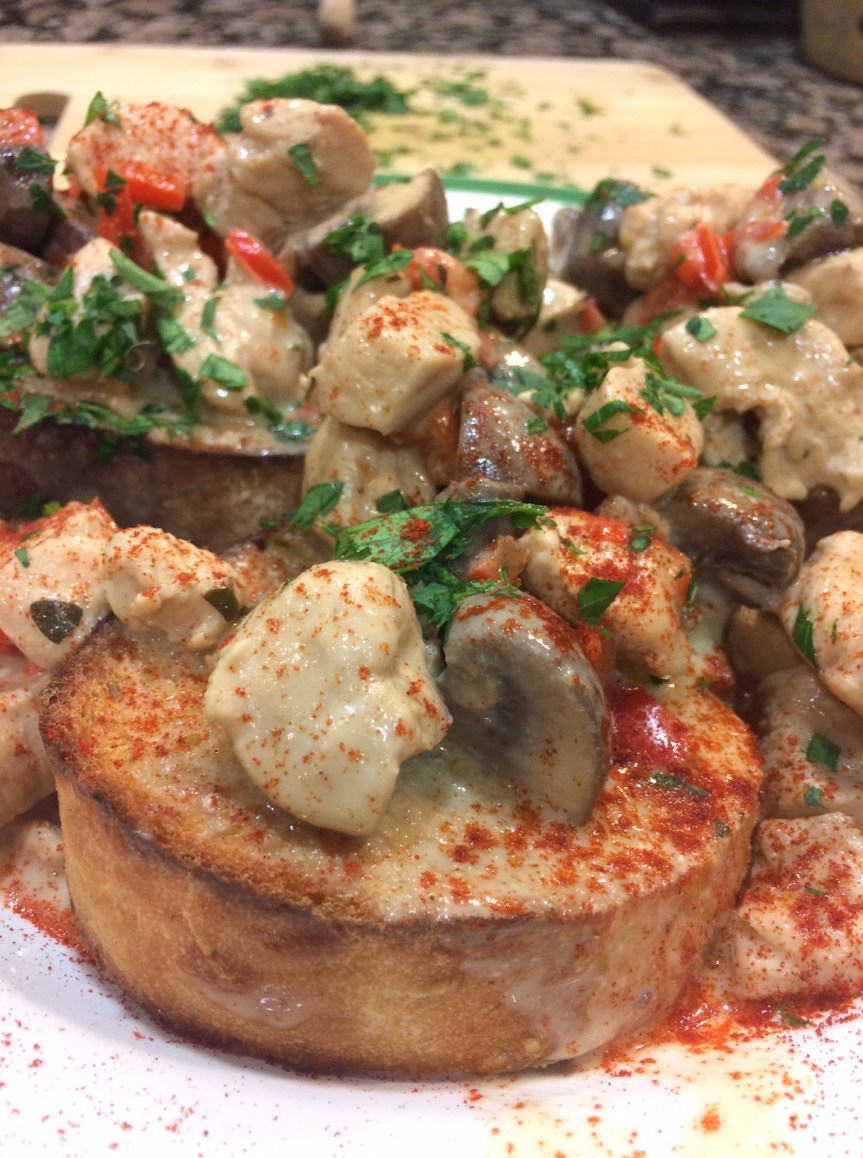
I know what you might be thinking. For many, the thought of Chicken A La King conjures up the worst of that era of the 50s and 60s when everything came from a can. When people couldn’t figure out what to do with leftover chicken, they smothered it in cream with canned mushrooms – or worse, just doused it in cream of mushroom soup (shudder). But Chicken A La King is a misunderstood dish. Before it was hijacked by the 50s canned-everything era, it enjoyed a place on the menus of some of the finest restaurants in the world – including the Delmonico Steak House in New York City and the Claridge Hotel in London – as far back as the late 19th century. This version is devoid of canned mushrooms, cream of mushroom soup, jarred pimentos, patty shells and leftovers; rather, it is a bright and fresh version closer to the originals from over a century ago that more closely resembles an elegant version of gravy on toast.
Time: 30 – 45 minutes
Level: Easy
Cost: About $3 per plate
Serves: 4- 6
Ingredients
- 1.5 – 2lbs chicken breast, cubed
- 8oz Crimini or Baby-Bella mushrooms, quartered
- 2 TBSP olive oil
- 1-2 cloves garlic, finely minced
- 2 TSP fresh thyme (or 1 TSP dried)
- 1 red bell pepper, finely diced
- 1/4 TSP cayenne pepper, or to taste
- 2 TBSP butter, diced
- 3 TBSP all purpose flour
- 1 cup Sherry wine
- 1/4 cup Brandy (for flambé, optional)
- 1/4 – 1/2 cup heavy cream, or half-and-half
- 3 TBSP fresh parsley, minced
- Dash of Paprika, garnish
- Rustic loaf of bread
Instructions
Prep all your ingredients and get ready to cook – this dish moves pretty fast.
After you’re finished prepping, preheat oven to 500°F for toast (this will take about the same amount of time as it will to cook the rest of the dish).
Heat olive oil in a large skillet or sauté pan over medium-high heat. When oil is shimmering, add mushrooms and sauté until they begin to caramelize just a bit, 2-3 minutes. Add diced butter and continue to cook, stirring constantly, until the butter is mostly melted. Add bell pepper and continue to cook until soft, 2-3 minutes more. Add garlic, thyme and cayenne pepper and sauté until very fragrant, about 2 more minutes.
Optional: Add 1/4 cup Brandy and flambé
Add cubed chicken and stir to incorporate. Stir in flour and continue to cook chicken until it is white all around and no pink is visible (it doesn’t need to brown, and it doesn’t need to be cooked through – it will finish cooking in the sauce).
Add sherry wine, bring to a boil, and reduce until the raw alcohol is cooked off, 2-3 minutes. Reduce heat to medium, stir in cream and reduce until sauce is thickened to a gravy-like consistency, 5-7 minutes over medium heat.
Meanwhile, while the sauce is reducing, thickly slice several pieces of rustic bread – about 1 or 1.5 inches thick – figure on two pieces per person. Drizzle both sides with olive oil and place them on a baking sheet. Place them in the 500° oven for about 5-6 minutes or until beautifully golden brown.
Remove toast from oven and plate. Ladle chicken and sauce generously over the toast. Garnish with fresh parsley and a dusting of paprika. Serve with steamed broccoli or asparagus.
Cook’s Note: Due to the richness of this dish, it can come across as a bit overly decadent (even though this version isn’t too bad for you). But the garnish here isn’t really optional – the parsley and paprika will brighten it up significantly.
 The Intrepid Gourmet